
Past exam of the mathematics course of the University of Cambridge 2006 ib Paper 3 10H c Created 2026-09-24 Updated 2026-09-24
Past exam of the mathematics course of the University of Cambridge 2006 ib Paper 3 10H b Created 2026-09-24 Updated 2026-09-24
Past exam of the mathematics course of the University of Cambridge 2006 ib Paper 3 10H a Created 2026-09-24 Updated 2026-09-24
Past exam of the mathematics course of the University of Cambridge 2006 ib Paper 2 9C Solution Created 2026-09-24 Updated 2026-10-14
A cut of a flow network of a directed flow network is a partition with the source in and the sink outside it. Its cut capacity is . Summing flow conservation over all vertices of cancels every internal edge and gives the flow value as outgoing flow minus incoming flow across the cut. Incoming flow is nonnegative and outgoing flow is bounded by capacity, soThis is weak duality for the maximum-flow problem; no converse theorem is needed for the upper bound.
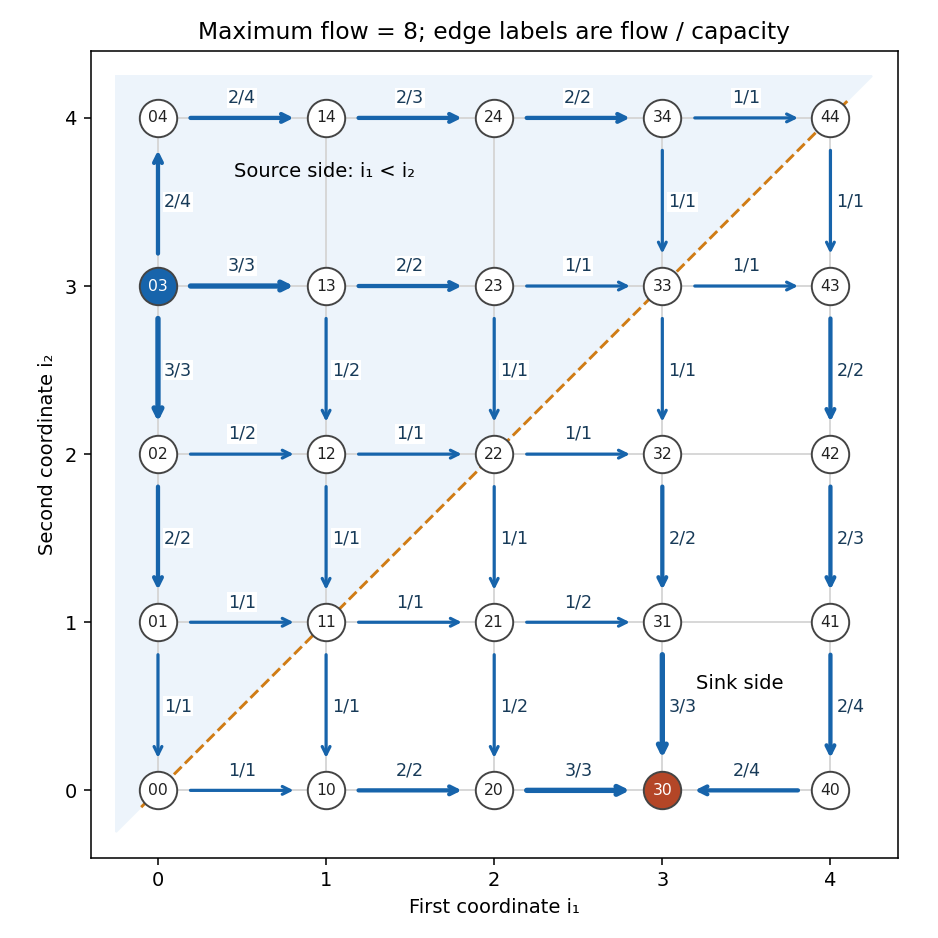
For this grid, use . It contains but not . An adjacent edge can leave only by reaching the diagonal. Each of the three interior diagonal vertices has two incoming crossing edges and each endpoint has one, making eight edges. Every crossing edge has capacity one. Thus the diagonal cut in a nearest-neighbour lattice flow has capacity eight.
Here is a feasible flow of value eight. Send one unit on each of the following directed paths, and zero on every edge not used. In this list abbreviates the vertex :Every path conserves flow at its intermediate vertices. To check the capacities without hiding a feasibility assumption, group used edges by capacity: the capacity-one edges are traversed at most once; the capacity-two edges at most twice; the capacity-three edges at most three times; the capacity-four edges at most twice. Shared source edges , , carry units, and the corresponding three sink edges carry . The diagram displays every positive edge flow beside its capacity. Thus all constraints hold and the matching cut proves

Past exam of the mathematics course of the University of Cambridge 2006 ib Paper 2 8A Solution Created 2026-09-24 Updated 2026-10-14
A material derivative measures the rate experienced by a moving fluid particle. If its position is with , the chain rule for any scalar field givesHence the operator is , and the material derivative differs from the time derivative at a fixed spatial point.
In the steady temperature problem and the transverse velocity vanishes. Thus at each fixed ,Integrating in and applying the inlet value givesA particle's travel time from the inlet is , so the formula is also the exponential decay along its characteristic curve. For fixed the temperature tends to zero near either wall, because the travel time becomes large. No value at is imposed by an inlet condition there, since the wall velocity is zero and the stated channel is open in .
Past exam of the mathematics course of the University of Cambridge 2006 ib Paper 2 7B Solution Created 2026-09-24 Updated 2026-10-14
Write for coordinates in the rest frame of and for those in the rest frame of . The Lorentz transformation is and . Along the worldline of , . Cancelling gives , so the relativistic velocity-addition formula yieldsApply the same Lorentz transformation between the rest frames of and to . Its velocity in the former is . Substitution simplifies toHere and the formulas use signed collinear velocities. In the given positive-direction setting they are positive speeds. The limit recovers ordinary addition, providing a check on both expressions.
Past exam of the mathematics course of the University of Cambridge 2006 ib Paper 2 6G Solution Created 2026-09-24 Updated 2026-10-14
Take the divergence of the Ampere-Maxwell law and use Gauss's law . Since the divergence of a curl is zero, this gives the charge continuity equation . Uniform conductivity and Ohm's law imply . ThereforeThe spatially uniform initial density stays uniform in the interior; is the charge relaxation time.
Denote the cylinder radius by . Cylindrical symmetry makes the interior electric field radial. Gauss's law on a coaxial cylinder of radius and length gives . ThusThe current does not disappear at the interface: the vacuum conducts no current, so charge accumulates on the cylindrical surface. Initially taking the charge to be the stated volume charge alone, its surface charge density satisfies , giving the charge relaxation in an isolated conducting cylinder lawThe total enclosed charge per unit length is . Consequently the exterior electric field isindependent of time. The boundary jump obeys , as it must. Applying Gauss's law to the decaying volume charge alone would incorrectly predict a decaying exterior electric field and violate electric charge conservation. The vector formulas also specify the inward direction if .
Past exam of the mathematics course of the University of Cambridge 2006 ib Paper 2 5A Solution Created 2026-09-24 Updated 2026-10-14
At a constrained stationary point where , every tangent direction to is orthogonal to . Vanishing of the directional derivative of in all such directions forces for a Lagrange multiplier . Solve these equations together with the constraint, then check the candidates and any singular or limiting cases for minima or maxima.
Let a closed cylinder have radius and height , with fixed . Its area is and the constraint is . The Lagrange multiplier equations giveThe second yields ; substituting into the first gives . Thus the minimum-area closed cylinder at fixed volume hasTo prove it is the global minimum, eliminate to obtain . Its derivative is , negative before the displayed radius and positive afterwards; the area tends to infinity both as and as . This establishes uniqueness and rules out limiting smaller areas.
Past exam of the mathematics course of the University of Cambridge 2006 ib Paper 2 4F iii Created 2026-09-24 Updated 2026-09-24
Past exam of the mathematics course of the University of Cambridge 2006 ib Paper 2 4F ii Created 2026-09-24 Updated 2026-09-24
Past exam of the mathematics course of the University of Cambridge 2006 ib Paper 2 4F i Created 2026-09-24 Updated 2026-09-24
Past exam of the mathematics course of the University of Cambridge 2006 ib Paper 2 3F ii Created 2026-09-24 Updated 2026-09-24
Past exam of the mathematics course of the University of Cambridge 2006 ib Paper 2 3F i Created 2026-09-24 Updated 2026-10-14
Past exam of the mathematics course of the University of Cambridge 2006 ib Paper 2 2E iii Created 2026-09-24 Updated 2026-09-24
Past exam of the mathematics course of the University of Cambridge 2006 ib Paper 2 2E ii Created 2026-09-24 Updated 2026-09-24
Past exam of the mathematics course of the University of Cambridge 2006 ib Paper 2 2E i Created 2026-09-24 Updated 2026-09-24
Past exam of the mathematics course of the University of Cambridge 2006 ib Paper 2 20C c Created 2026-09-24 Updated 2026-09-24
Past exam of the mathematics course of the University of Cambridge 2006 ib Paper 2 20C b Created 2026-09-24 Updated 2026-09-24
Past exam of the mathematics course of the University of Cambridge 2006 ib Paper 2 20C a Created 2026-09-24 Updated 2026-09-24
Past exam of the mathematics course of the University of Cambridge 2006 ib Paper 2 1E Solution Created 2026-09-24 Updated 2026-10-14
Sylvester's law of inertia says that any real quadratic form has coordinates in which it is a sum of positive squares minus negative squares, with unused coordinates, and that the numbers are invariant under every invertible linear change of coordinates. Its rank is ; its signature of a quadratic form is commonly , with also called its signature pair.
The symmetric matrix here is , where and . On the line spanned by , has eigenvalue . If , then , so that the orthogonal complement has eigenvalue with multiplicity . Thus the off-diagonal all-ones quadratic form hasFor the form vanishes, so rank and scalar signature are both zero, with inertia . Including this case is necessary because the distinguished eigenvalue then becomes zero.
There are unlisted articles, also show them or only show them.