
Past exam of the mathematics course of the University of Cambridge 2006 ia Paper 5 10 e Created 2026-09-24 Updated 2026-09-24
Past exam of the mathematics course of the University of Cambridge 2006 ia Paper 5 10 d Created 2026-09-24 Updated 2026-09-24
Past exam of the mathematics course of the University of Cambridge 2006 ia Paper 5 10 c Created 2026-09-24 Updated 2026-09-24
Past exam of the mathematics course of the University of Cambridge 2006 ia Paper 5 10 b Created 2026-09-24 Updated 2026-09-24
Past exam of the mathematics course of the University of Cambridge 2006 ia Paper 5 10 a Created 2026-09-24 Updated 2026-09-24
Past exam of the mathematics course of the University of Cambridge 2006 ia Paper 5 1 e Created 2026-09-24 Updated 2026-09-24
Past exam of the mathematics course of the University of Cambridge 2006 ia Paper 5 1 d Created 2026-09-24 Updated 2026-09-24
Past exam of the mathematics course of the University of Cambridge 2006 ia Paper 5 1 c Created 2026-09-24 Updated 2026-09-24
Past exam of the mathematics course of the University of Cambridge 2006 ia Paper 5 1 b Created 2026-09-24 Updated 2026-09-24
Past exam of the mathematics course of the University of Cambridge 2006 ia Paper 5 1 a Created 2026-09-24 Updated 2026-09-24
Past exam of the mathematics course of the University of Cambridge 2006 ia Paper 4 9C Solution Created 2026-09-24 Updated 2026-10-14
Let be the cylindrical unit vectors. The surface has an upward normal vector proportional to . If is the vertical component of the normal force, its radial component is . In the stated approximation, vertical acceleration and the vertical driving-force component are neglected, so vertical balance gives . The horizontal contact force is consequently . The projected velocity and its speed areThe driving force is parallel to this velocity, with components and . Use the acceleration in polar coordinates and Newton's second law to obtainThese equations apply where ; at rest the direction of an exactly velocity-aligned drive is not determined.
For a prescribed path, write , . The chain rule gives and . Subtract times the azimuthal equation from the radial equation. The driving force and both cancel:Thus the constraint for tangentially driven motion on an axisymmetric surface isThe denominator must give a nonnegative squared speed, and the calculation uses . At the polar origin a limiting Cartesian description is appropriate.
For the paraboloid and Archimedean spiral, putThen, for ,The branch tending to has positive angular velocity, henceSince , solve the azimuthal equation for the required force:This is positive for , consistent with a forward drive. Taking the limit gives
These are the large-time limits of the printed projected equations. Their mechanical approximation has a precise range limitation: on the exact surface, gives , which along this solution grows like . At fixed positive , it is not small as . Thus the requested limits are formal limits of that reduced model; neglect of vertical motion is not a uniform approximation to the full three-dimensional motion all the way to infinity.
Past exam of the mathematics course of the University of Cambridge 2006 ia Paper 4 8E Solution Created 2026-09-24 Updated 2026-10-14
A countable set is one admitting an injection into ; this includes finite sets and the empty set. An infinite countable set can equivalently be listed in a sequence indexed by .
For a countable union of countable sets , choose an injection for each nonempty . Assign the pair , where is the least index with . This is an injection into . The pairs are countable by diagonal enumeration; explicitly, with natural numbers starting at one, the Cantor pairing functionmaps them bijectively to . Composing the two maps proves that the union is countable. Empty members contribute no elements.
To prove uncountability of the power set , suppose all subsets could be listed as . DefineFor every , differs from on whether it contains . Thus is missing from the supposedly exhaustive list. This Cantor diagonal argument proves is uncountable.
For increasing functions in the question's non-strict sense, encode every subset bywhere the value at zero is only a convenient auxiliary convention. ThenEach is even strictly increasing, hence is a nondecreasing function as required, and its successive differences recover uniquely. This is an injection from the uncountable power set into the requested collection. Therefore the increasing functions form an uncountable set.
For a decreasing function in the question's sense, is a nonincreasing function with positive integer values. Each strict decrease lowers its value by at least one, so there can be at most strict decreases. There is consequently a final drop, after which the function is constant. Every such function is determined by a finite initial list whose final value repeats forever. The set of all these lists is contained ina countable union of countable sets, hence countable by the result just proved. Thus the decreasing functions form a countable set. These contrasting cardinalities of monotone natural-number functions come from the absence of an upper bound for increasing values and the finite number of drops available to decreasing natural-number values. If the natural numbers include zero, the same proof uses the bound instead.
Past exam of the mathematics course of the University of Cambridge 2006 ia Paper 4 7E Solution Created 2026-09-24 Updated 2026-10-14
Fermat's little theorem states that, for a prime number and any integer ,If , both sides vanish modulo . Otherwise multiplication by permutes the nonzero residue classes modulo : it is injective because implies by cancellation. Taking the products of these residues givesThe factorial is coprime to , so cancellation proves and hence the stated version. This proves Fermat's little theorem in both cases.
Let be a Carmichael number. If a prime square divided , choose . Since is an odd composite integer, , and . This contradicts the required modular congruence modulo . Therefore every Carmichael number is squarefree.
For each prime divisor of , choose the allowed primitive root modulo . The Carmichael identity applied to the positive integer gives , and cancellation gives . By its defining order property,Conversely, suppose a composite integer is squarefree and has this divisibility for every prime divisor. For an arbitrary integer , modulo a prime divisor there are two cases. If , then . Otherwise Fermat's little theorem and give , so again . Since the prime divisors are distinct and pairwise coprime, their product divides . This is the proof of Korselt criterion:
If for distinct odd primes with , the condition at would require . Reducing modulo gives , so . But , which is impossible. Thus a product of two distinct odd primes is not Carmichael.
For , squarefreeness is automatic. Since ,Apply the analogous reductions at and to obtainFinally , with distinct odd prime factors, andAll three divisibilities hold, so 1729 is a Carmichael number.
Past exam of the mathematics course of the University of Cambridge 2006 ia Paper 4 6E Solution Created 2026-09-24 Updated 2026-10-14
For finite sets , the inclusion-exclusion principle statesTo prove it, fix an element belonging to exactly of the sets. If , it contributes zero to both sides. If , its total weight on the right isby the binomial theorem. Summing these pointwise contributions proves the formula.
Let the universe be the permutations of , and let be the set of permutations fixing . A derangement belongs to none of the . If specified points must be fixed, the remaining points can be permuted in ways, so every such -fold intersection has that size. There are choices of the specified fixed points. Applying inclusion-exclusion to the complement of their union gives the derangement counting formulaThe term is the whole universe. Since the exponential power series converges absolutely at ,The alternating-series remainder additionally gives . Thus the fraction is the probability of no fixed points in a uniformly chosen permutation and approaches .
Past exam of the mathematics course of the University of Cambridge 2006 ia Paper 4 5E iv Created 2026-09-24 Updated 2026-09-24
Past exam of the mathematics course of the University of Cambridge 2006 ia Paper 4 5E iii Created 2026-09-24 Updated 2026-09-24
Past exam of the mathematics course of the University of Cambridge 2006 ia Paper 4 5E ii Created 2026-09-24 Updated 2026-09-24
Past exam of the mathematics course of the University of Cambridge 2006 ia Paper 4 5E i Created 2026-09-24 Updated 2026-10-14
Past exam of the mathematics course of the University of Cambridge 2006 ia Paper 4 4C Solution Created 2026-09-24 Updated 2026-10-14
Write . The simple pendulum becomes , . Its equilibria are . The linearization is . For even its eigenvalues are , and for odd they are . The conserved energyhas a strict local minimum at each even multiple of , proving nonlinear Lyapunov stability there. The odd multiples are saddles and are unstable. ThereforeThe stable centres are not asymptotically stable because energy is conserved.
The saddle energy is , so the separatrix is determined byEnergy levels form closed libration curves around the centres; levels have velocity of constant sign and describe rotations. The separatrices join neighboring saddles in the unwrapped plane. On the angle cylinder, where is identified modulo , they are homoclinic to the single saddle.
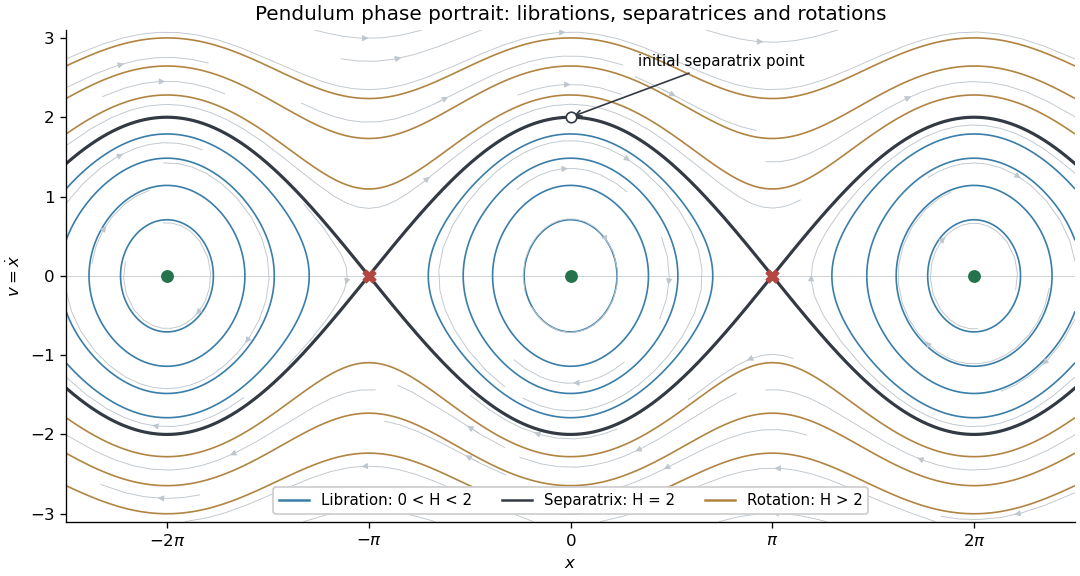

At the positive separatrix has . Before reaching the neighboring saddle at , the velocity is , so the time to angle isAs , . The integrand is therefore asymptotic to , whose improper integral diverges logarithmically. Thus the pendulum separatrix approach takes infinite time:Starting with velocity gives the reflected approach to and the same infinite time. The velocity tends to zero but never reaches zero at a finite time.
Past exam of the mathematics course of the University of Cambridge 2006 ia Paper 4 3C Solution Created 2026-09-24 Updated 2026-10-14
Let be the car's mass and let be its forward speed. Initially the driven contact surfaces slip backward relative to the ground because . Thus kinetic friction on the car acts forward. On the horizontal surface the total normal force is , so Newton's second law gives . While slipping persists,The contact slip speed is . Its first zero is the onset of rolling without slipping, henceThe engine maintains the prescribed wheel speed, so wheel spin-down is not part of this calculation.
On a slope of angle , directed uphill, the normal force is and gravity contributes along the slope. Therefore the uphill acceleration while slipping is . If it is positive, the onset of rolling without slipping occurs atThe inequality follows because . If , the car does not accelerate uphill to , so there is no finite catch-up time in this sliding-friction model. The finite-time conclusion presumes positive traction sufficient to climb the slope.
There are unlisted articles, also show them or only show them.