
OSSS exploration of a one-arm event Created 2026-09-24 Updated 2026-09-28
Choosing an intermediate radius uniformly and exploring the open cluster meeting that sphere gives a decision tree for a one-arm event. Translation and a union bound control each revealment by a constant times the average of the one-arm probabilities over the possible radii.
Decision tree Created 2026-09-24 Updated 2026-10-14
A decision tree represents a deterministic computation of a known Boolean function by inspecting input bits. Each internal vertex of its binary tree names a coordinate to query, its two outgoing edges carry answers 0 and 1, and each leaf carries the output 0 or 1. Starting at the root of a tree, read the named bit, follow its answer edge, and repeat until a leaf is reached. Correctness requires the leaf's label to equal for every input .[ref]
Complexity Measures and Decision Tree Complexity: A Survey by Harry Buhrman and Ronald de Wolf. Buhrman and de Wolf, Complexity Measures and Decision Tree Complexity: A Survey, section 3.1, manuscript p. 5: deterministic trees and D(f)
The next coordinate, or the decision to stop, can depend on earlier answers: this is adaptive querying. The same input always follows the same graph path; adaptivity does not require randomness. A correct leaf must have the same output for every completion of the observed bits. Thus a decision tree can stop as soon as the observations form a query certificate. Querying an already known coordinate adds no information, so we use decision trees without repeated coordinates on a graph path; an efficient tree also removes queries made after the output is already forced.
The motivation is exact computation with shortcuts. If inspecting an input entry is expensive, the question is how much of the input must actually be read. The decision-tree query cost counts these inspections, while local calculations on known values are free in this model; this cost need not equal an implementation's time complexity. Here the Boolean function is specified in advance and must be computed exactly on every input. Decision tree learning instead fits a predictor from data, with a different objective.
Hilbertian basis Created 2026-09-24 Updated 2026-10-03
A Hilbertian basis is a complete orthonormal family: its closed linear span is the whole Hilbert space, equivalently every vector is the norm-convergent sum of its Fourier coefficients against the basis.
Least-squares polynomial in an orthogonal-polynomial basis Created 2026-09-24 Updated 2026-09-24
For orthogonal polynomials under a positive weighted integral inner product, the least-squares approximation to of degree at most isIts residual is orthogonal to every polynomial of degree at most .
Orthogonal projection matrix Created 2026-09-24 Updated 2026-10-14
A matrix represents a linear projection when applying it twice has the same effect as applying it once. For an orthogonal projection with the standard Hermitian inner product on , the additional condition is that the conjugate transpose equals the original matrix:Thus is both idempotent and a Hermitian matrix. Over the real numbers this says . Its image of a linear map is the retained linear subspace, while its kernel of a linear map is the orthogonal complement: vectors in the image are unchanged, and vectors in the kernel become zero.
For a matrix with full column rank, projecting onto its column space givesThe invertibility of follows from linear independence of the columns. If those columns are an orthonormal set, and . These formulas and the conditions in the real case are developed in MIT 18.06SC, Projections onto Subspaces, pp. 1–3.
For the line spanned by ,In particular, and . The eigenvalues are on the retained direction and on the removed direction. This exposes the meaning of an orthogonal projection as retaining selected components, rather than stretching them.
Symmetry refers to the specified inner product. In the real weighted setting, the formula becomes and satisfies and . For the preceding weighted line example,It is not symmetric under the ordinary transpose, but it is an orthogonal projection for the weighted Euclidean inner product. The matrix criterion should therefore be used with the standard Hermitian inner product, not silently transferred to a different geometry.
Spectral-arc criterion for perfect unitary discrimination Created 2026-09-24 Updated 2026-09-24
Two unitary gates are perfectly distinguishable in one use exactly when
Thom class Created 2026-09-24 Updated 2026-09-28
A Thom class of an -oriented rank- vector bundle is a class restricting to the chosen generator on every fiber pair .
Orientation-reversing diffeomorphism Created 2026-09-24 Updated 2026-10-03
An orientation-reversing diffeomorphism reverses the chosen orientation. In oriented local coordinates its derivative has negative determinant.
Residual sum of squares in simple linear regression Created 2026-09-24 Updated 2026-09-24
Commuting ordinal addition Created 2026-09-24 Updated 2026-09-24
Associativity of ordinal addition Created 2026-09-24 Updated 2026-09-24
For all ordinals ,This follows by transfinite induction on from the recursive definition of ordinal addition.
Mostowski collapse theorem Created 2026-09-24 Updated 2026-09-24
Odd-order obstruction for a split prime in an imaginary quadratic field Created 2026-09-24 Updated 2026-09-24
Simple zero Created 2026-09-24 Updated 2026-10-14
Mean motion Created 2026-09-24 Updated 2026-09-24
Mean motion is the average orbital angular frequency. A Kepler orbit about gravitational parameter has .
Mean longitude Created 2026-09-24 Updated 2026-09-24
Mean longitude is an angle that advances uniformly at the mean motion in an unperturbed Kepler orbit.
Longitude of periapsis Created 2026-09-24 Updated 2026-10-06
Orbital inclination Created 2026-09-24 Updated 2026-09-25
True anomaly Created 2026-09-24 Updated 2026-10-06
The true anomaly is the angle at the focus from periapsis to the current position of an orbiting body, measured in the direction of motion.
Nonunique optimal prefix code Created 2026-09-24 Updated 2026-10-14
An optimal prefix code can be nonunique in several different senses. Exchanging the labels on the outgoing edges of an internal vertex changes codewords while preserving every symbol's codeword length, the code tree shape, and expected codeword length. This freedom exists even with strictly unequal probabilities. Exchanging equal-probability symbols between leaves also preserves expected codeword length; if their leaf depths in a code tree differ, their individual codeword lengths change, though the set of leaf depths does not. For example, three equiprobable symbols have optimal codeword lengths : any of the three can receive the one-bit codeword.[ref]
A Method for the Construction of Minimum-Redundancy Codes by David A. Huffman. p. 1099, Derived Coding Requirements: equal-probability messages may have unequal lengths and may exchange codes without changing the mean
Ties between weights of entire subtrees during Huffman coding can go further and change the code tree shape and its collection of codeword lengths. Take and first merge , creating weight . Next, of weight can merge either with or with the subtree, both of weight . The two resulting prefix codes areFor the second prefix code, bits. Both merge sequences add weights , whose sum is . Enumerating the full binary trees with four leaves also proves optimality independently: costs , while the least cost of is again . The two code trees cannot be obtained from each other merely by relabelling leaves or exchanging edge labels: their collections of leaf depths in a code tree differ.
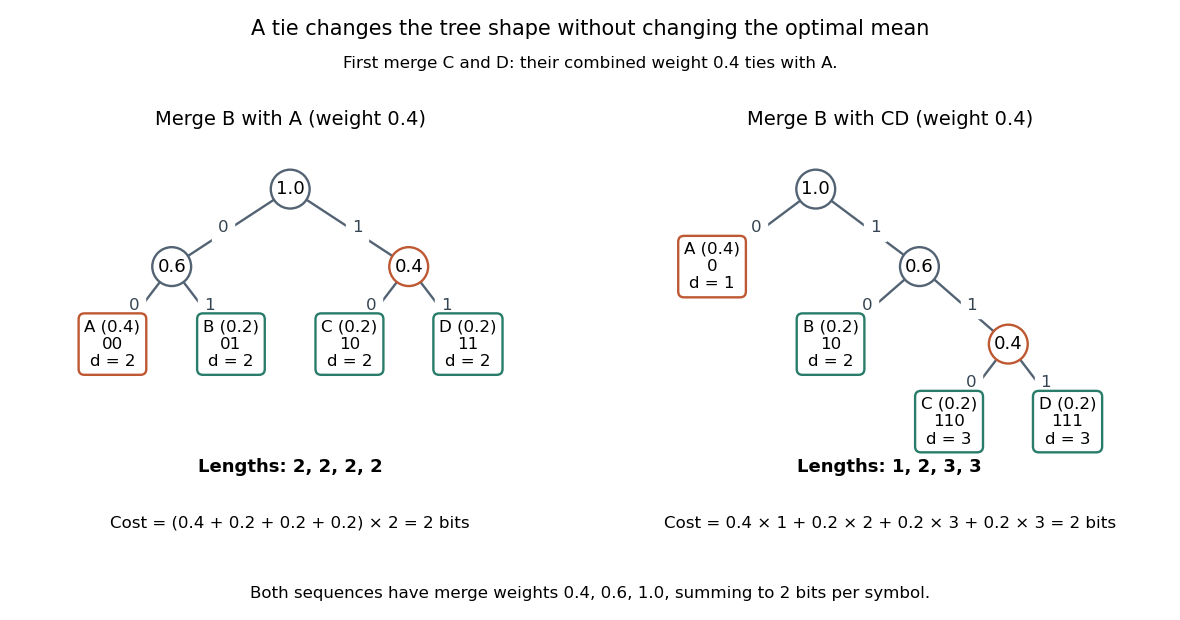
A tie between a symbol and a merged subtree gives two optimal prefix trees, with depths 2,2,2,2 and 1,2,3,3
. Details. 
The quantifier in the Huffman sibling property is visible here too. Choose as two least-probability symbols. In the displayed balanced optimal prefix code, they are not sibling leaves in a code tree. Exchanging , which have equal probabilities, produces another balanced optimal prefix code in which are deepest sibling leaves in a code tree. Thus the proof supplies an optimal representative with the chosen pair together. It does not force that labelling on every optimum. An implementation can make its tie choices and edge assignments deterministic when encoder and decoder need to reproduce the same codewords; optimal mean length alone does not specify them.
There are unlisted articles, also show them or only show them.