
Mixed boundary condition Created 2026-09-24 Updated 2026-10-14
A mixed boundary condition imposes different kinds of boundary conditions on different portions of the boundary. A common elliptic example combines a Dirichlet boundary condition on one portion with a Neumann boundary condition on the remainder.
Neumann boundary condition Created 2026-09-24 Updated 2026-10-14
A Neumann boundary condition prescribes the outward normal derivative of the unknown function on the boundary.
Dirichlet boundary condition Created 2026-09-24 Updated 2026-10-06
Energy measurement Created 2026-09-24 Updated 2026-10-14
An ideal energy measurement returns an eigenvalue of the Hamiltonian with probability equal to the squared norm of the state's projection onto its eigenspace. After obtaining a nondegenerate energy, the state is the corresponding energy eigenstate.
Quasirandom Boolean function Created 2026-09-24 Updated 2026-09-24
A Boolean function is -quasirandom when conditioning any set of at most coordinates to any values changes its -expectation by at most .
Junta Created 2026-09-24 Updated 2026-10-14
Fourier-Walsh transform Created 2026-09-24 Updated 2026-10-14
On the finite Boolean hypercube, these coefficients are the Hadamard transform of the vector of function values, with expectation normalization.
Monotone Boolean function Created 2026-09-24 Updated 2026-10-07
Van den Berg-Kesten inequality Created 2026-09-24 Updated 2026-11-05
Russo-Seymour-Welsh theorem Created 2026-09-24 Updated 2026-11-05
For independent bond percolation on the square lattice at , the Russo-Seymour-Welsh theorem gives nontrivial crossings at every scale. For each fixed aspect ratio , there is such thatwhere is the left-to-right rectangle crossing in bond percolation probability. The constant can depend on , but not on the rectangle's size.
Reflection extensions and transverse crossings in overlapping rectangles permit longer crossings to be assembled from square crossings. The Harris-FKG inequality controls intersections of these increasing events; dual bond percolation supplies the complementary crossing bound. These are the geometric ingredients of the original square-lattice crossing analysis.[ref]
For example, a rectangle twice as wide as it is high retains a positive crossing probability as both dimensions grow. The bounds imply positive probabilities for open or closed circuits in fixed-shape annuli and support the one-arm extension estimate. Their critical-parameter assumption is essential: a corresponding uniform lower bound would contradict exponential decay of subcritical percolation.
Percolation susceptibility Created 2026-09-24 Updated 2026-11-05
The percolation susceptibility is the expected size of the open cluster containing a specified root:
Unique subsequential limit of a bounded sequence Created 2026-09-24 Updated 2026-10-14
If a bounded real sequence has the property that every convergent subsequence converges to the same number , then the full sequence converges to . Otherwise, a subsequence stays at least some fixed distance from ; Bolzano--Weierstrass gives it a convergent subsubsequence, contradicting the assumed uniqueness.
Nested interval theorem Created 2026-09-24 Updated 2026-10-14
If are nonempty closed intervals with finite endpoints, then at least one real number belongs to every member. If their lengths tend to zero, exactly one real number belongs to every member. The result turns an unlimited sequence of consistent enclosures into an existence guarantee.
Write . Nesting makes the left endpoints nondecreasing and the right endpoints nonincreasing. Their bounds give finite supremum and infimum, withIndeed, every is an upper bound for all the , so the least-upper-bound property gives for every . This proves the displayed interval is nonempty. If , its two endpoints must coincide. This is the connection to the completeness of the real numbers discussed in Günther Hörmann and David Langer, Einführung in die Analysis, §§3.15–3.16: nested intervals and order completeness.
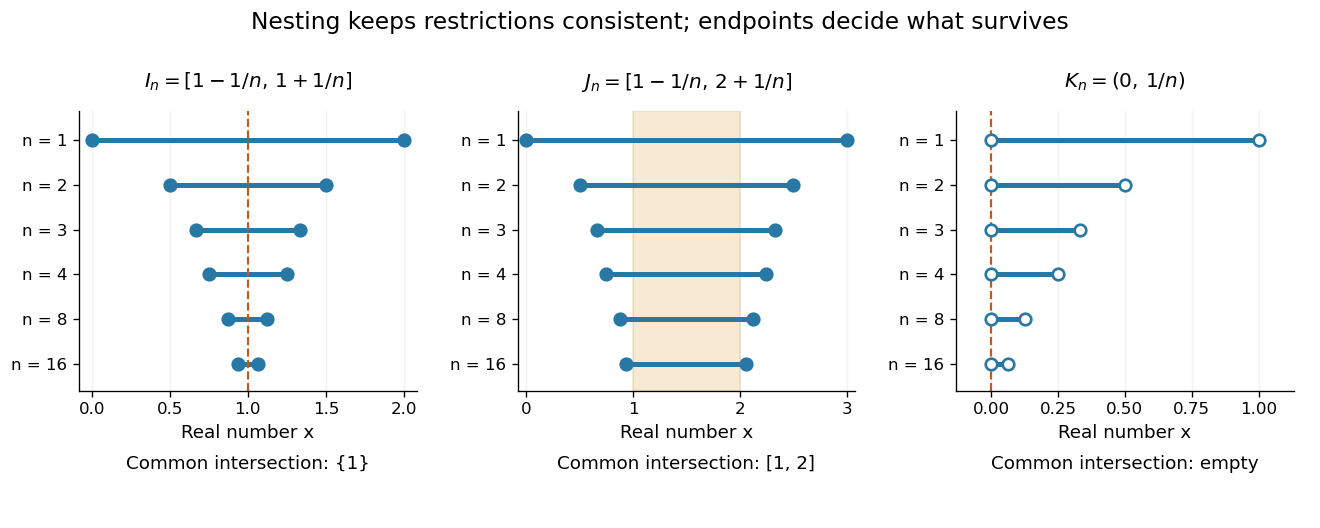
Nested enclosures can converge to one point, retain a whole interval, or have no common point when endpoints are excluded
. Details. 
The distinction between existence and uniqueness is useful in computation. If an unknown point lies in every , the midpoint satisfiesThus the enclosure itself certifies an absolute error without knowing the answer. The bisection error bound is the special case where each update halves the width.
Closedness and a finite initial enclosure matter. The open intervals have no common point, while the closed but unbounded intervals also have empty intersection. A picture of a few intervals cannot certify the intersection of an infinite family; the hypotheses of the nested interval theorem do that work.
Bingham sliding law Created 2026-09-24 Updated 2026-09-28
Shifted inverse-radius potential Created 2026-09-24 Updated 2026-11-05
Consider a point mass in the central potentialHere is a positive length offset, and is the conserved angular momentum. With reciprocal radius , the Binet equation becomeswhere primes denote derivatives with respect to the orbital angle . A circular orbit requires , with . The right side has its maximum at . Thus there are two circular orbits for and none above that maximum.
Writing and retaining linear terms givesThe outer branch is radially stable at fixed angular momentum, while is unstable. At the meeting point the linear restoring coefficient vanishes, so the linear test is degenerate. Stating the sign and domain assumptions is essential to this branch classification.
Biharmonic stream function for a fixed disk in planar shear Created 2026-09-24 Updated 2026-09-29
Similarity solution for tangentially forced Stokes wedge Created 2026-09-24 Updated 2026-10-06
Intersection multiplicity Created 2026-09-24 Updated 2026-11-05
For two plane curves and meeting only at an isolated point locally on a smooth surface over an algebraically closed field , their intersection multiplicity isIn local plane coordinates centered at , this is also . The quotient is finite-dimensional because the local intersection is isolated. This length counts contact that the underlying point set alone cannot detect.[ref]
The Stacks project. Section 43.16, tag 0B01, computing intersection multiplicities by local-ring length
The coordinate axes have quotient and multiplicity one. The curves and , , instead givewith basis , hence multiplicity . For the higher value records tangency. If the curves share a local component, this quotient has infinite length and the isolated-intersection formula does not apply. Summing the local multiplicities for projective plane curves without a common component gives the product of degrees in Bézout's theorem.
Projective plane curve Created 2026-09-24 Updated 2026-10-14
A projective plane curve is a projective curve embedded in the projective plane, usually given by one homogeneous equation.
Logarithmic moments of the Cauchy kernel Created 2026-09-24 Updated 2026-09-28
There are unlisted articles, also show them or only show them.