
Removable singularity Created 2026-09-24 Updated 2026-09-24
An isolated singularity is removable when the function extends holomorphically across it, equivalently when its Laurent series has no negative-power terms.
Normal covering map Created 2026-09-24 Updated 2026-10-03
A connected covering is normal, or regular, when its deck transformations act transitively on each fibre. Under the subgroup classification, this is equivalent to the associated subgroup of the fundamental group being normal.
Covering-space subgroup and deck-group quotient Created 2026-09-24 Updated 2026-09-29
Cell complex of a covering from a coset graph Created 2026-09-24 Updated 2026-09-24
For a presentation complex, the covering associated with a subgroup has one vertex for each coset. A generator gives directed edges according to its coset action, and every relator has one lifted 2-cell beginning at each vertex.
Degree of a connected covering Created 2026-09-24 Updated 2026-09-28
Support vector machine Created 2026-09-24 Updated 2026-09-24
A support vector machine chooses a separating decision function by trading a wide geometric margin against hinge-loss violations.
Plug-in classifier excess-risk bound Created 2026-09-24 Updated 2026-09-24
For binary classification with posterior estimate , the plug-in classifier satisfies
L-nearest-neighbour classifier Created 2026-09-24 Updated 2026-10-05
The L-nearest-neighbour classifier estimates each class probability by its empirical frequency among the nearest training covariates and predicts a class of greatest estimated probability.
Sackur-Tetrode equation Created 2026-09-24 Updated 2026-11-05
Canonical partition function for an ultrarelativistic gas in a power-law trap Created 2026-09-24 Updated 2026-11-05
Coprime-factorization lower bound for a quadratic-form class number Created 2026-09-24 Updated 2026-11-05
Let be a positive odd integer with distinct prime factors. Thenwhere is the class number of a negative discriminant.
Assign each complete prime power in the prime factorization of to one of two factors . There are ordered integer factorizations with coprime factors. Interchanging and pairs them without a fixed pair, because and coprime equal factors would both be one. Thus there are unordered pairs.
Each pair gives the primitive binary quadratic form of discriminant of a binary quadratic form . It is a reduced positive definite binary quadratic form, so distinct pairs give distinct equivalence classes under proper equivalence by uniqueness of the reduced positive definite binary quadratic form. This proves the lower bound. For the excluded case , the separate value also satisfies the weaker numerical inequality .
Two distinguished classes of discriminant minus eight q Created 2026-09-24 Updated 2026-11-05
For an odd prime , the formsare primitive binary quadratic forms of discriminant of a binary quadratic form . Their diagonal polynomial coefficients are positive, so they are positive definite, and makes both satisfy the reduced positive definite binary quadratic form inequalities.
Their proper equivalence classes are distinct. The first represents one at , but the second has minimum positive value two: if , , while and give at least two. Since proper equivalence preserves represented integers, the two forms cannot be equivalent.
Thus . If the class number of a negative discriminant is exactly two, these are all its primitive proper classes. That completeness hypothesis is the reason a local square test can select one specific form in prime representation when h of minus eight q equals two.
Jacobi constant Created 2026-09-24 Updated 2026-11-05
The Jacobi constant is a conserved quantity for the circular restricted three-body problem. In barycentric coordinates rotating at constant angular frequency , defineThe equation of motion in a rotating frame is . Taking its dot product with proves : the Coriolis force does no work.
Only positions satisfying are accessible. The boundary gives a zero-velocity surface; openings near Lagrange points allow transit between regions but do not force it. Ordinary inertial-frame energy can change even while remains constant.[ref]
Introduction to Celestial Mechanics by Richard Fitzpatrick. Online “Jacobi integral”, equations (9.10)–(9.15): conserved combination and nonconservation of inertial energy
No-signalling box Created 2026-09-24 Updated 2026-11-05
A no-signalling box is a conditional probability distribution whose marginal distribution for either party is independent of the other party's input. It can therefore exhibit correlations stronger than quantum correlations without transmitting information superluminally.
Chromatic polynomial after attaching a leaf Created 2026-09-24 Updated 2026-10-14
Attaching a new vertex that is a leaf of a graph multiplies the chromatic polynomial by : after colouring the old graph, the new vertex may receive any colour except its neighbour's. Starting with one vertex and repeatedly adding a leaf of a graph constructs any finite tree. Thus a tree with vertices hasIn contrast, every pair of vertices in a complete graph must receive different colours, so the multiplication principle gives the falling factorialFor positive integers this product vanishes, expressing the impossibility of assigning distinct colours to all vertices.
Deletion-contraction recurrence for the chromatic polynomial Created 2026-09-24 Updated 2026-10-14
Deleting an edge removes one colour constraint. Edge contraction describes exactly the newly admitted colourings that violate that constraint. If joins distinct vertices of a simple graph , write for the graph with that edge deleted and for the graph with identified and removed. Parallel edges produced by the contraction may be reduced to one edge, since they impose the same condition on a proper vertex coloring. ThenTo see why, divide the proper vertex colorings of into two classes. Those with different colours at are exactly the colourings of . Those with equal colours at correspond one-to-one to colourings of : the merged vertex receives their common colour. Subtracting the second class leaves the first.
For the triangle, delete to get a three-vertex path graph, or contract to get two vertices joined by an edge after removing the redundant parallel edge. Consequently,At , this says . Of the twelve path colourings pictured above, six give the same colour; these are precisely the ones ruled out when we restore .
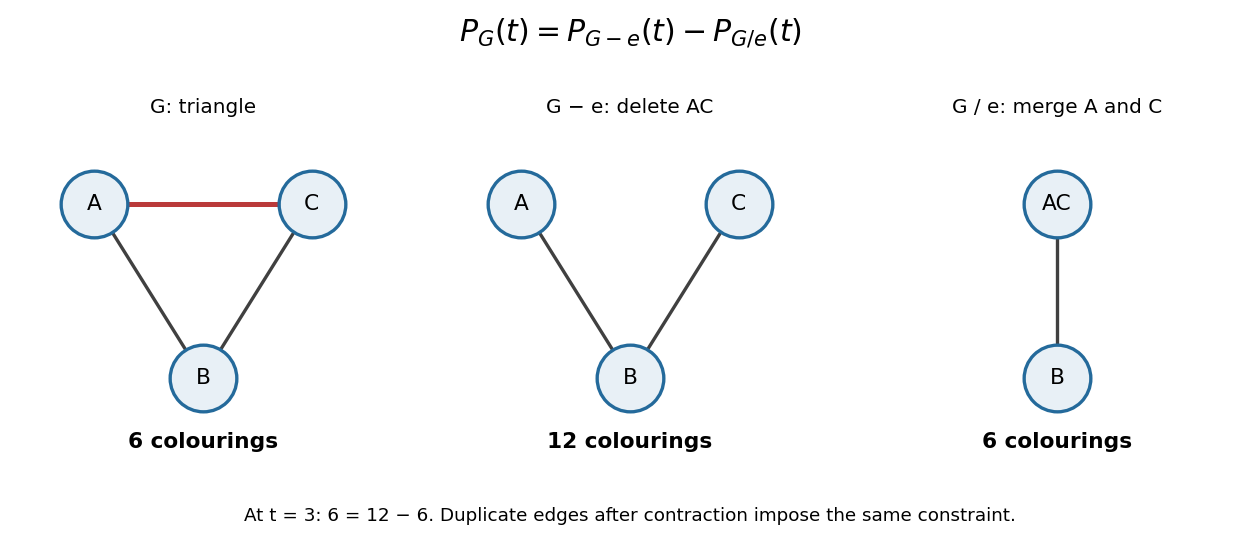

This recurrence is useful because it reduces a constrained counting problem to smaller graphs. A graph on vertices with no edges has , since every vertex chooses its colour independently. Repeated edge deletion and edge contraction reduce to this case and show that the counting function is a polynomial. The same recurrence gives its leading coefficients. The method is conceptually simple, although the number of recursive cases can still grow rapidly.
Brooks' theorem Created 2026-09-24 Updated 2026-10-03
A connected graph of maximum degree has chromatic number at most unless it is a complete graph or an odd cycle.
Chi-squared stochastic ordering Created 2026-09-24 Updated 2026-11-05
Chi-squared distributions are stochastically increasing in their statistical degrees of freedom. For any real , take independent and . Gamma additivity givesFor integer , this is the familiar construction by adding extra independent squared standard normal variables. For noninteger degrees of freedom, multiplying the gamma moment-generating functions proves the same statement.
Under this coupling the larger-degree variable is larger on every sample path. Hence for every , and in fact the inequality is strict for : average and use and the strictly positive chi-squared density. Therefore every quantile at a fixed probability in strictly increases with the degrees of freedom. Comparing chi-squared critical values must account for this change; the distribution is not fixed while only its label changes.
Euler sequence Created 2026-09-24 Updated 2026-09-24
Total Chern class Created 2026-09-24 Updated 2026-10-06
The total Chern class is .
There are unlisted articles, also show them or only show them.