
Campanato iteration lemma Created 2026-09-24 Updated 2026-09-24
Partial isometry Created 2026-09-24 Updated 2026-09-24
An operator on a Hilbert space is a partial isometry when it is isometric on . Equivalently, is the orthogonal projection onto this initial space.
Positive element of a C-star algebra Created 2026-09-24 Updated 2026-10-03
An element of a C-star algebra is positive when for some , equivalently when and . Continuous functional calculus gives it a unique positive square root .
Relevance of independent self-sums Created 2026-09-24 Updated 2026-11-05
Let take values in the vector space over the two-element finite field. In this additive group, subtraction equals addition. Suppose is a C-relevant pair of random variables relative to , and take mutually independent copies . Then is -relevant to .
For a proof, let and take an independent representative of . The entropy submodularity for three independent sums givesso the definition of Entropic Ruzsa distance yieldsThe last step is the Entropic Ruzsa triangle inequality. Apply the same argument to and add the inequalities.[ref]
The binary finite field hypothesis makes the displayed self-sum argument agree with the difference convention in Entropic Ruzsa distance. On a general abelian group, signs must be retained explicitly.
Irreducibility of the accessible subset automaton Created 2026-09-24 Updated 2026-09-24
For distinct accessible subset states, choose a state in their symmetric difference. A word taking it to the unique final state accepts from one subset; uniqueness of the starting state prevents acceptance from the other. Thus the accessible part of the subset automaton is irreducible.
Exponential test-function characterization of Brownian motion Created 2026-09-24 Updated 2026-09-24
Let be continuous with . Ifis a martingale for every real , then conditional expectations solveThus is independent of and distributed as , so is Brownian motion.
Brownian transition semigroup Created 2026-09-24 Updated 2026-10-14
Each Gaussian-convolution operator is a rescaled Weierstrass transform; the semigroup combines all times.
Cameron-Martin theorem for a linear drift Created 2026-09-24 Updated 2026-10-14
For the Cameron-Martin space of Wiener measure path , the Cameron-Martin theorem says that translation of Brownian motion by this linear function changes its law through time by the density
Brownian motion with drift Created 2026-09-24 Updated 2026-09-24
Time inversion of Brownian motion Created 2026-09-24 Updated 2026-09-24
If is Brownian motion, thenis also Brownian motion. Its covariance is , and continuity at zero follows from almost surely.
Gaussian-process characterization of Brownian motion Created 2026-09-24 Updated 2026-10-14
A centered Gaussian process with almost surely continuous sample paths and covariance is standard Brownian motion. Here Gaussian process means that every finite-dimensional distribution is a multivariate normal distribution; having separate normal distributions at each time would not suffice. This characterization is stated in Pitman, Basic Properties of Brownian Motion, Definition 15.2.
To compute the Brownian covariance kernel directly, suppose . Since and the added Brownian increment is centered and independent of ,Symmetry gives for arbitrary nonnegative times. For instance, and their correlation is . Positions are therefore related even though disjoint Brownian increments are independent: both positions contain the displacement accumulated during the first unit of time. Conversely, taking differences of gives zero covariance for disjoint increments; their joint multivariate normal distribution turns this into independence.
Exponential Brownian martingale Created 2026-09-24 Updated 2026-09-24
For every real ,is a martingale. Conditional expectation factors at time because the Gaussian increment is independent of the past and has exponential moment .
Brownian bridge Created 2026-09-24 Updated 2026-09-24
A standard Brownian bridge is the centered Gaussian process on . Its covariance is and it satisfies .
Brownian exit time Created 2026-09-24 Updated 2026-09-24
For a domain , the Brownian exit time is . It is a stopping time, and it has finite expectation when is bounded.
Transience of Brownian motion in dimension at least three Created 2026-09-24 Updated 2026-11-05
Standard Brownian motion in is transient for : almost surely. In dimension three, start away from zero and use the positive local martingale . It is a supermartingale, hence converges to a finite limit. Brownian scaling and the normal distribution of show that in probability, so its almost-sure limit must be zero. Thus .
For a start at zero, apply the same argument from any positive deterministic time; the position there is nonzero almost surely. In higher dimensions, project onto three coordinates: the full radius dominates a radius already tending to infinity. This differs from recurrence of planar Brownian motion, where every neighbourhood is visited repeatedly.
Brownian scaling Created 2026-09-24 Updated 2026-10-14
For every , the stochastic process is standard Brownian motion. Its Brownian increments remain independent and have variance ; continuity and the zero starting value are preserved. Equivalently,Equality here is of whole-process distributions, including every finite-dimensional distribution. It is not an equality of the two expressions along a particular realization. With , speeding time up fourfold requires dividing displacement by two to recover the standard law. The figure applies exactly these coordinate changes to four finite samples; the shared colors indicate reused samples, while the dashed lines show pointwise standard deviations, not bounds on entire sample paths.
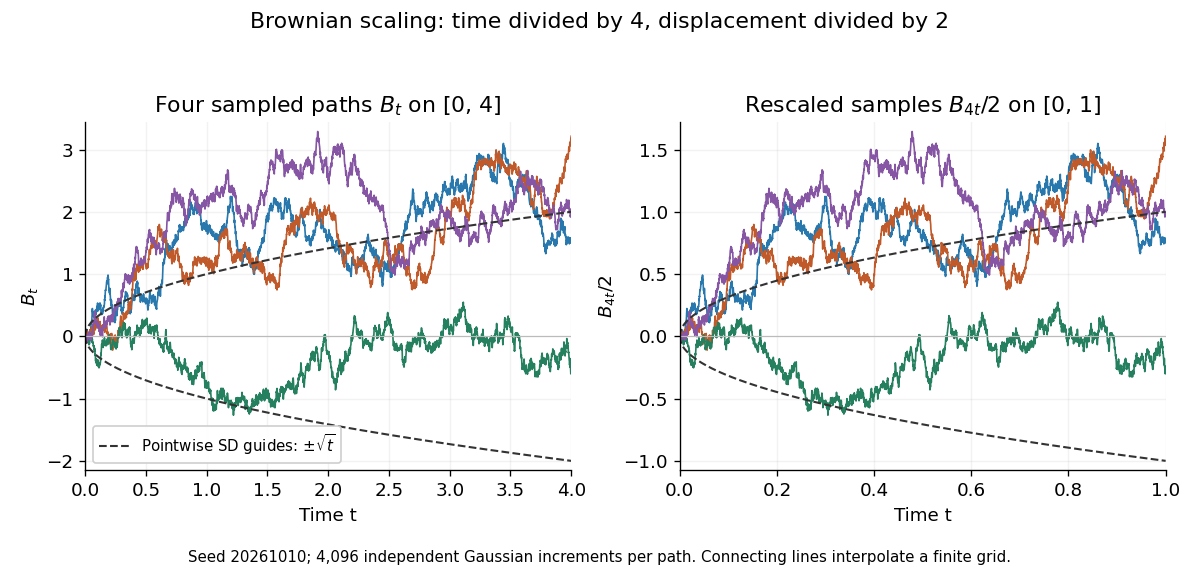
Seeded Gaussian samples before and after Brownian scaling with c equal to four
. Details. 
The same square-root normalization explains how a simple random walk approaches Brownian motion. Let , where the independent steps take values and with equal probability. Then has variance . Its linear interpolation isand . Donsker's theorem says in with the uniform norm: this is convergence in distribution of random paths. The interpolation bound vanishes, but the theorem does not assert pointwise convergence of an arbitrarily fixed walk to an independently chosen Brownian motion. The usefulness is that many-step discrete motion has a universal continuous limit.[ref]
Lévy characterization of Brownian motion Created 2026-09-24 Updated 2026-11-05
A continuous local martingale with is standard Brownian motion in its given filtration if and only if its quadratic variation satisfies for every , simultaneously almost surely.
For the nontrivial direction, the Itô formula makes a complex local martingale. Its absolute value is deterministically bounded on each finite horizon, so it is a true martingale. Conditioning at givesThe conditional characteristic-function criterion for Brownian increments identifies a centered normal distribution independent of . This turns a bracket computation into a proof of the complete Brownian motion law.
Nowhere differentiability of Brownian motion Created 2026-09-24 Updated 2026-09-24
Brownian paths are almost surely nowhere differentiable. An increment over duration is typically of order , so its difference quotient is of order rather than approaching a finite limit.
Unbounded function Created 2026-09-24 Updated 2026-11-05
A real- or complex-valued function is unbounded when no finite constant bounds the moduli of all its values. Equivalently, for every there is an allowed input with .
Unboundedness does not say that all sufficiently large inputs produce large values. For example, on the nonnegative real numbers is zero at , yet grows without bound. Thus this function is unbounded but has no limit as .
Far-field boundary condition Created 2026-09-24 Updated 2026-09-24
There are unlisted articles, also show them or only show them.