
One has , with no requirement that itself be Hermitian. Moreover,Thus is Hermitian and positive semidefinite. The positive semidefinite property is stronger than the Hermitian conclusion alone.
Taking the Hermitian adjoint reverses the products and leaves their sum unchanged:Thus the symmetrized product is Hermitian, whether or not and commute. This is the Hermitian anticommutator divided by two.
The commutator is anti-Hermitian: . It is also Hermitian precisely when it is zero, so it is not Hermitian in general; it is Hermitian if and only if and commute. For example, for the Pauli matrices.
For finite-dimensional operators, use and the Hermitian assumptions. The commutator satisfies , soThus is Hermitian. These adjoint identities are the intended matrix-level setting; for unbounded operators, domains and self-adjointness require additional analysis.
Past exam of the mathematical methods I course of the University of Oxford 2017 8 b iv Solution 2026-10-25
Substituting and using the diagonalization givesFor and energy level one in the chosen units, its ellipse equation isThe major semiaxis has length along ; the minor semiaxis has length along . The full axis lengths are and . The original-coordinate curve is the same ellipse tilted by , elongated along ; an orthogonal coordinate change preserves lengths and does not change the ellipse itself.
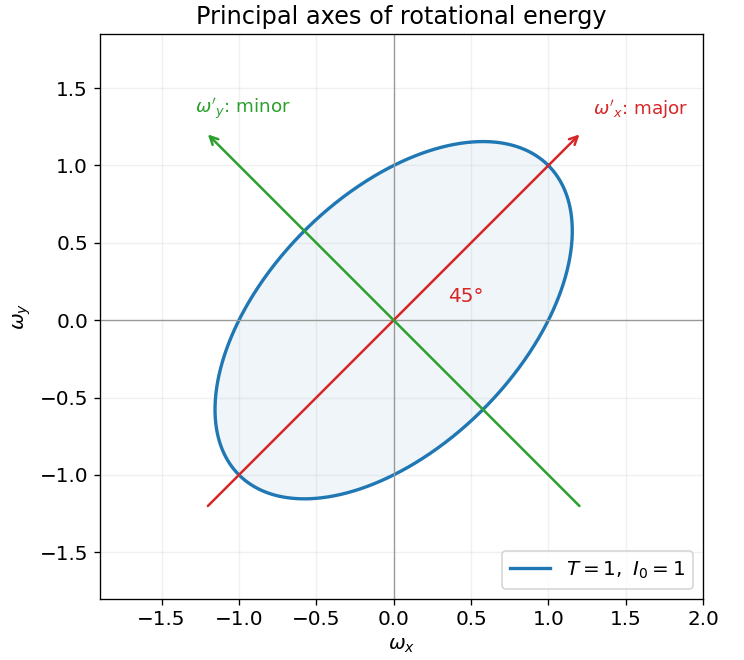
Principal axes of the rotational-energy ellipse
. Original plot at I0 equal to one and energy equal to one, showing the longer axis along the normalized (1,1) eigenvector and the shorter perpendicular axis. Details.
Past exam of the mathematical methods I course of the University of Oxford 2017 8 b iii Solution 2026-10-25
The matrix has the standard rotation matrix form , with . ThusWith , the new first axis points along the original direction and is counterclockwise from the original first axis. Specifying this coordinate convention avoids confusing rotation of the axes with the inverse transformation of component columns.
Past exam of the mathematical methods I course of the University of Oxford 2017 8 b ii Solution 2026-10-25
The normalized vectors and give eigenvalues and . ThereforeThe columns are orthonormal, so and direct multiplication verifies . Signs of individual eigenvectors are free; the displayed signs also make .
Past exam of the mathematical methods I course of the University of Oxford 2017 8 b i Solution 2026-10-25
In the quadratic form, the two equal off-diagonal contributions together supply the mixed term. Comparing coefficients givesFor a nontrivial physical moment of inertia scale take ; then this inertia tensor is positive definite.
Past exam of the mathematical methods I course of the University of Oxford 2017 10 c ii Solution 2026-10-25
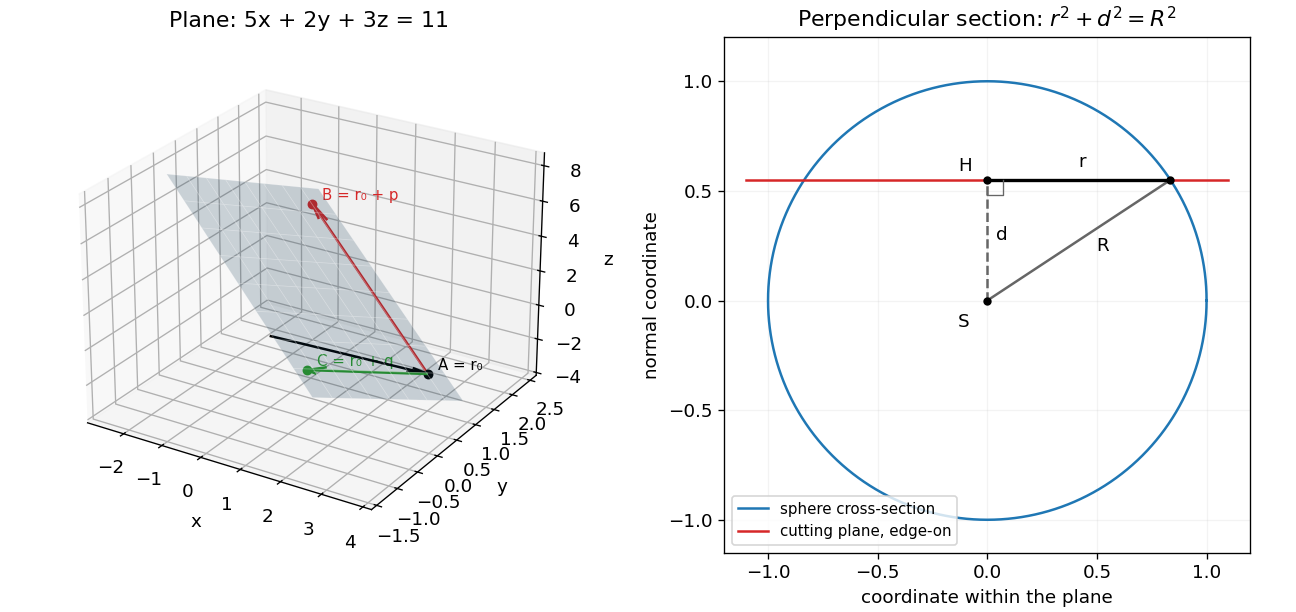
Let be the sphere centre. The circle centre is its perpendicular projection onto the plane:For the specific plane this isFor a point on the section, its displacement from lies in the plane and is perpendicular to . The Pythagorean theorem therefore givesA genuine circle requires . At the section is a single tangent point, and at the plane misses the sphere. A central cut gives a great circle of radius .
Past exam of the mathematical methods I course of the University of Oxford 2017 10 c i Solution 2026-10-25
Provided are linearly independent, their linear combinations fill a two-dimensional direction space. Adding translates it to the plane through . The unit normal and constant areThen for every pair of parameters. Conversely a point satisfying differs from by a vector in , proving that the two descriptions give exactly the same plane.
For the three points, choose , and . Their cross product is , which is nonzero. The plane therefore has equationEach supplied point satisfies it. Its unit normal is , up to an overall sign, and .

For the quadratic form of a squared cross product, express the two scalar terms as quadratic forms in :Then . In particular, for ,The cancellation is structural: , while its action on every vector perpendicular to a nonzero is multiplication by . Its eigenvalues are therefore ; for the whole matrix is zero.
Past exam of the mathematical methods I course of the University of Oxford 2017 resit 8 c i Solution 2026-10-25
For nonzero vectors with angle , and . Hence gives Lagrange's identityIf either vector is zero both sides vanish, so this covers every case. Alternatively, expansion of the three cross product components gives the same identity without introducing an angle.
At critical damping, the characteristic polynomial has the repeated root . Its independent solutions are and , givingThe factor supplies the second independent solution that would be lost by using just one exponential. There is no oscillatory factor at this boundary between the underdamped and overdamped regimes.
Past exam of the mathematical methods I course of the University of Oxford 2017 resit 7 b i Solution 2026-10-25
For the damped harmonic oscillator, the characteristic polynomial is . When , its roots are , with . ThusHere and are arbitrary real constants. The frequency is , and the amplitude envelope decays with time constant when ; the zero-damping limit recovers simple harmonic motion.
Matrix multiplication is associative, soThe uniqueness of the matrix inverse then givesThe order is reversed; does not generally work because matrix multiplication need not be commutative.
Past exam of the mathematical methods I course of the University of Oxford 2016 11 a iv Solution 2026-10-25
Past exam of the mathematical methods I course of the University of Oxford 2016 11 a iii Solution 2026-10-25
For a Hermitian matrix , . Reversing the product of identical factors has no effect, soHence every positive integer power is Hermitian. The identical-factor condition matters; a product of different Hermitian matrices need not be Hermitian.
There are unlisted articles, also show them or only show them.