
If , every surviving terminal price is already below the strike, so this is a barrier digital put paying one at expiry exactly when the upper barrier has been avoided. To use the Black-Scholes reflection symmetry, cap the free digital-put strike at , rather than continuing to use :Indeed, has terminal payoff one throughout the alive region, while its reflected argument exceeds and hence has zero terminal payoff. The barrier values again cancel. Using in both terms would generally leave an unwanted reflected terminal payoff near the barrier.
Writing makes the discounted survival probability explicit:The price is independent of in this case. Both cases combine by replacing the free strike with in the up-and-out digital put formula.
Let and . The Black-Scholes reflection symmetry gives another solution . Subtracting it enforces absorption:At the terms agree. At expiry the reflected argument satisfies , so its digital-put payoff vanishes; the first term supplies the required terminal payoff. These facts and the bounded pricing solution's uniqueness prove the formula. The up-and-out digital put price is zero once knocked out.
While the up-and-out digital put is alive, its pricing domain is , . Its Black-Scholes equation, terminal financial payoff, and absorbing boundary condition areFor completeness, the natural limiting condition is , with . A positive geometric Brownian motion cannot hit zero in finite time, and from a very small starting value the survival and below-strike terminal events have probability tending to one. If the barrier has already been hit, its value is zero regardless of the current stock price.
For , the terminal payoff tends to one from inside at , while an already hit barrier pays zero. Thus there is a terminal-boundary corner discontinuity; the terminal condition is imposed only for , not as a requirement of continuous extension at .
For a terminal price distinct from , differentiating the put's financial payoff gives . The difference quotients are bounded by one, and the continuous lognormal distribution has zero probability at the strike. The dominated convergence theorem therefore permits differentiation inside its discounted expectation. The put-price strike derivative is exactly the price of the digital put option:Equivalently, risk-neutral pricing discounts the probability .
Differentiate the Black-Scholes formula for the European put option with respect to its strike. The chain rule givesThe final two terms cancel by both identities in part i. Hence the put-price strike derivative is
Let , so . Squaring givesExponentiation provesAt fixed , only depends on , so the partial derivatives are
Past exam of the mathematical methods II course of the University of Oxford 2022 9 b ii Solution 2026-10-25
Let and on the relevant intervals. The chain rule givesThus the one-form is explicitly an exact differential. Fixing its potential to vanish at determines it uniquely on the connected domain:Continuity of on the integration ranges suffices. For arbitrary smooth data defined throughout , that half-plane also supplies the simply connected domain in the previous argument.
For the specialization , the potential based at is defined in the positive quadrant; it cannot be continued through using this formula. Taking keeps both endpoints in that component. Their ratios are both , so the term cancels andNo condition on beyond existence on the traversed ratios enters this difference.
Past exam of the mathematical methods II course of the University of Oxford 2022 9 b i Solution 2026-10-25
For a sufficiently smooth vector field on an oriented surface with compatible boundary orientation, Stokes theorem statesApply it to in the plane. The closed line integral is the area integral of . Thus makes it vanish whenever a spanning surface lies within the smooth domain. In a simply connected domain this implies path independence: join one path from to to the reverse of another, and their difference is a zero closed line integral.
The domain qualification is essential. On the punctured plane, , satisfy , but the line integral around the unit circle is . A disk spanning that circle passes through the singularity. Hence the printed implication requires an appropriate domain assumption; zero curl alone is not a global path independence theorem.
Past exam of the mathematical methods II course of the University of Oxford 2021 7 iv d Solution 2026-10-25
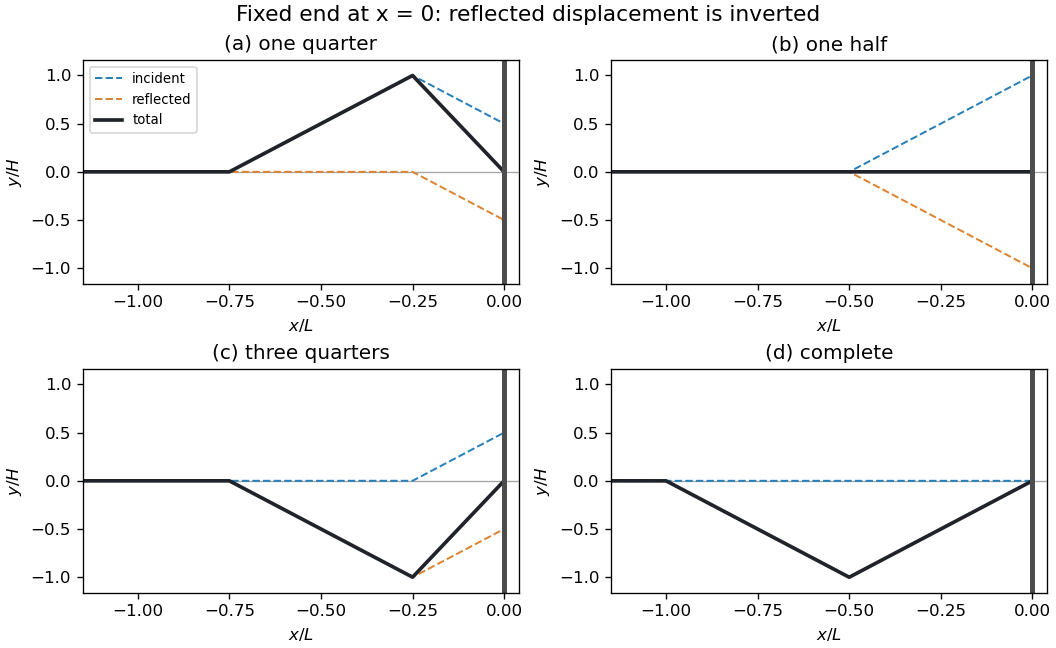
At , the incident pulse has left the physical half-line, so only the inverted reflected pulse remains. Its straight segments pass throughIt subsequently travels toward decreasing at the original wave speed , with unchanged width and peak amplitude magnitude .

Past exam of the mathematical methods II course of the University of Oxford 2021 7 iv c Solution 2026-10-25
At , the reflected pulse dominates the overlap. The total displacement is zero outside and consists of straight segments throughThis is the inverted version of the quarter-reflected profile. The entire negative pulse has not yet separated from the incident pulse.
Past exam of the mathematical methods II course of the University of Oxford 2021 7 iv b Solution 2026-10-25
At , the two triangular pulses coincide with opposite signs:The instantaneous sketch is the straight equilibrium line. This is destructive interference, not the disappearance of the wave energy. For example, on the transverse velocity is , so the mechanical string is passing through equilibrium with nonzero kinetic energy.
Past exam of the mathematical methods II course of the University of Oxford 2021 7 iv a Solution 2026-10-25
Put the fixed end at , with the mechanical string occupying . Let be the incident peak amplitude, set and , and take when the incident front first reaches the end. The symmetric triangular pulse in the source has initial profile , whereThe fixed-end reflection of a triangular pulse follows from the Dirichlet boundary condition and the superposition principle, giving the reflected displacementThe minus sign is the inversion on reflection. At , the resulting profile is zero outside and consists of the straight segments throughThe segment beside the wall is steeper because incident and inverted reflected pulses overlap there.
Subtract the two values of the survival function, or integrate the probability density function directly:The final zero records the requested third significant figure.
Integrating the probability density function over the stated interval givesThe strict endpoint does not affect the probability for this continuous probability distribution.
Past exam of the mathematical methods II course of the University of Oxford 2019 9 a ii Solution 2026-10-25
At distance below the support, the cable must carry the weight of the remaining length . Thus its equilibrium tension is , and the local transverse wave speed isThe linear mass density cancels. More precisely the small-displacement equation with variable tension is ; its local characteristic speed is the expression above, even though a first-spatial-derivative term is also present.
The wave travel time on a hanging uniform cable is obtained from :Although the local speed tends to zero at the free end, the endpoint singularity in the travel-time integral is integrable. This finite result belongs to the ideal flexible-cable model, with bending stiffness neglected.
Past exam of the mathematical methods II course of the University of Oxford 2019 9 a i Solution 2026-10-25
Assume small transverse slopes, a flexible string, constant tension and uniform linear mass density . For an element of equilibrium length , the vertical force is the difference of the vertical tension components at its ends. To first order in slope,Its mass is and its transverse acceleration is . Newton's second law therefore gives , orThis is the one-dimensional wave equation for small-amplitude transverse waves. Changes in string length and horizontal acceleration are second order in slope and are neglected in this linear approximation.
Past exam of the mathematical methods II course of the University of Oxford 2019 8 c iii Solution 2026-10-25
For , the azimuthal unit vector is , soOn a counterclockwise circle at fixed height, . Henceindependent of the positive radius. Clockwise orientation reverses the sign.
There is no contradiction with the zero curl found in solution. The vector field is undefined on the axis, so it is not continuously differentiable on a disc spanning ; the hypotheses of Stokes theorem fail for that disc. It is smooth on a planar annulus excluding the axis, where Stokes theorem correctly gives zero: the two boundary line integrals cancel, .
The same check works for general . A counterclockwise circle has circulation . Integrating the curl over an annulus gives, for ,For , both sides are zero. Thus all three preceding results are consistent with Stokes theorem; the necessary distinctions are the regularity of the vector field and inclusion of every oriented boundary component.
Past exam of the mathematical methods II course of the University of Oxford 2019 8 c ii Solution 2026-10-25
In cylindrical coordinates, . The tangential coefficient is positive for every real and , so the large-scale circulation is always counterclockwise when viewed from positive .
By solution, the infinitesimal local angular velocity is . Its sign gives“Zero local spin” does not mean zero velocity: at a marked small element is still carried around the axis while its infinitesimal rotational component is zero. Orbital motion around the axis and local vorticity are different measurements.
Past exam of the mathematical methods II course of the University of Oxford 2019 8 c i Solution 2026-10-25
Write and work away from the axis, where . The vector field is independent of and has zero vertical component, so only the vertical curl can be nonzero:ThereforeThis local spin in an azimuthal power-law flow depends on the radial variation of the tangential speed, not merely on the sign of that speed.
There are unlisted articles, also show them or only show them.