
Differentiate to obtain . Let , with . All solutions of areSince , the first family consists of local maxima and the second of local minima. Their function values follow from :The derivative is periodic, but itself is not: increasing by lowers by , which accounts for the indexed vertical offsets.
A stationary point is a point where the function is differentiable and its first derivative vanishes. Interpret the cube root as the real cube root, and put . Then . For , the product rule and chain rule giveThe denominator is positive wherever it is defined. Consequently the two stationary abscissae areUsing the stationary equation to simplify the value of gives . Thus the complete stationary points areNumerically they are approximately and . The numerator of is positive outside and negative inside, so the first is a local maximum and the second a local minimum.
At , the real function is continuous but has a vertical tangent; the factor does not cancel either cube-root singularity. Those points are not stationary points. This is the distinction required when finding stationary points with real cube-root factors.
On an outward-oriented sphere of radius , the electric field is normal with constant magnitude . Thus its flux isIt is independent of . There is no contradiction with solution: the classical divergence theorem cannot be applied to a full ball while pretending that is smooth at its center. On a punctured ball the outer flux and the inward-normal inner flux cancel, in agreement with zero ordinary divergence there.
The three-dimensional Dirac delta distribution is supported at the origin and satisfies the sampling identityfor smooth compactly supported test functions . It is not an ordinary function with a finite value at zero; its total integral is one, and translating it moves the point at which the test function is sampled.
The globally valid source equation isFor a direct weak verification, excise a ball of radius and integrate outside it. Since the ordinary divergence vanishes there, the result is . This is precisely the displayed distributional divergence and restores the divergence theorem with the point charge included.
Away from the origin, the electric field is , with here denoting the position vector in the numerator and its Euclidean norm in the denominator. The spherical-coordinate formula for divergence givesAt the origin the electric field is singular, so the ordinary divergence is undefined there. The equation above must not be extended to the whole space as an ordinary smooth-field identity. Its correct distributional divergence, derived in solution, includes the point source.
Take spherical polar coordinates with polar angle measured from positive and azimuthal angle :The derivative matrix isExpanding its determinant gives . ThusThe inverse formula holds where and ; it excludes the origin and polar axis. These formulas use the general chain rule and determinant construction in solution.
For general coordinates expressed as functions of , the chain rule gives , whereThe Jacobian determinant is the oriented volume scaling of this linearized map. Thus the unsigned volume element transforms as . Where the coordinate change is invertible, the inverse Jacobian determinant is , by the Jacobian chain rule.
For cylindrical coordinates, use , , and unchanged height . Direct differentiation giveswhose determinant is . ThereforeBoth directions are displayed because “from Cartesian to cylindrical” can refer either to the derivative of the new coordinates or to the factor used in transforming a Cartesian volume integral. They are reciprocals; the cylindrical axis is a coordinate degeneracy.
Past exam of the mathematical methods II course of the University of Oxford 2017 10 b iii Solution 2026-10-25
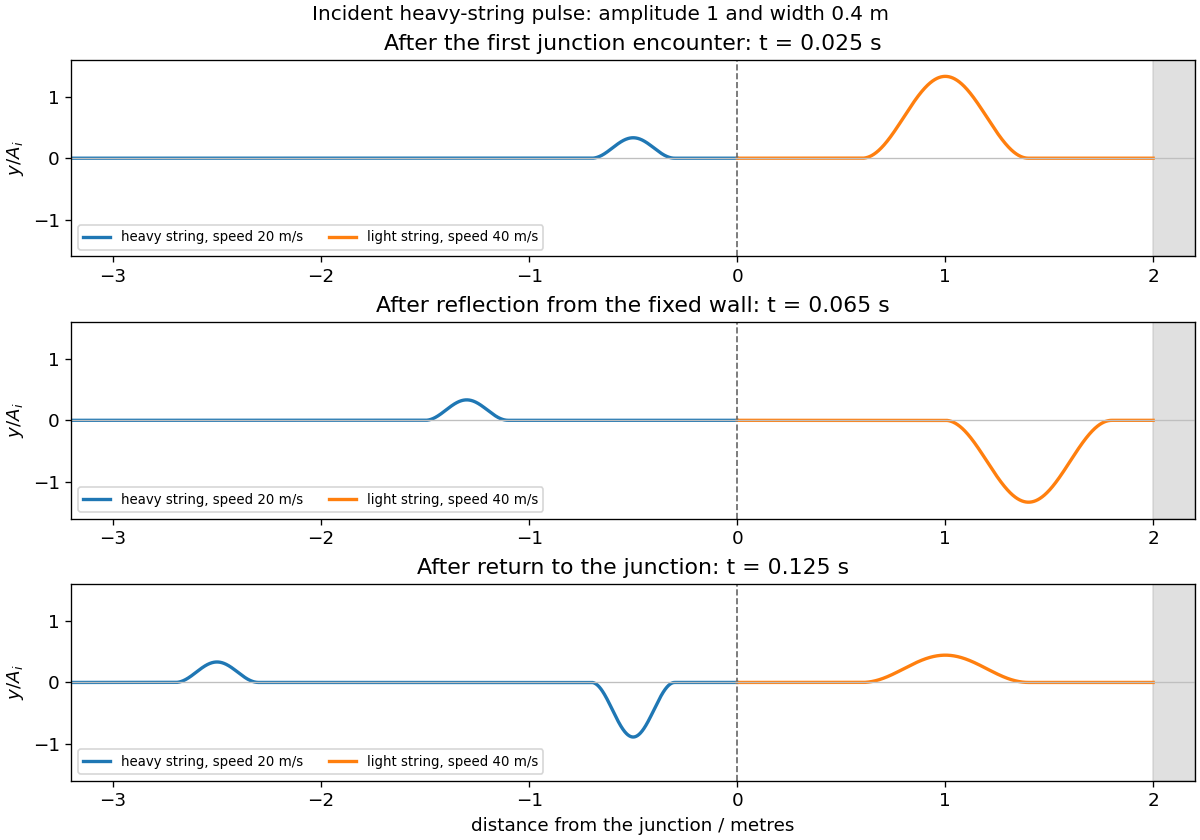
At the return encounter, transmission from light to heavy multiplies the amplitude by , giving a backward heavy-string pulse of amplitude . Its speed halves, so its width returns to . Reflection within the light segment multiplies the incoming amplitude by , giving a right-going pulse of amplitude and width . The earlier reflected pulse is already farther along the heavy string.
Past exam of the mathematical methods II course of the University of Oxford 2017 10 b ii Solution 2026-10-25
Reflection at a fixed end has displacement coefficient . The light-string pulse therefore returns from the wall with amplitude and width . It is inverted and travels left at . Taking the first junction encounter as time zero, its centre reaches the wall after and returns to the junction after ; a finite pulse takes its own duration to complete each encounter.
Past exam of the mathematical methods II course of the University of Oxford 2017 10 b i Solution 2026-10-25
After the first encounter, the reflected pulse travels backwards through the heavy string with amplitude and width . The transmitted pulse has amplitude and speed . Its temporal duration is unchanged at the stationary junction, so its spatial width doubles to . Both pulses retain the original displacement sign.
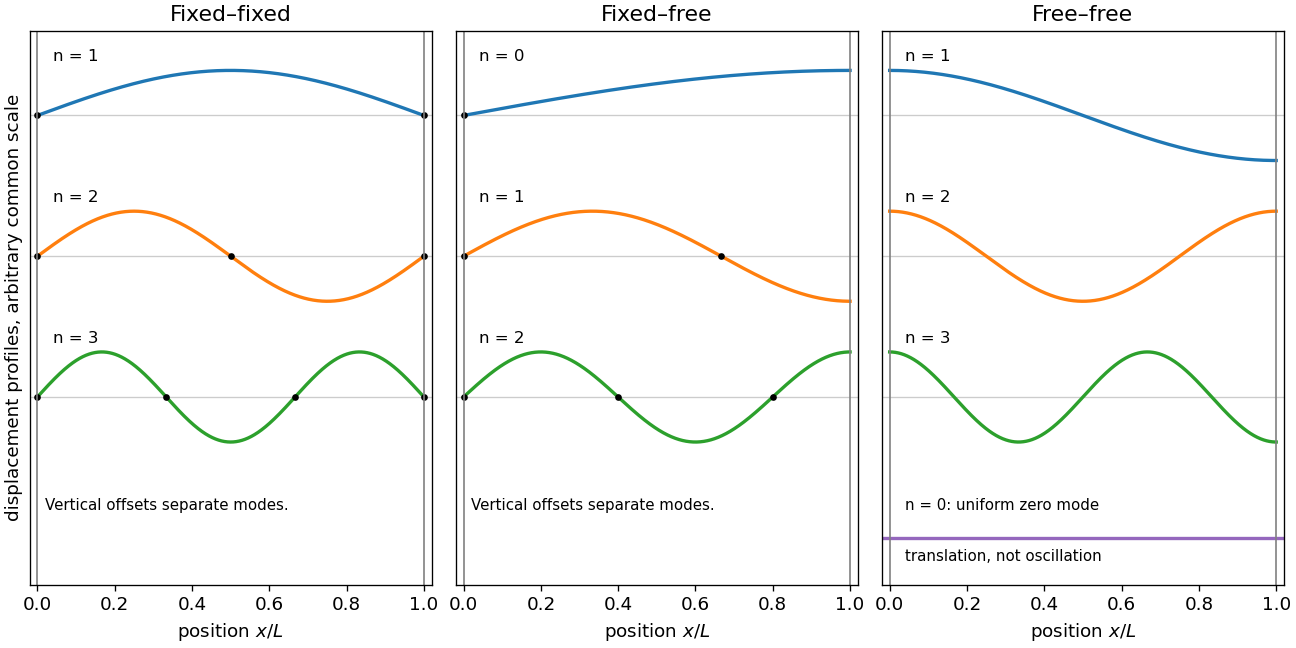
Free ends give , so the oscillatory normal modes areThere is also the zero mode , with uniform displacement : a free string can translate without a restoring force. It is not a positive-frequency oscillation. The first three oscillatory shapes are , and , with an antinode at each end. The figure includes the uniform mode too, so that the zero-frequency limit is explicit.
A free end has zero transverse force, hence , rather than zero displacement. With , write . The remaining condition is , givingThe first three shapes have one, three and five quarter-waves. Each has a node of a standing wave at the fixed end and an antinode at the free end; the mode frequencies are in the ratio .
For a uniform string, let . A separated mode obeys , . Fixed ends require , soThe first three normal modes have one, two and three half-waves respectively. Their interior nodes of a standing wave are at for .
Past exam of the mathematical methods II course of the University of Oxford 2016 10 b ii Solution 2026-10-25
The plane cuts the positive coordinate axes at , and . Choose its unit normal vector , pointing away from the origin. In the parametrization , the vector surface element for this orientation is . Thusand the triangular projection givesFor the opposite orientation the answer is . The normal direction must be stated because this open surface has no prescribed orientation in the question.
Past exam of the mathematical methods II course of the University of Oxford 2016 10 b i Solution 2026-10-25
Use the cone parametrization for , . Its surface element is . Since , the scalar surface integral isThis uses only the curved conical surface. There are no closing discs in the specified integration surface.
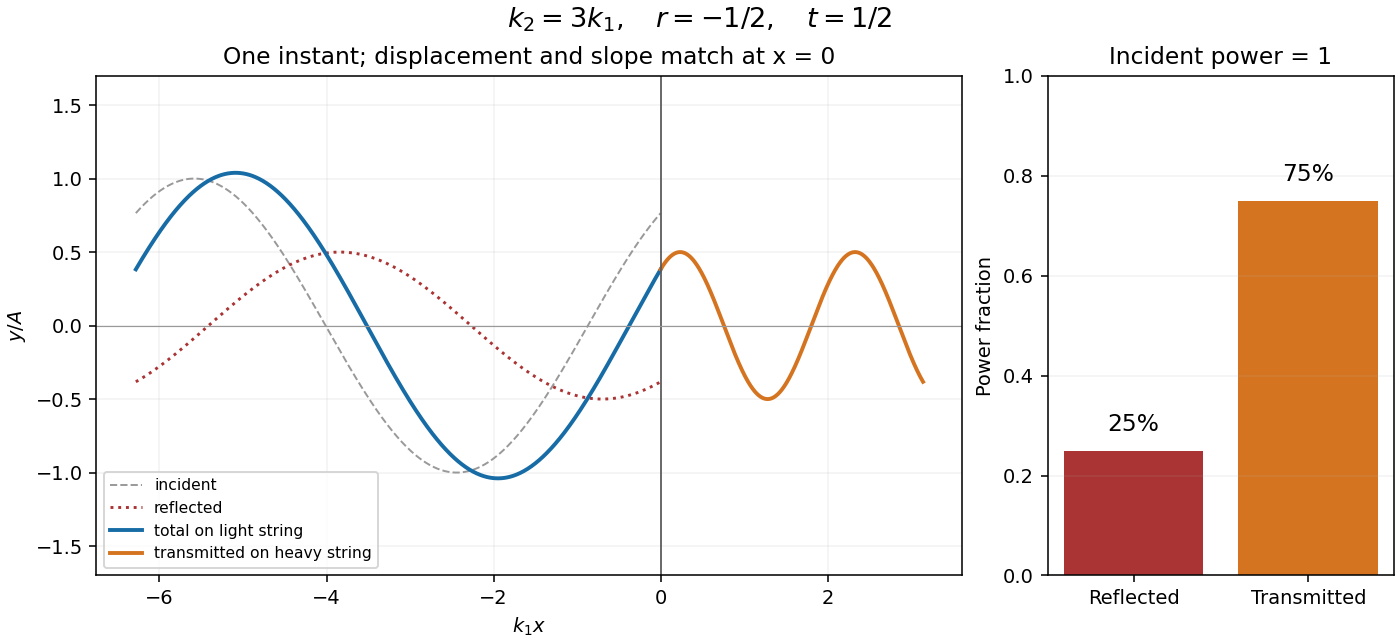
At the same tension, , so , and . The transmitted power fraction is not , because the two strings have different wave impedances. Using the energy flux of a transverse string wave,The reflected fraction is , so . The transmitted displacement amplitude is and its wavelength is . The negative indicates a reflected phase reversal; it does not mean negative reflected energy.
Write the complex displacements as and . At a massless join, continuity of displacement and transverse force givesEliminating gives the displacement transmission coefficient and reflection coefficient,The angular frequency is shared across a stationary interface, whereas the wavelength changes. The equal-tension assumption is used in the slope condition.


Past exam of the mathematical methods II course of the University of Oxford 2015 12 c ii Solution 2026-10-25
Interpret the axis-directed route as successive coordinate-axis-parallel segmentsOn the first segment, , so the field vanishes. On the second, , so it again vanishes. On the last, , and only is nonzero, giving . ThusThe second and third segments are parallel to the corresponding global axes; they do not return to the global - or -axis before reaching the endpoint.
Past exam of the mathematical methods II course of the University of Oxford 2015 12 c i Solution 2026-10-25
On the specified parametrized curve, and . Substitution into the field gives . HenceThe line integral is thereforeBoth the field and the tangent vector must be evaluated along the curve; integrating one field component alone would miss two contributions.
Past exam of the mathematical methods II course of the University of Oxford 2015 11 e iii Solution 2026-10-25
If , then and the junction behaves approximately as a free end for the incident string. The limits areThe reflected displacement is not inverted, and at the junction it adds in phase to the incident displacement, producing nearly twice its amplitude. The transmitted displacement is also in phase. A transmission amplitude near two does not create power: the lighter string has much smaller impedance, and . These are limiting statements for positive densities, not an ordinary propagating-wave model for an exactly massless second string.
Past exam of the mathematical methods II course of the University of Oxford 2015 11 e ii Solution 2026-10-25
If , then and the wave meets a much larger string impedance. The displacement and power coefficients approachThe junction behaves approximately as a fixed end. The reflected displacement reverses sign, corresponding to a phase shift of ; the small transmitted displacement is not inverted. For a large but finite density ratio, and the transmitted power fraction is about , tending to zero rather than vanishing identically at every finite ratio.
There are unlisted articles, also show them or only show them.