
Past exam of the mathematical methods II course of the University of Oxford 2015 11 e i Solution 2026-10-25
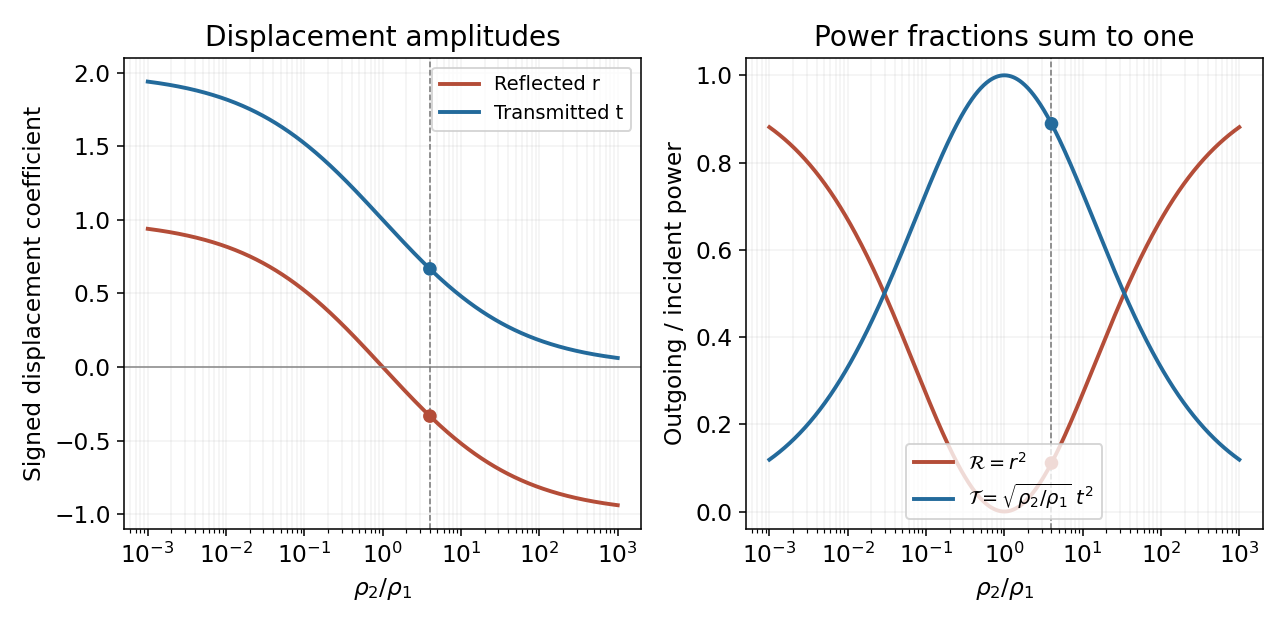
For equal linear mass densities and common tension, . The junction relations then giveThere is no mechanical-impedance discontinuity, so no reflected wave is needed to satisfy displacement and force continuity. The transmitted displacement is in phase with the incident wave and has the same amplitude; all incident power crosses the junction.
Past exam of the mathematical methods II course of the University of Oxford 2015 11 d ii Solution 2026-10-25
The reflected wave remains on the incident string, so its wavenumber magnitude is still . Its outward power magnitude isThus , verifying energy conservation. With signed positive- fluxes, and the same statement is . The minus sign of the reflected displacement is a phase reversal, whereas the minus sign of its flux records travel in the opposite direction; these are different uses of a sign.
Past exam of the mathematical methods II course of the University of Oxford 2015 11 d i Solution 2026-10-25
The transmitted and incident waves have the same angular frequency and tension, but the transmitted wavenumber is twice as large. The time-average string-power formula therefore givesThe extra factor is essential. Squaring the displacement transmission coefficient alone would give , which is not the transmitted power fraction in strings with different linear mass densities.
Past exam of the mathematical methods II course of the University of Oxford 2015 10 a iii Solution 2026-10-25
With the same positive displacement convention for both masses, the first eigenvector equation is . At the symmetric frequency it reduces to , while at the antisymmetric frequency it becomes . HenceIn both normal modes the displacement magnitudes are equal. For the first, the masses move in phase and their separation stays unchanged; for the second they move in opposite phase, alternately approaching and separating. A negative signed amplitude ratio records a phase difference of , not a negative displacement magnitude. The left panel of the later figure plots these signed normal mode shapes with the fixed wall values included.
Past exam of the mathematical methods II course of the University of Oxford 2015 10 a ii Solution 2026-10-25
Put and . The mass-normalized stiffness matrix isIts symmetric eigenvector has eigenvalue , while its antisymmetric eigenvector has eigenvalue . ThusThe symmetric frequency does not depend on the middle spring constant because that spring has no extension in an in-phase normal mode. The antisymmetric motion stretches the middle spring and has the higher frequency for .
Past exam of the mathematical methods II course of the University of Oxford 2015 10 a i Solution 2026-10-25
Let be displacements from equilibrium, with positive directions chosen alike. Hooke's law and Newton's second law giveFor a normal mode , the determinant condition isSolving the quadratic for givesThe angular frequencies are the positive square roots. Positive masses and spring constants make the stiffness quadratic form positive definite, ensuring both squared frequencies are positive. Distinct spring constants do not require equal masses or any symmetry approximation.
On , the restricted function is . Its derivative is , so the turning points are . The restricted second derivative is , negative at zero and positive at . ThusThe corresponding points in the plane are and . Along the diagonal the derivative is , not a single arbitrary partial derivative; here , so their zeros and sign changes agree with the restricted-curve calculation.
On , the restricted function is , so changes from negative to positive at zero. HenceThe restricted second derivative vanishes there, but the quartic term determines the minimum. This does not contradict the two-dimensional saddle: values decrease along other directions, including the diagonal near the origin.
At an interior stationary point, a negative determinant of the symmetric Hessian matrix means its two eigenvalues have opposite signs. Along their eigenvectors the leading quadratic change has opposite signs, and the higher-order remainder cannot reverse these signs sufficiently close to the point. Hence the nondegenerate saddle condition isWhen the determinant vanishes, a saddle is still possible but is not determined by second derivatives alone: is a simple example. Thus these tests are decisive for nondegenerate stationary points, not an exhaustive classification from first and second derivatives of every smooth function.
At an interior stationary point, let , , and . The quadratic change in the Taylor expansion is negative in every nonzero displacement when the Hessian matrix is negative definite. Applying the minimum test to gives the sufficient nondegenerate maximum conditionsThe quadratic term then dominates the smaller Taylor remainder in a sufficiently small neighborhood, proving a strict local maximum. A vanishing determinant requires higher-order analysis instead.
For a twice continuously differentiable function, a finite second-order Taylor expansion about an interior point iswhere , , at that point. A differentiable interior extremum requires . For a strict minimum guaranteed by the quadratic term, the Hessian matrix must be positive definite. Completing the square gives . Thus sufficient nondegenerate minimum conditions areIf , the second-order test is inconclusive; for example has a strict minimum at zero despite a zero Hessian. The finite Taylor argument only needs regularity. The source's infinite Taylor representation additionally needs suitable analyticity: a smooth flat function, such as extended by zero at the origin, has every Taylor coefficient zero there but is positive nearby.
Past exam of the mathematical methods I course of the University of Oxford 2022 9 a iii Solution 2026-10-25
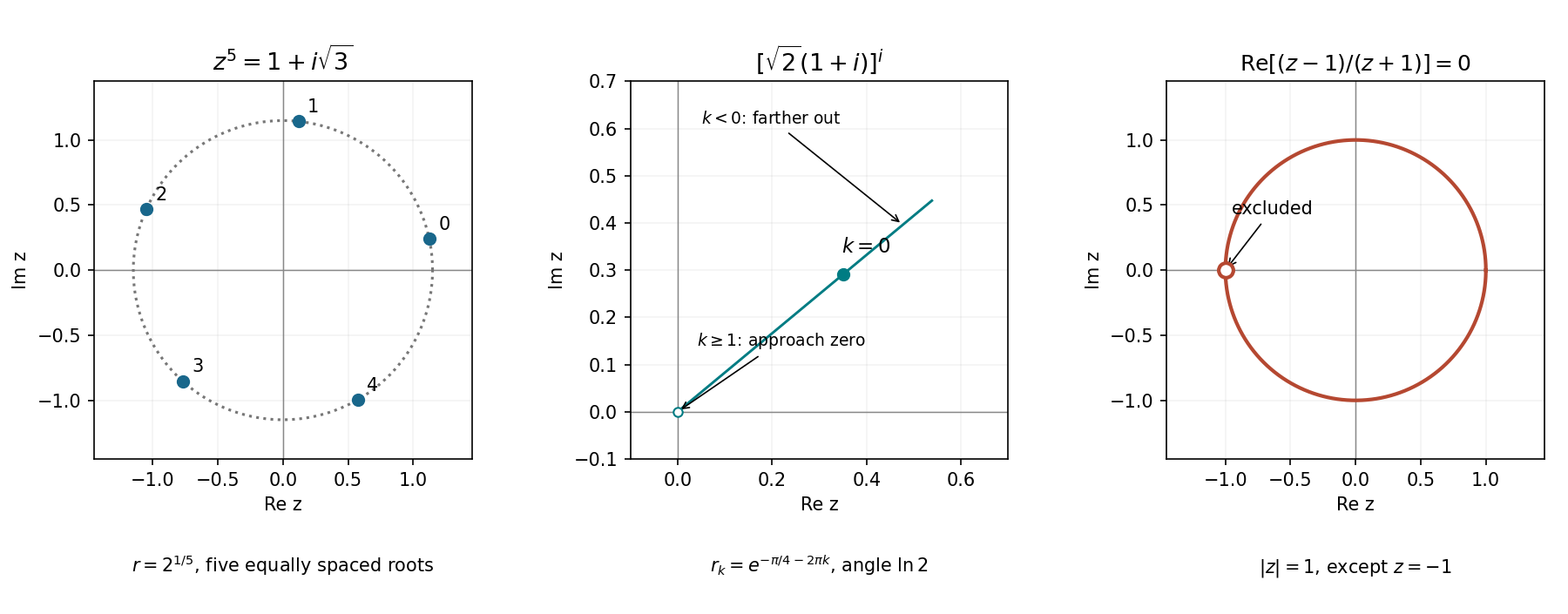
For , multiply numerator and denominator by . The real part isThus its zero locus isIt is the unit circle with the point removed. That point cannot be restored by the zero numerator obtained after clearing a denominator: the original expression is undefined there.
Past exam of the mathematical methods I course of the University of Oxford 2022 9 a ii Solution 2026-10-25
The base is . Its complex logarithms are , . Exponentiating times each logarithm gives all values of the multivalued power:The values form a discrete geometric sequence along the Argand ray of angle . Consecutive radii differ by . The origin is an accumulation point but is not itself a value. If the power is instead defined using the principal logarithm, only is retained. The phrase “all values” requires this branch distinction.
Past exam of the mathematical methods I course of the University of Oxford 2022 9 a i Solution 2026-10-25


Past exam of the mathematical methods I course of the University of Oxford 2022 8 b iii Solution 2026-10-25
Write , , and . Differentiating with respect to the two parameters givesFor nonparallel directions, . Solving this linear system yieldsThe quadratic being minimized is strictly convex in the two parameters under this nonparallel assumption, so the critical point gives the unique pair of closest points. Parallel lines do not select a unique value of .
Past exam of the mathematical methods I course of the University of Oxford 2022 8 b ii Solution 2026-10-25
For nonparallel direction vectors, let . Every joining vector has the same normal component, . Its norm is therefore at least the absolute value of that component. Minimizing makes it perpendicular to both directions, and hence parallel to , attaining the bound:The expression printed without absolute values is an oriented separation, not a nonnegative distance. Reversing either line's parametrization can flip its sign. For parallel nonzero directions, this normal is undefined and the distance is instead .
Past exam of the mathematical methods I course of the University of Oxford 2022 8 a ii Solution 2026-10-25
Assume and allow all . Put and . Every resulting vector is perpendicular to and has . Conversely, for and any perpendicular to with , chooseThe vector triple product gives , and . Thus every point of the closed disk centered at the origin, perpendicular to , of radius is attained. The boundary circle alone would omit allowed directions of . For the locus is the origin; for the original expression is undefined.
Past exam of the mathematical methods I course of the University of Oxford 2022 11 c ii Solution 2026-10-25
For , the reduced equation is . The constant forcing has particular solution one, while the resonant cosine requires . ThusThe secular factor is the signature of resonance. It must replace the divergent nonresonant coefficient ; substituting directly into that coefficient is invalid.
There are unlisted articles, also show them or only show them.