
Using the convention , the characteristic polynomial isSince for every , the only eigenvalue over the real numbers is . Solving givesThus the only eigenspace over the real numbers is the axis of the rotation.
Choose the rotation taking to , to and to itself. The columns of the matrix of a linear map are these images of the standard basis, soThis fixes the orientation used throughout this question.
A system of linear equations is solvable exactly when . If is one solution, thenso its solution set is , a translate of the kernel of a linear map.
For , the matrix is an invertible matrix, andEvery is in the image of a linear map and has exactly one preimage. For , its first two columns span the image of a linear map, while the corresponding homogeneous linear system gives the kernel of a linear map:The prescribed satisfies the displayed condition precisely when . If , it lies outside the image of a linear map and there is no solution. If , it lies in the image of a linear map, and the nonzero kernel of a linear map supplies infinitely many solutions.
For sufficiency, let be a basis of and suppose the kernel of a linear map is trivial. The vectors are linearly independent, since implies . Extend them to a basis of . Define a linear map byThen agrees with the identity operator on a basis, hence on all of . Thus a left inverse exists precisely when is injective; this is the linear left inverse criterion.
If , every would satisfy , so would be a surjective linear map. But its image of a linear map has dimension at most , whereas . Therefore no such exists. This is the obstruction to a right inverse: cannot reach every target vector.
Here . By the rank-nullity theorem, , and a dimension is a nonnegative integer. All three possibilities occur:The images of a linear map in these examples have dimensions , respectively, while the corresponding kernel of a linear map is , and . The identity above excludes all other pairs.
For , maximize the coefficient of . Its logarithmic derivative isIt changes sign once, at . The perpetual power put option therefore has candidate valueThe same boundary follows from smooth fit, . To establish optimality among all stopping times, rather than only fixed barriers, we verify the candidate. Let be the infinitesimal generator. The maximum property of gives everywhere, and for . For , set . ThenThus the discounted candidate is a nonnegative supermartingale. The smooth fit removes the derivative-jump local time of a semimartingale term in the Itô formula. The optional stopping theorem and localization bound every exercise policy's discounted expected value by . Immediate exercise attains it below ; the first hitting time of attains it above . The terminal remainder vanishes since . This proves the displayed value.
For it reduces to the ordinary perpetual put option. Larger lowers the optimal trigger, because the more strongly curved financial payoff makes further downward moves more valuable. If , under the risk-neutral measure the stock tends to zero almost surely, so the supremum is , approached as the exercise time tends to infinity and not attained at a finite time when . If , the values at deterministic exercise times grow without bound; the perpetual value is infinite. These cases do not admit the positive-rate formula above.
Assume , put and let . In the continuation region , the time-independent Black-Scholes equation is a Cauchy-Euler equation. Substituting givesSet . The two powers are and . The boundary condition as removes the growing solution; value matching at sets the coefficient. Hence the fixed-trigger value isFor the policy exercises immediately, giving . The quoted continuation expression alone does not apply below the exercise boundary. Equivalently, the discounted boundary-hitting representation gives , which multiplies the exercise financial payoff.
Write and . The European power put formula isHere has a lognormal distribution. Since is decreasing and is a convex function, its discounted expected value is also decreasing and convex as a function of . For it is smooth and strictly positive: the normal distribution assigns positive probability to whatever the current positive spot price. Its endpoints areThe dominated convergence theorem justifies the second limit, because . For a quantitative sketch, the binomial theorem and truncated lognormal moment givewhere is the standard normal distribution function. This finite sum is useful for drawing the curve; its positive expectation form makes its qualitative shape clearer.
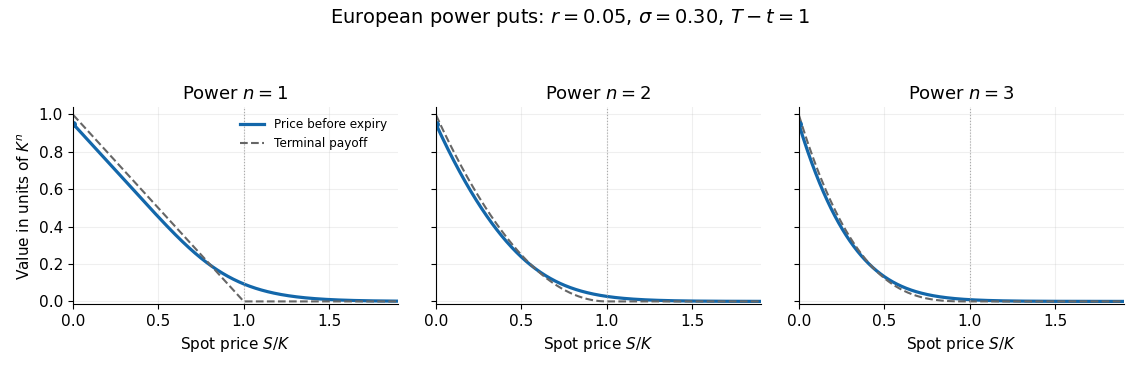

The solid curves use , , and ; the dashed curves show their terminal financial payoffs for comparison. Each price remains positive at and tends smoothly towards zero beyond it. At small , discounting gives a price below the undiscounted financial payoff; European exercise is permitted only at expiry.
The barrier-triggered put exercises at the particular stopping time . The American put option optimizes over all allowed exercise times, soIt can be strictly smaller, but can never exceed the American value. Equality is possible if immediate exercise is already triggered and optimal; a fixed barrier is not generally the optimal finite-maturity exercise rule.
The comparison with the European put option can go in either direction. By the early exercise premium for a fixed barrier,Thus an early payment gains interest but sacrifices remaining put time value; the expression inside braces need not have a fixed sign for arbitrary barriers.
For a concrete general construction take current spot , , , and . Set and , the perpetual put option exercise boundary. For , the perpetual value at equals and strictly dominates the finite-maturity European value. The premium formula and positive probability of hitting therefore give . Strictness follows from the perpetual verification argument: before a fixed positive expiry, its discounted value loses drift whenever the stock is below , with positive expected occupation time when started at .
Conversely, for sufficiently close to , every possible payment of the exploding put is at most , whether paid at touch or on surviving to expiry. Hence , while . This gives for such barriers, and also strict inequality below the American value.
These examples establish both possibilities in general, not a claim that every fixed initial state admits both. If and only alive barriers are allowed, all those barriers are in the same perpetual stopping region and the premium comparison is nonnegative.
If the barrier is reached, path continuity gives and the early payment is . If it is not reached, the terminal payment is exactly the down-and-out put payoff. When , moving a fixed payment from the hitting time to expiry does not change its value. Hence the barrier-triggered put price isHere are evaluated with zero interest rate. If the barrier has already been hit, the exploding put has been exercised and has no remaining value after its payment; the displayed replication concerns an initially alive contract and its cash flows.
A down-and-out digital call with strike at the barrier pays one exactly when the barrier is avoided until expiry. Reflection therefore gives its alive priceThe complementary contract pays one at expiry when the barrier has been hit. Its price isThis is a cash-at-expiry one-touch option, not cash paid at the first touch. After the barrier has already been hit, its price is regardless of the current spot. In particular this branch applies immediately for . Current spot alone does not encode the full path history.
Put . The Black-Scholes reflection symmetry maps to , which solves the same PDE. Their difference vanishes at . For at maturity the reflected argument is below , where the terminal function in part ii is zero. Thus the boundary and terminal data of the alive down-and-out put are satisfied:The killed-domain Feynman-Kac formula identifies this solution with the discounted payoff conditional on survival. For , or after any prior barrier hit, the actual price is zero. The reflected difference is a formula on the alive domain ; extending that algebraic expression to generally gives a nonzero, possibly negative function and is not a valid barrier-option price.
Let . While the contract is alive, the down-and-out put pays at maturity; a prior touch has already knocked it out.
The truncated terminal payoff can be represented by the ordinary European-price combinationAt maturity its three regions areIndeed it is zero below , equals between and , and is zero above . This supplies the terminal building block for reflection.
The zero-below-barrier property is a property of the terminal payoff. Before maturity, need not vanish for , because the ordinary European contracts can still finish above . The killed barrier option price, rather than this unrestricted European combination, is zero after a touch.
For a long position in the claim, hold shares and bank value so that claim plus hedge has zero initial value. The Black-Scholes equation and Itô's formula show that the total position is self-financing and its Brownian and drift terms cancel. Equivalently, the positive replicating portfolio holds shares and bond value .
Under the usual growth, integrability and admissibility conditions, no-arbitrage forces the claim price to be : a different price could be traded against the replicating portfolio. The qualification matters because an arbitrary formal PDE solution without a suitable financial class need not be a valid price.
For , Itô's formula givesMatch the Brownian coefficient with the self-financing portfolio by choosing the option delta and bond value . Equating drifts cancels the physical drift and givesThis is the pricing equation for a linear asset with additive noise. Its spatial domain is the whole real line, because the asset can be negative. In particular the diffusion term is , not . The derivation is delta hedging and does not impose a boundary condition at .
The portfolio value is . The self-financing condition means that changes in holdings are financed by trading within the portfolio, with no external infusion or withdrawal. ThusThe holdings are predictable and satisfy the usual stochastic-integrability and admissibility conditions; without admissibility, doubling strategies would spoil the intended no-arbitrage interpretation.
There are unlisted articles, also show them or only show them.