
If , the objective is zero at every feasible point, so every point of the ellipsoid is a minimizer. Suppose now . A minimum cannot be interior: a sufficiently small step in direction would remain feasible and decrease the objective. The boundary is active.
Forstationarity gives . A positive-definite symmetric matrix is invertible, and the minimizing sign has . Enforcing the boundary gives
For global optimality, use the inner product . The Cauchy-Schwarz inequality givesThe proposed point attains the negative of this bound. Thus the minimum is , and equality in the Cauchy-Schwarz inequality, together with the sign and boundary conditions, makes this minimizer unique when .
Use the LagrangianThe Lagrange multiplier equations areFeasibility makes , so . The second equation becomes , forcing and then . The constraint gradient is nonzero on the feasible set, so the multiplier calculation has no missing singular feasible point.
To verify the global minimum rather than just stationarity, eliminate :Equality holds exactly at or , with minimum value .
For the vector equation, the Jacobian matrix isWrite the updated coordinates as . The second equation of the multivariable Newton iteration gives . Substituting into its first linearized equation givesHence , and, whenever ,
Starting from gives . Every subsequent iterate remains on the diagonal, where this is exactly the scalar Newton root-finding iteration from (b). The value , so .
For , concavity again puts the tangent's zero at or above . Alsoso . After one scalar step the sequence therefore enters the invariant interval proved in (b). It converges to at least quadratically. If the vector error is measured in the Euclidean norm, then , so the scalar quadratic estimate also gives a quadratic vector estimate. The initial off-diagonal step causes no difficulty because its Jacobian matrix is invertible and lands exactly on the diagonal.
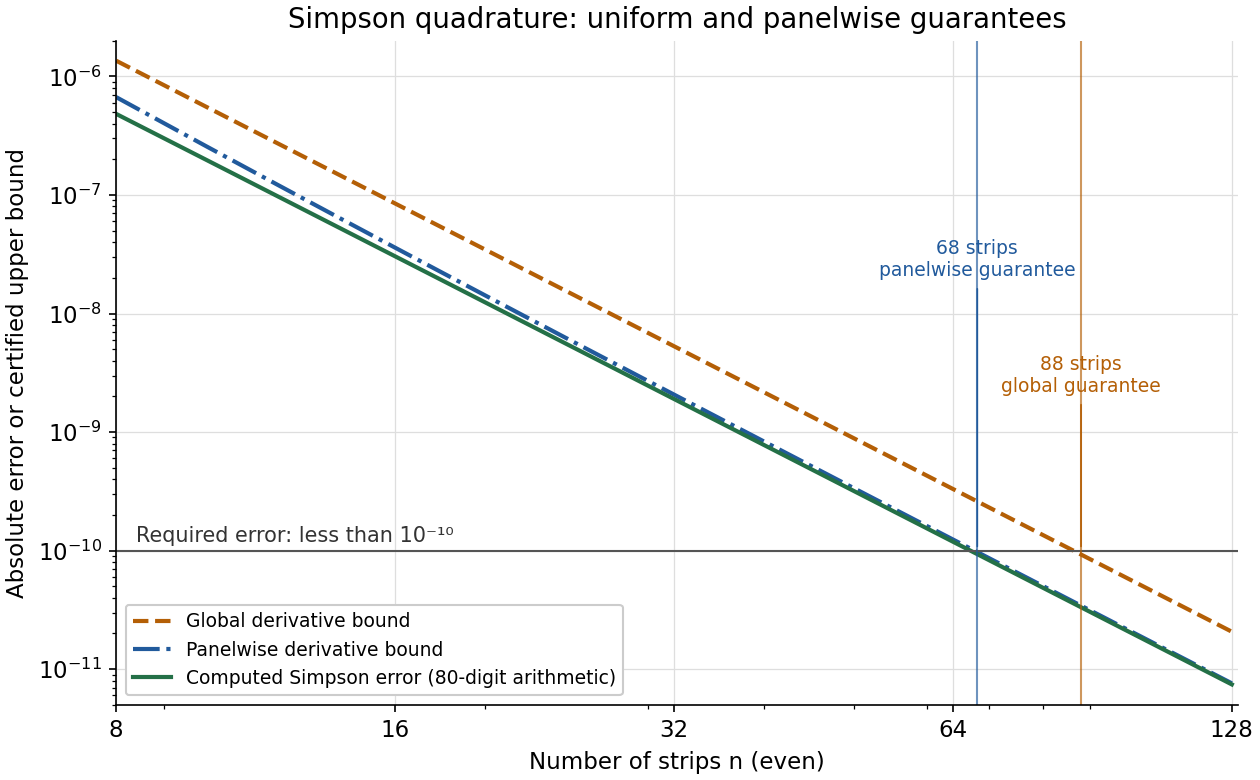
No: Monte Carlo integration is poorly suited to this smooth one-dimensional problem at such a tight tolerance. A sample-average Monte Carlo estimator has a standard error proportional to , whereas the deterministic composite Simpson's rule bound decreases as here and already certifies the target with tens of strips. Random sampling would require vastly more function evaluations and supplies a probabilistic error statement rather than the displayed deterministic guarantee.
The global bound requiresSince the strip count must be even, the smallest count certified by this bound is .
For the tighter bound, use the bisection method on the continuous extension for . The initial root bracket is valid: , while is below the global bound and hence below . To identify the smallest admissible even count, the monotonicity of can also be justified.
Put andFor , differentiation showsThe numerator is nonnegative because : its difference from starts at zero and has nonnegative derivative , by the arithmetic-geometric mean inequality. Thus , and . Therefore increases with , so is strictly decreasing with . Bisection locates its unique threshold crossing; then check the neighboring even integers, retaining the strict error inequality.
For example, and , so the tighter bound certifies strips. These are evaluations of the bound, not an assumption that it equals the actual quadrature error.

There are unlisted articles, also show them or only show them.