
Past exam of the symmetry and relativity course of the University of Oxford 2016 1 e Solution 2026-10-25
The magnitude of the electric force is , directed so that the electron gains energy. The work across the gap is . With the source precision ,Reducing the field by 20 percent gives kinetic energy andA large fractional energy change therefore produces only a small speed change, since the original electron is already highly relativistic.
Past exam of the symmetry and relativity course of the University of Oxford 2016 1 d Solution 2026-10-25
Let and . A constant laboratory three-force means , hence from rest. Using givesThe dimensionless time makes the shapes transparent: starts at one with zero slope and becomes asymptotically linear; starts linearly and approaches one without reaching it at finite time. The acceleration decreases as .
Integrating the velocity gives the distance along the force,Thus a constant three-force produces hyperbolic motion with constant proper acceleration , although its velocity is never Newtonian at large time. The following original curves supply the requested sketches.
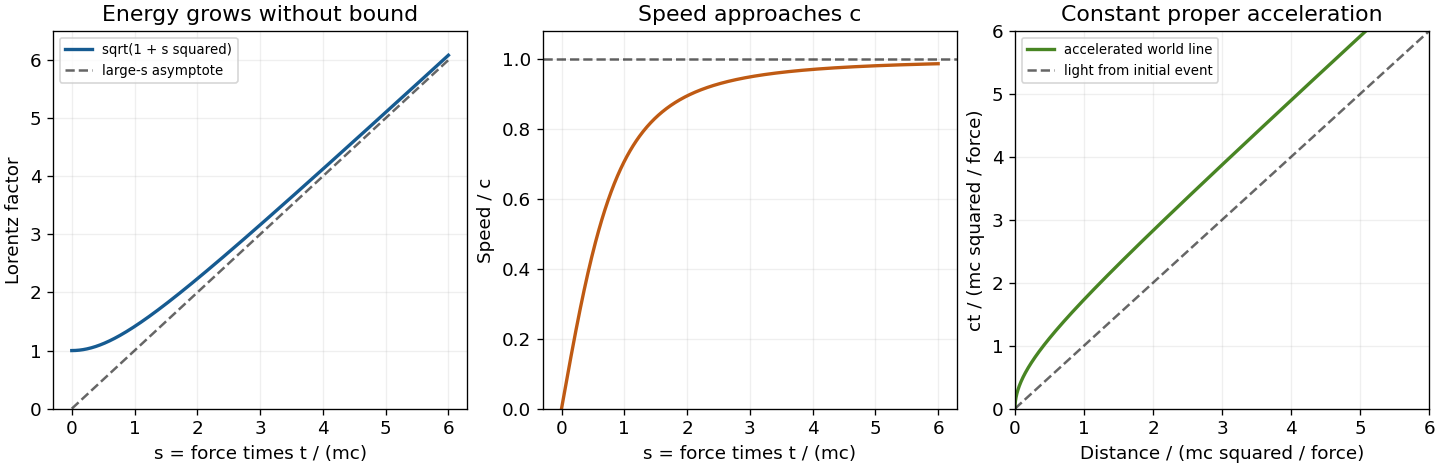
Lorentz factor, speed and world line for acceleration from rest under a constant laboratory three-force
. Details. Past exam of the symmetry and relativity course of the University of Oxford 2016 1 c Solution 2026-10-25
The proper acceleration is , the magnitude of the instantaneous rest-frame three-acceleration. A pure force is a four-force preserving rest mass, or equivalently satisfying . Indeed gives .
For the right-hand branch of the hyperbola, use , and , taking . Direct differentiation givesThe sign of follows the sign of , whereas the coordinate acceleration on this branch is positive. ConsequentlyThe proper-time parameterization , independently gives constant proper acceleration. Restoring dimensions, a hyperbola has . Constant proper acceleration does not mean that all inertial-frame components of the four-force are constant.
Past exam of the symmetry and relativity course of the University of Oxford 2016 1 b Solution 2026-10-25
The event separation is timelike precisely whenA simultaneous pair in an inertial frame would instead have . Since a Lorentz transformation preserves this interval, no such simultaneous frame exists. A timelike pair can be brought to the same spatial position: the required velocity is , whose magnitude is less than .
The separate condition says that the two event-position four-vectors, measured from the chosen spacetime origin, are orthogonal in the Minkowski inner product. It is invariant under Lorentz transformations about that origin but not under arbitrary translations. It is not a general criterion for their causal separation.
For a concrete example, put and . Their inner product vanishes, but their separation has squared interval , which can be positive, zero or negative. If is timelike, a rest frame for makes ; this means that and the chosen origin are simultaneous in that frame, not that and are simultaneous.
Past exam of the symmetry and relativity course of the University of Oxford 2016 1 a Solution 2026-10-25
For a massive particle on a timelike world line, proper time satisfies . Its four-velocity and four-acceleration are and . Differentiating givesThe invariant Minkowski inner products areFor the explicitly requested contraction,Thus four-acceleration is orthogonal to four-velocity. Equivalently this follows by differentiating the constant Lorentz scalar with respect to proper time.
Past exam of the symmetry and relativity course of the University of Oxford 2015 4 d Solution 2026-10-25
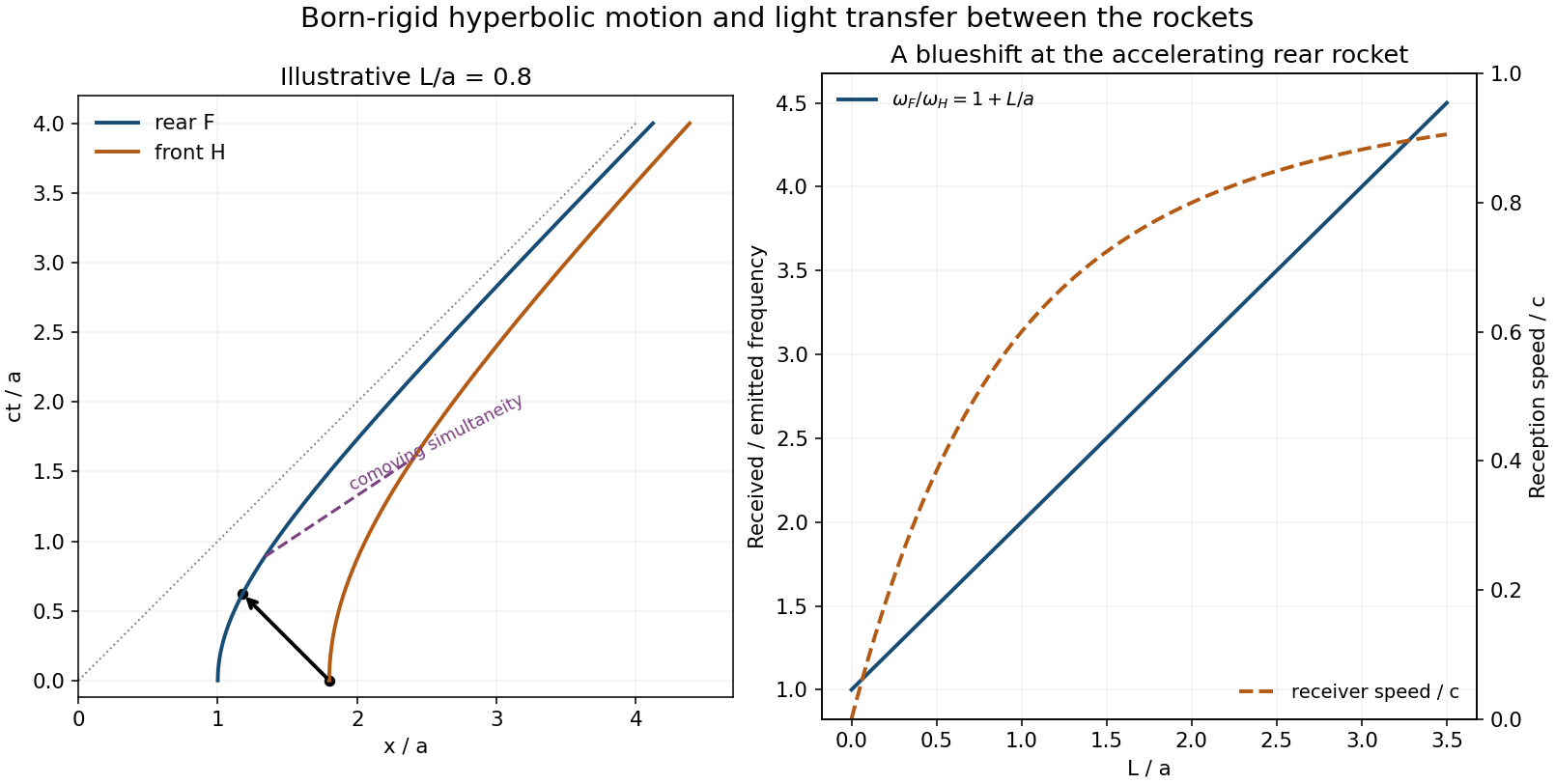
The photon leaves the front rocket at and moves toward decreasing , so its laboratory path is . Intersect it with the rear hyperbola, keeping the future root. Squaring and cancelling givesThe rear rocket's speed there isAt emission the front rocket is instantaneously at rest in S, so the photon laboratory frequency is . At reception the rear rocket moves in while the photon travels in . The Doppler factor for this head-on reception isThe receiver sees a blueshift. It is essential to use the front velocity at emission and the rear velocity at reception; comparing the two velocities at one laboratory time would describe the wrong pair of measurements. The result also agrees with the Rindler light-transfer frequency ratio for static accelerated observers at radii and . In the weak-acceleration limit , the shift is , and the arrival time approaches , providing useful checks.
Past exam of the symmetry and relativity course of the University of Oxford 2015 4 c Solution 2026-10-25
Take as a length. For the rear hyperbola,The implicit front event from iii has and . Eliminate the rear time to obtainThe rear proper acceleration is , while the front proper acceleration is . Thus Born rigidity in the acceleration requires the front rocket to accelerate less strongly. Their constant separation is measured on the tilted instantaneous-rest slices; their equal-laboratory-time coordinate separation decreases from rather than staying constant. At both rockets are at rest, at and .
Past exam of the symmetry and relativity course of the University of Oxford 2015 4 a Solution 2026-10-25
Maintaining a fixed separation in one inertial laboratory frame is not the same as maintaining a fixed separation measured locally with the accelerating rockets. The attached string is prevented from undergoing the laboratory contraction that an unstrained comoving string would have. It is therefore stretched and develops tensile stress: this is Bell's spaceship paradox, not a failure of Lorentz contraction.
For sufficiently prolonged acceleration and a finite elastic breaking strain, the string breaks. If an acceleration history produces only a small bounded increase in speed, whether it actually breaks depends on its material strength; the kinematic conclusion is stretching, not an unconditional assertion that every arbitrarily weak acceleration must snap every string. Stress also propagates through a real string at a finite speed. The construction enforcing Born rigidity in the following parts is a different set of trajectories chosen to keep the comoving separation fixed.
Past exam of the symmetry and relativity course of the University of Oxford 2015 3 d Solution 2026-10-25
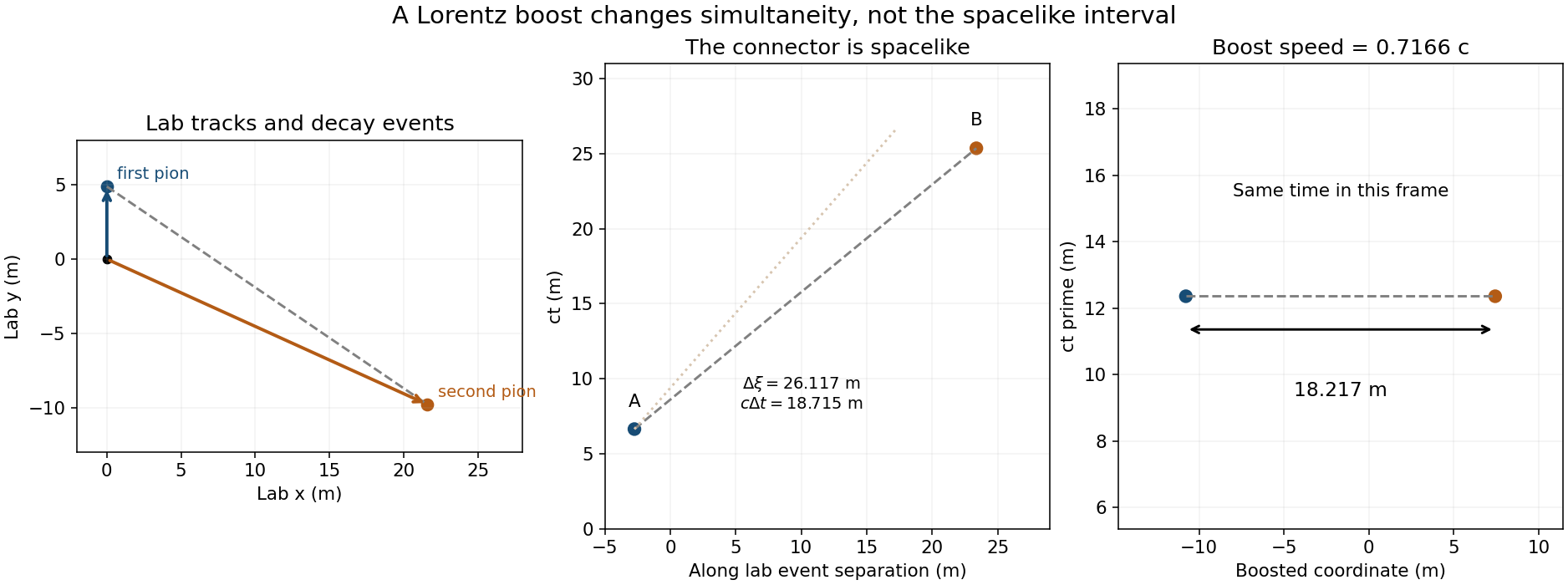
Take the kaon decay as the common origin. A pion traveling freely with constant momentum has lab decay time and position . The supplied proper survival times therefore giveConsequently the separation from the first decay event to the second isThe requested distance is the separation of the two events, not the sum of the two individual pion path lengths.
Here , so the separation is a spacelike separation. There is an inertial frame in which the events are simultaneous; in that frame their distance equals the invariant spacelike length:One such frame moves along with , of speed . The simultaneity condition is then .
The spacelike distance between daughter decay events provides an independent invariant check: the daughter four-velocity contraction givesIt produces the same distance without using the particular kaon laboratory boost. A simultaneous frame exists only when this expression is positive, as it is for these two survival times.
Past exam of the symmetry and relativity course of the University of Oxford 2015 3 c Solution 2026-10-25
Choose the kaon momentum along and the first pion along . Momentum conservation givesBoth pions have mass . Apply the on-shell condition to the second pion, using :Substitute and . The equal daughter masses cancel, leavingWith the supplied rest energies and MeV,The second pion travels below the parent axis, atReflection in the axis gives the equivalent opposite-sign configuration. The condition requires MeV for this perpendicular first-pion geometry. The given MeV lies within that range; the geometry cannot be extrapolated to an arbitrarily boosted kaon.


Past exam of the symmetry and relativity course of the University of Oxford 2015 3 b Solution 2026-10-25
The covariance of a selected particle momentum sum follows because, for a fixed set of particle four-momenta, their sum is a four-vector by linearity of the Lorentz transformation. Thereforeis invariant. The subset need not comprise the entire plasma, and its particles need not move together. This expression includes cross terms between different particles; it is not the sum of their individual rest-mass squares in a.
The comparison must use the same subset and the transformed four-momenta at the same chosen events. Selecting “the lowest-energy half” anew in each frame need not do that. For example, take four photons along , with energies in each direction. The two lowest in the original frame are an opposite pair and have invariant energy squared . After a boost at along , both forward photons are redshifted enough to become the lowest pair; that new collinear pair has zero invariant mass. This does not contradict covariance, because the subset changed.
If energies are resampled on a different simultaneity slice in an interacting plasma, they can also refer to different events. A physical conserved subsystem total must then include exchanged field energy and any boundary flux as appropriate. Such operational conservation requirements are distinct from the exact algebraic covariance of a sum of fixed four-vectors.
Past exam of the symmetry and relativity course of the University of Oxford 2015 3 a Solution 2026-10-25
Each on-shell particle satisfies . Thus for a selected subset ,It is Lorentz invariant when the same particle labels and physical states are compared, with each energy and momentum transformed as that particle's four-momentum. No requirement that the particles share a velocity is needed. Their energies can change under interactions while their individual fixed rest masses remain the same.
A frame-dependent rule for choosing “half” is more delicate: different subsets can have different sums of rest-mass squares. If every particle has the same rest mass and the number selected is fixed, however, the displayed sum is unchanged even if the selected identities change. In a massless plasma it is identically zero for every subset. The precise condition is constancy of the selected scalar sum, not a blanket claim that every frame-dependent selection must change it.
Past exam of the symmetry and relativity course of the University of Oxford 2015 2 d Solution 2026-10-25
First note that the supplied spin equation preserves : its electromagnetic bracket has contraction , and the remaining transport term cancels as in i.
For an explicitly electromagnetic acceleration, set and define . Antisymmetry gives , so the spin equation can be writtenContract with :The first term vanishes because a symmetric product of the two spin covectors contracts an antisymmetric tensor; the second vanishes by spin–velocity orthogonality. In the instantaneous rest frame , so is precisely the squared proper spatial-spin magnitude. It remains constant for arbitrary under this transport, though its direction can precess. In this equation is the dimensionless g-factor; the dimensional gyromagnetic ratio includes .
Past exam of the symmetry and relativity course of the University of Oxford 2015 2 b Solution 2026-10-25
Use and a constant Minkowski metric. Vary the velocity-dependent square root before imposing the proper-time normalization. Equivalently, vary a reparametrization-invariant worldline action first and then choose proper time. Its canonical covector momentum isThe coordinate derivative at fixed velocity is . The Euler-Lagrange equation and the chain rule from a therefore giveDefine the antisymmetric field tensor byThe particle equation becomesAntisymmetry ensures , so the force is orthogonal to the four-velocity and preserves . The worldline variation before proper-time normalization is essential: substituting into the Lagrangian before taking its velocity derivative would turn the kinetic term into a constant and incorrectly remove the inertial momentum. The normalization is a property of the proper-time solution, not permission to discard the variational dependence.
There are unlisted articles, also show them or only show them.