
Past exam of the symmetry and relativity course of the University of Oxford 2017 1 d Solution 2026-10-25
The equal and opposite incoming momenta make the laboratory the centre-of-mass frame. The initial total four-momentum is timelike. One outgoing photon would have null four-momentum, so an isolated two-body annihilation cannot produce exactly one photon. Two photons are kinematically possible and must have opposite momenta and equal energies:The quoted is the rest energy , not a mass in SI units. The energy balance includes both rest energies as well as the total kinetic energy.
Past exam of the symmetry and relativity course of the University of Oxford 2017 1 c Solution 2026-10-25
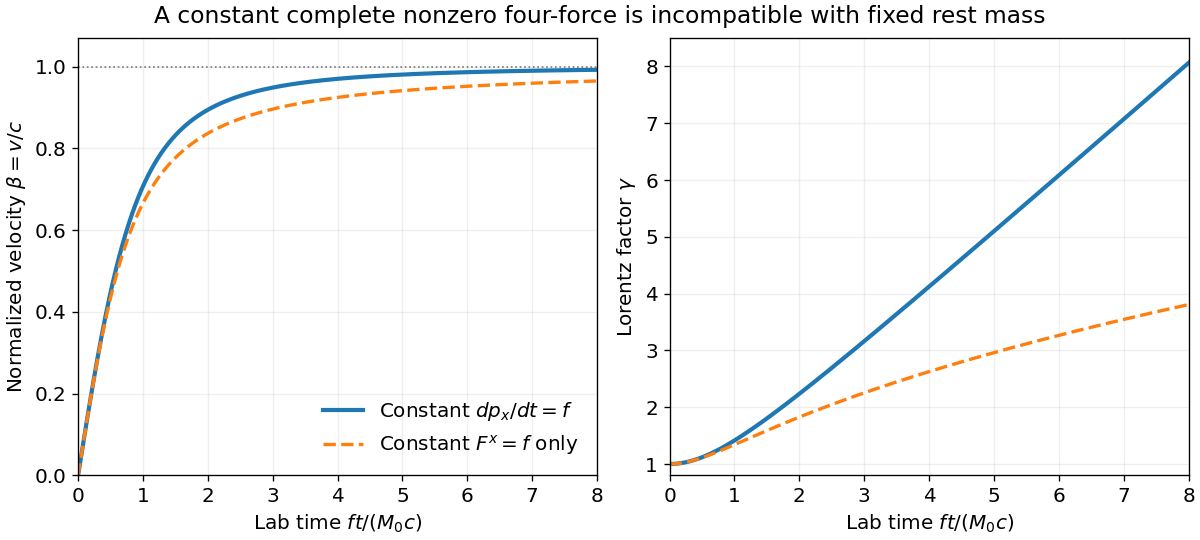
There is no nonzero, literally constant four-force that is a pure force throughout this motion. Initially , so purity forces . If the full four-vector were constant, ; its square would be , which cannot remain for a nonzero initially spatial . This is a genuine ambiguity in the source wording.
The usual consistent interpretation is constant laboratory relativistic force , equivalently constant one-dimensional proper acceleration . Take and let . Integrating momentum conservation with the applied impulse gives , soThe corresponding four-force has components , which are not constant, although its invariant magnitude is . Its temporal component is indeed . The speed rises from zero and approaches asymptotically; starts at one, initially rises quadratically and becomes linear in at late times.
If instead only the spatial four-force component is held constant, the distinct consistent answer is most simply parametrized by :This follows by integrating and . The temporal component must still vary. These two interpretations must not be conflated with a constant four-vector.

Past exam of the symmetry and relativity course of the University of Oxford 2017 1 b Solution 2026-10-25
Along a massive particle's world line, proper time satisfies . A pure force preserves its rest mass. Differentiating and givesso for a pure force. This is a restriction on rest-mass transfer, not a statement that its work in every frame vanishes.
Write . Since , the four-acceleration isIf , this reduces to , whenceHere is the proper acceleration. The positive expression printed in the source is in the opposite metric signature, or the squared acceleration magnitude in ours. For example, at rest with nonzero acceleration, has in our convention. Thus one must not combine the printed positive sign with a mostly-minus norm.
Past exam of the symmetry and relativity course of the University of Oxford 2017 1 a Solution 2026-10-25
For a massive particle on a timelike world line, the four-velocity is , with . Its four-momentum is and its four-force is . Here is proper time. A massless trajectory does not admit this massive-particle proper-time parametrization.
The asserted classification of arbitrary orthogonal vectors is false. With the chosen Minkowski metric, and are nonzero, orthogonal and both spacelike vectors. Also and are orthogonal null vectors. The valid statement is that a nonzero vector orthogonal to a timelike vector is spacelike. To prove it, choose the rest frame of the timelike vector, ; then forces , so .
The relativistic energy-momentum relation givesTherefore . A photon is an example: . A collection of photons need not itself have zero invariant mass.
Past exam of the symmetry and relativity course of the University of Oxford 2016 4 b Solution 2026-10-25
In the massive particle's rest frame, and the physical Pauli-Lubanski pseudovector is , up to a common overall sign. Their Minkowski inner product is therefore zero. Since it is a Lorentz scalar,in every inertial frame, for any nonzero scalar normalization of . This proves the requested orthogonality without a boosted component calculation.
The printed assertion that its particular normalization is always a unit vector needs qualification. For the displayed components ,Thus dividing by is unit spacelike only when , or when in that denominator is explicitly replaced by the proper rest-spin magnitude with correctly boosted components of . As a counterexample to the literal displayed normalization, choose with nonzero momentum: it gives , not . Orthogonality remains true, but it does not establish normalization.
Past exam of the symmetry and relativity course of the University of Oxford 2016 4 a Solution 2026-10-25
Take , and . ThenExpanding the cyclic derivative of produces six second derivatives, which cancel in pairs because partial derivatives commute. HenceThis Bianchi identity contains and . The inhomogeneous Maxwell equations areThe temporal component is , since ; the spatial components give . The source suppresses the coupling factor, as in units with or a rescaled current.
For the physical Lorentz force density on matter, the consistent tensor formula isIts temporal component is power transferred to matter per unit volume divided by . The printed expression has the opposite sign for the stated definition of in this convention. A stationary positive charge in a positive electric field is a concrete check: the physical upper spatial force is , whereas the printed expression, raised to an upper index, gives . It can represent the opposite momentum transfer to the electromagnetic field, but must not be identified with the force on the charge without changing a convention.
Past exam of the symmetry and relativity course of the University of Oxford 2016 3 d Solution 2026-10-25
For a forward wave, the Faraday's law of induction fixes the relative amplitudes and signs:Thus the two scalar amplitudes in the source cannot both be positive when the stated propagation direction and axes are used. The supplied product magnitude fixes only an overall amplitude in the chosen field units.
One convenient potential representative isIndeed gives the electric field and gives the signed magnetic field above. Moreover , the Lorenz gauge condition. The potentials are not unique because residual gauge transformations may preserve this condition.
Since , the electromagnetic electromagnetic field invariants satisfy and away from field nodes. A boost along positive with speed givesHere and . The wave becomes a static spatially varying magnetic pattern in this frame. This is possible because its medium wave four-vector is spacelike, ; it is not a vacuum-photon rest frame. The medium moves in the new frame, so its original rest-frame constitutive relation must not be reused there unchanged.
No inertial frame makes the magnetic field vanish throughout a nontrivial wave: that would turn the positive invariant into a nonpositive one. Both fields vanish at isolated nodes already, which is distinct from removing a field everywhere.
Past exam of the symmetry and relativity course of the University of Oxford 2016 3 c Solution 2026-10-25
Keep the unequal masses: equal and opposite velocities are not equal and opposite momenta. Write the rest energies , , , and let the incoming Lorentz factor of each particle be . ThenThe transverse photon has energy and no momentum. If the final composite has rest energy , squaring its four-momentum gives the exact constraintThe mixed term contains no longitudinal momentum contribution because the photon is transverse. For a specified final rest energy, the physical positive root isprovided it is real and at least one.
The source does not specify the composite rest mass or its binding energy. With the usual approximation that the lowest final rest energy is , the minimum incoming energy occurs at that lowest mass and isIf a hydrogen bound state is intended at precision sensitive to its binding, replace by its actual rest energy in the preceding equation; the mass cannot be inferred exactly from the phrase “single particle.” Higher composite excitation raises the required incoming energy on this branch. Setting initial total momentum to zero would give a different answer and contradict the stipulated equal-speed electron and proton.
Past exam of the symmetry and relativity course of the University of Oxford 2016 3 b Solution 2026-10-25
The phase velocity is the speed of a constant-phase surface, . The group velocity is the envelope speed of a narrow packet, , requiring a local dispersion relation rather than only a single monochromatic wave. In an isotropic transparent medium with ,For a vacuum wave, over the packet bandwidth, so both speeds are and . No superluminal signalling is implied by a phase speed in a dispersive material.
Past exam of the symmetry and relativity course of the University of Oxford 2016 3 a Solution 2026-10-25
Three useful observational phenomena are relativistic Doppler effect in spectral lines from approaching and receding ejecta, relativistic beaming through jet brightness asymmetry, and apparent superluminal motion inferred from successive radio images of moving knots. The first compares spectral frequencies with rest-frame lines; the second compares the two sides after accounting for intrinsic emission and absorption; the third tests the light-travel-time relation . NRAO's time sequence of Galactic microquasar ejecta gives a concrete example of the third measurement.[ref]
Microquasars in Our Own Galaxy by National Radio Astronomy Observatory. VLA time-series observations of GRS 1915+105 and explanation of apparent superluminal separation by subluminal jets directed toward the observer
These are tests of relativistic radiation kinematics when source geometry and environmental effects are controlled, rather than claims that any one redshift or brightness contrast by itself uniquely proves special relativity.
For the frequency transformation, a photon has wave four-vector with in vacuum. The temporal component of a Lorentz boost isThis is the relativistic Doppler effect: frequency changes both because of relative motion along the ray and because clocks in relative motion are time dilated. The angle here is measured in S. A frame chasing the photon redshifts it, ; a head-on frame blueshifts it. Transverse angles defined in different frames must not be interchanged.
Past exam of the symmetry and relativity course of the University of Oxford 2016 2 d Solution 2026-10-25
Let be the incident laser-photon energy and . The maximum in the usual soft-laser geometry occurs for a head-on encounter followed by a forward outgoing photon along the electron beam. Boost into the initial electron rest frame: the incident energy becomes . Backscattering there gives the Compton scattering recoil relation . Boosting this outgoing photon forward to the lab givesThe familiar limit additionally requires and . The denominator is the recoil correction, not an optional factor at arbitrary incident energy.
For completeness, if the incidence direction is prescribed rather than optimized, let its unit vector be and the outgoing direction . Squaring the residual electron four-momentum on its mass shell gives the more general kinematic relationThus an unspecified crossing angle must not silently be identified with head-on incidence; the boxed result is the maximum for the stated head-on soft-photon arrangement.
Numerically gives , and a photon has energy . The maximum scattered energy is , givingThe rest-frame incident photon is only about one electronvolt, so the small recoil correction is consistent with the amplification estimate.
Past exam of the symmetry and relativity course of the University of Oxford 2016 2 b Solution 2026-10-25
The initial momentum magnitude satisfies . Equality of longitudinal and transverse magnitudes therefore givesAn electric field along changes , while the magnetic Lorentz force only rotates the transverse momentum. Its magnitude remains fixed. At the longitudinal turning point , henceFor an electron initially moving toward positive , the decelerating field points toward positive because its charge is . The electric work over givesThe radius is determined by transverse momentum rather than total energy:so the requested radius plot is horizontal. The cyclotron angular frequency changes as and the helix pitch shrinks to zero. These statements neglect radiation, as stipulated.
Past exam of the symmetry and relativity course of the University of Oxford 2016 2 a Solution 2026-10-25
For a Lorentz boost of speed along , the velocity-addition formula formulas areSubstitute , and take the ratio. The common time-transformation denominator cancels, yieldingTo specify the direction rather than just its tangent, use . This keeps the correct quadrant when the boost reverses the sign of the longitudinal velocity. For physical subluminal speeds the canceled denominator is positive. At and nonzero , the transformed direction is perpendicular to the boost; if the particle is exactly comoving, its transformed velocity vanishes and the angle is undefined.
There are unlisted articles, also show them or only show them.