
Past exam of the symmetry and relativity course of the University of Oxford 2022 3 d Solution 2026-10-25
Let and in A. Each has Lorentz factor . The relative Lorentz factor of in the rest frame of follows from their four-velocity tensor contraction:Let be the relative speed divided by . In the rest frame of , take between the photon's propagation direction and 's velocity. The observed angular frequency is the invariant . Applying it to the emitter, whose rest angular frequency is , gives . Since ,This is a relativistic Doppler effect calculation using both emitters' and receivers' rest clocks; the time delay of reception introduces no extra factor for constant velocities.
For the direction in A, write the wave four-vector as , where is a unit vector. Equality of the emitted and received angular frequencies gives . Since the two laboratory Lorentz factors are equal, their time components cancel:Thus the complete answer in three spatial dimensions isIf propagation is additionally assumed to lie in the stars' motion plane, this reduces to either direction along the internal angle bisector, or from . Reflection exchanging the stars' laboratory velocities explains the angle bisector by symmetry. The source does not specify coplanar propagation or the stars' positions, so it does not fix the sign or exclude an out-of-plane ray. For example gives and satisfies the same no-shift condition. Initial positions can be chosen to make such a ray connect emission and reception. All these possibilities give the same rest-frame above.
Past exam of the symmetry and relativity course of the University of Oxford 2022 3 c Solution 2026-10-25
For , decompose the velocity as , parallel and perpendicular to . A rotation-free Lorentz boost gives the velocity-addition formulaThese two components are orthogonal, soThe last equality is Lagrange's identity for the cross product. For physical subluminal speeds, , givingThe case follows directly or by continuity. An independent form useful for checks is , obtained from the transformed four-velocity normalization.
Past exam of the symmetry and relativity course of the University of Oxford 2022 3 b Solution 2026-10-25
The Lorentz boost from A to B givesDivide each spatial displacement by . The velocity-addition formula isThe same result follows by transforming the four-velocity and using . The transverse velocities change because the transformed time increment depends on , even though the transverse spatial coordinates are unchanged.
Past exam of the symmetry and relativity course of the University of Oxford 2022 3 a Solution 2026-10-25
For a massive particle, the proper time is determined by the Minkowski interval along its worldline:Choose future-directed time increments. With the Lorentz factor ,We use for the source's to distinguish four-velocity from velocity . Since proper time is invariant and is a four-vector, is a four-vector, with . The rest-frame result follows immediately.
Past exam of the symmetry and relativity course of the University of Oxford 2022 2 d Solution 2026-10-25
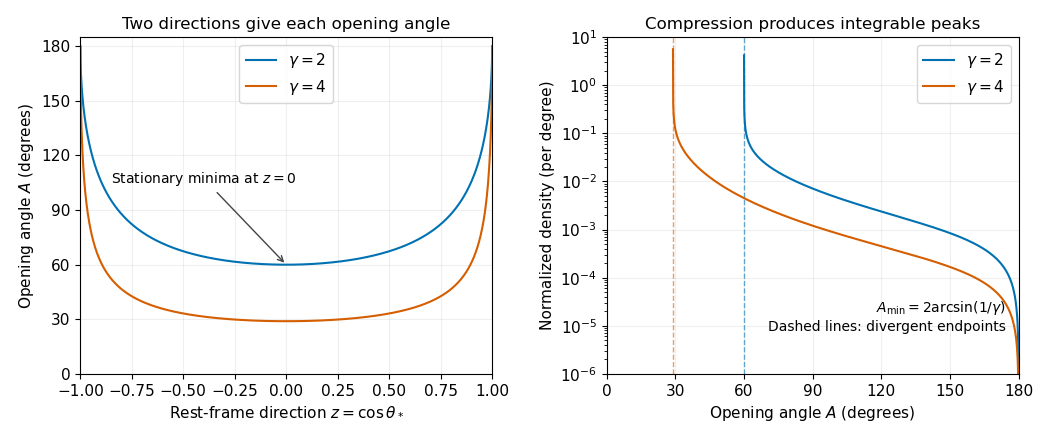
From c, , with equality when : the photons are emitted perpendicular to the Lorentz boost axis in the center-of-momentum frame. ThereforeAt the minimum, the map is stationary: writing , its leading behavior is . A nonzero interval of uniformly distributed is therefore compressed near , producing an integrable inverse-square-root singularity in the opening-angle probability density. No differentiation of that probability density is needed. For finite , the probability density vanishes at . For the center-of-momentum frame is the laboratory and every event has : the probability distribution becomes a Dirac delta distribution, rather than the singular substitution in c. At large , in radians.

Past exam of the symmetry and relativity course of the University of Oxford 2022 2 c Solution 2026-10-25
In the center-of-momentum frame, four-momentum conservation gives two opposite photon momenta, each of energy . Let , with the axis along the Lorentz boost from that frame to the laboratory. Reversing the axis specified in the source changes to and has no effect on the following product. The Lorentz transformation of four-momentum givesWriting , b now impliesThe isotropy assumption is on . Each interior opening angle has two inverse branches, and , both of which must enter the change of variables for probability densities. The positive branch has derivativeConsequently the diphoton opening-angle distribution isIts support is for , and its integral is , the integral of the original angular probability density before normalization. Thus the normalized probability density is . Omitting one inverse branch would incorrectly halve the total count.
Past exam of the symmetry and relativity course of the University of Oxford 2022 2 b Solution 2026-10-25
By four-momentum conservation, . With the Minkowski metric, the neutral pion has , while each photon has and . Taking the Minkowski norm givesThe half-angle identity therefore yieldsThis is a measurement of the diphoton invariant mass using two photon energies and their opening angle, independent of the neutral pion's laboratory velocity.
Past exam of the symmetry and relativity course of the University of Oxford 2022 2 a Solution 2026-10-25
Use and define the total four-momentum . For an inertial frame moving with velocity relative to the laboratory, the Lorentz boost givesChoose parallel to and require zero total three-momentum. ThenThis requires , so that the total four-momentum is timelike. Its invariant mass is , the total relativistic energy in the center-of-momentum frame. If all particles are exactly parallel photons, the total four-momentum is null and no finite-velocity center-of-momentum frame exists.
Sign qualification. The minus sign printed in the source describes the laboratory's velocity in the center-of-momentum frame, or the parameter of an active Lorentz boost with a plus-sign spatial rule. It is not the velocity of the center-of-momentum frame relative to the laboratory under question 1's passive convention. For example, a single particle with has its rest frame moving at . The printed would give , which is not zero. This explicitly resolves the sign rather than assigning a rest frame moving away from the particle.
Past exam of the symmetry and relativity course of the University of Oxford 2022 1 e Solution 2026-10-25
Let . The Lorenz gauge condition on the plane electromagnetic wave givesThe vacuum wave equation gives for a nonzero amplitude; equivalently and . Use the gauge transformation withBecause , this is a residual Lorenz gauge symmetry and . For a propagating plane electromagnetic wave, , so take . ThenThe second equality follows from . The electric field and magnetic field are unchanged by this gauge transformation. Thus Lorenz gauge permits a representative in radiation gauge; Lorenz gauge alone does not require the spatial amplitude of every representative to be transverse.
Past exam of the symmetry and relativity course of the University of Oxford 2022 1 d Solution 2026-10-25
The Lorenz gauge condition is . Substitute the electric potential and magnetic vector potential into Gauss's law:Next the Ampère-Maxwell equation, the curl of the curl identity, and the Lorenz gauge condition giveThe gradient terms cancel. Since , the time component obeys , so togetherThe four-potential can be chosen to transform as a four-vector. To make the argument rigorous, choose the retarded potential with no freely added homogeneous solution. If , this choice isThe retarded Green function is a Lorentz scalar under proper orthochronous Lorentz transformations, and is invariant. The four-vector rule for therefore proves . More generally, transform any homogeneous initial data by this same rule. Both the wave equation and the Lorenz gauge condition are then preserved.
Qualification. The wave equation by itself cannot prove the transformation rule for every independently chosen gauge potential: the d'Alembert operator has a nontrivial kernel of a linear map. For a concrete counterexample, zero sources and zero fields admit in one inertial frame and in another. Both satisfy the wave equation and the Lorenz gauge condition, but the latter is not the Lorentz transformation of zero. It is a residual Lorenz gauge symmetry, generated by . Thus the usual assertion is a covariant choice of four-potential, with a consistent gauge transformation and homogeneous data, rather than a uniqueness result from the displayed equation.
Past exam of the symmetry and relativity course of the University of Oxford 2022 1 c Solution 2026-10-25
Take the divergence of the Ampère-Maxwell equation and use that the divergence of a curl is zero:The last step uses Gauss's law. Thus the charge continuity equation is exactlyFor a direct justification that this four-current is a four-vector, take one locally comoving population of electric charges, with rest charge density and four-velocity . Invariance of electric charge and length contraction give and , hence . Summing populations preserves the four-vector rule. In particular, and . The Lorentz invariance of its four-divergence then explains why charge conservation holds in every inertial frame. A single zero-divergence condition alone would not determine a field's transformation law; the physical charge density and current density provide the additional content.
Past exam of the symmetry and relativity course of the University of Oxford 2022 1 b Solution 2026-10-25
The four-gradient rules from a giveThe Lorentz transformation coefficients are constant, so the partial derivatives do not differentiate them. This proves the Lorentz invariance of the d'Alembert operator:For example, the two longitudinal terms transform as , using and commuting partial derivatives. The transverse terms are unchanged. Applied to a scalar field, therefore gives a Lorentz scalar.
Past exam of the symmetry and relativity course of the University of Oxford 2022 1 a Solution 2026-10-25
Write the Lorentz transformation as . Acting on a scalar field, the chain rule gives the four-gradientFor the specified Lorentz boost, the inverse is obtained by changing to , soThese are precisely the covector component rules for the lowered coordinates. Raising the index with the Minkowski metric reverses the time component, yieldingIndeed and , the contravariant four-vector rules. Thus the index on a partial derivative with respect to an upper coordinate is lower.
Past exam of the symmetry and relativity course of the University of Oxford 2021 4 d Solution 2026-10-25
Let generate Lorentz boosts with the same exponential convention as the rotation generators of rotations . The Lie algebra of the Lorentz group isConsequently non-collinear Lorentz boosts do not close among themselves: the product contains a rotation, the Wigner rotation. For an explicit counterexample, in coordinates write , and similarly for . ThenA pure rotationless Lorentz boost has a symmetric matrix, whereas this product has spatial entries and for . It is therefore a concrete product of two pure Lorentz boosts that is not a pure Lorentz boost. Collinear Lorentz boosts are the special case that do form a one-parameter group, with additive rapidities.
Allowing all spatial directions and closure generates both the and, through their commutators, all . The smallest connected group containing all these Lorentz boosts is the proper orthochronous Lorentz groupIt contains arbitrary compositions of spatial rotations and Lorentz boosts continuously connected to the identity. It has six continuous parameters. Here “smallest” refers to the subgroup generated by all continuous pure Lorentz boosts, not to an arbitrary collection already including discrete reversals.
The full Lorentz group has four connected components, distinguished by the sign of the determinant and the direction of time. Representatives are the identity, parity , time reversal , and . ThusMultiplication by these discrete transformations relates the components algebraically; no continuous path within the Lorentz group joins different components. Translations are not required for closure here; adding them gives the larger Poincaré group.
Past exam of the symmetry and relativity course of the University of Oxford 2021 4 c Solution 2026-10-25
The supplied matrix obeysSeparate the even and odd powers in the matrix exponential to obtainIt fixes the component and is a counterclockwise active rotation viewed from . This sign differs from the clockwise convention in b, because the source fixes the sign of both and the exponential. Replacing by yields the clockwise rotation.
With , the generators of rotations obeyThe commutator measures the leading difference between performing two infinitesimal rotations in opposite orders. For example, with and ,The failure to commute is itself an infinitesimal rotation about the perpendicular axis; the Lie algebra closes on the same three generators of rotations.
To pass from this local statement to the full group property, put . These are real antisymmetric matrices, with . The Baker--Campbell--Hausdorff formula shows locally that the logarithm of a product of their exponentials remains a linear combination of the , because all nested commutators do. Globally, each exponential has and . If have these properties, thenEvery real three-dimensional orthogonal matrix of determinant has an eigenvector with eigenvalue : its nonreal eigenvalues come in conjugate pairs, and the product of all three is . On the perpendicular plane it acts as a two-dimensional rotation. It therefore has axis-angle form and can be written . Thus the product is again a rotation. The identity is , the inverse reverses , and associativity comes from matrix multiplication. This proves that all these rotations form the special orthogonal group . The commutator supplies local closure, while the orthogonality and axis-angle argument supplies the necessary global step.
Past exam of the symmetry and relativity course of the University of Oxford 2021 4 b Solution 2026-10-25
For an active clockwise rotation of column vectors in the usual oriented plane, takeDirect matrix multiplication givesThus the rotation matrix is an orthogonal matrix, preserving the Euclidean inner product, with determinant .
For a passive one-dimensional Lorentz boost, use rapidity , :This is not unless . Hence a nontrivial Lorentz boost is not an orthogonal matrix for the Euclidean inner product. Instead it preserves the Minkowski metric:by . Thus it is pseudo-orthogonal. The zero-rapidity identity is the explicit exception to the assertion that a Lorentz boost is not orthogonal.
Past exam of the symmetry and relativity course of the University of Oxford 2021 4 a Solution 2026-10-25
A symmetry is a transformation of a physical system that preserves its laws: it maps admissible solutions and consistently transformed data to admissible solutions. The central symmetry of special relativity is Lorentz invariance, expressing equivalence of inertial frames and preservation of the Minkowski interval and the universal speed of light. With spacetime translations included, the spacetime symmetry group is the Poincaré group.
A practical sufficient check is to express an equation as an equality between Lorentz tensors of the same type, with every repeated upper/lower pair correctly contracted and the same free indices on both sides. Every ingredient, including sources and background fields, must have its stated Lorentz transformation rule. For example, is a Lorentz scalar equality, and equates four-vectors. Such manifest Lorentz covariance makes the form of the equation the same in every inertial frame.
This is a sufficient test when the transformation rules are genuine physical ones, not a guarantee from writing index symbols. A fixed preferred four-vector could make an equation formally covariant if it too were transformed, while its chosen physical background breaks Lorentz invariance. Conversely, an equation written in three-dimensional components can be fully consistent with special relativity, as the Lorentz force is, even when the covariance is not manifest.
Past exam of the symmetry and relativity course of the University of Oxford 2021 3 c Solution 2026-10-25
Let starred quantities denote the capacitor's rest inertial frame, , , and . Work in the uniform interplate region of an ideal parallel-plate capacitor, neglecting its fringing field of a capacitor. To transform from that rest inertial frame to a laboratory in which the capacitor moves along , use the positive-sign Lorentz transformationFor a purely electric field, the spatial block of the electromagnetic stress-energy tensor isThis is the negative of the Maxwell stress tensor: it has along the electric field and perpendicular to it. The stress contribution to energy transport in a moving capacitor is essential to the Lorentz transformation of the energy density and flux.
Plates parallel to . Choose and . The electromagnetic field tensor and electromagnetic stress-energy tensor areThe transformed nonzero independent electromagnetic field tensor components are and . Thus and , consistent with . Transforming the electromagnetic stress-energy tensor givesIn particular, the laboratory Poynting vector is , and the electromagnetic energy density is . The ratio is subluminal for , but differs from the capacitor's velocity. The difference from a simple convective flux isThe extra term is , the rest-frame stress multiplied by the velocity. This shows why treating stored field energy as an unstressed parcel moving rigidly with the plates misses part of the energy transport.
Plates parallel to . Now . The rest tensors areThe electric field is parallel to the Lorentz boost, so remains unchanged and . The cancellation between and givesThere is no Poynting flux in the ideal interior in this orientation, although the region containing the electric field moves. The longitudinal negative stress contribution cancels the convective term: . Field energy is removed at the receding boundary and supplied at the advancing boundary by work on the charged plates; it need not flow through the interior to accompany the moving region. At edges, omitted fringing fields provide additional local structure.
For a finite idealized interplate rest volume , length contraction gives . The field-only integrated laboratory energies would consequently be and , with . Their different transformation laws are not paradoxical: the field alone is not a closed system. Include the plates and the supports holding them apart, whose mechanical stresses balance the Maxwell stress tensor. The total closed-system four-momentum then has the ordinary Lorentz transformation law. This is the same distinction between a subsystem and a conserved whole that appears in b.
Past exam of the symmetry and relativity course of the University of Oxford 2021 3 b Solution 2026-10-25
Use the electromagnetic field tensor convention stated above, and lower indices with the Minkowski metric . Lowering a single time index changes its sign. Summing both orders of each antisymmetric index pair gives the Lorentz scalarFor , and . Direct substitution in the printed electromagnetic stress-energy tensor yieldsFor a spatial index , and . HenceThus the full top row isHere is the electromagnetic energy density and the Poynting vector, using . By the symmetry , these components describe both energy flux divided by and times the electromagnetic momentum density . Keeping the factor is essential because the time coordinate is .
There are unlisted articles, also show them or only show them.