
Past exam of the symmetry and relativity course of the University of Oxford 2021 2 c Solution 2026-10-25
For an ultrarelativistic particle, relativistic beaming concentrates the synchrotron radiation within an angle of order around its instantaneous velocity. A fixed viewing direction in the orbital plane receives an intense signal only when the tangent sweeps through that direction. One electron, or one sufficiently short bunch, therefore produces one pulse per revolution, separated by . Several bunches produce the corresponding additional pulses per revolution.
The time during which the velocity points within that cone is of order , but this is the emission interval. If is the arrival time at a distant detector,Near alignment, . Thus synchrotron pulse compression reduces the observed duration by a further factor of order :A more explicit geometric estimate chooses the cone edges . With , along the line of sight, the difference in arrival-time compression for a moving source isThe order-one coefficient depends on how pulse width is defined; the robust scale is . The usual central-cone estimate gives . These estimates agree on the attosecond scale and must not be confused with .[ref]
Synchrotron Radiation by Richard Fitzpatrick. §12.22, equations (1979)–(1981): distinction between emission interval and detector arrival interval
Bunch qualification. The source says only that the bunches are short, without their longitudinal length . Different electrons pass the same emitting tangent at times separated by up to about , with essentially the same path length from that tangent to the detector. The bunch-length broadening of synchrotron radiation means that the measured bunch envelope is the single-electron pulse convolved with the bunch's passage-time profile; its scale is generally at least of order , with additional detector bandwidth effects. For example, a bunch, very short compared with this ring, gives an approximately envelope, much longer than the single-electron duration. No unique numerical bunch-envelope width follows from the supplied data. The pulse argument also presumes that the accepted direction is tangent to the orbit; a direction far outside the orbital plane receives no comparable intense forward pulse.
Past exam of the symmetry and relativity course of the University of Oxford 2021 2 b Solution 2026-10-25
For uniform circular motion, the transverse Lorentz force supplies the change in direction of three-momentum:The magnetic rigidity relation gives . Using ,The coordinate centripetal acceleration is . For transverse acceleration, the magnitude of the four-acceleration, or proper acceleration, is . The supplied Larmor formula, in its proper acceleration form, therefore givesThe emitted power here is also the laboratory total emitted power: in the instantaneous rest inertial frame the dipole radiation pattern has zero net radiated three-momentum, so both emitted energy and elapsed coordinate time gain the same Lorentz factor on transformation. This does not assert that a directional detector flux is invariant.
Numerically , per electron, andThe synchrotron's radiofrequency accelerating system must replace this lost energy to keep and magnetic rigidity fixed over many revolutions. The fraction lost per turn is about , so a fixed-orbit calculation over one turn is self-consistent.[ref]
Synchrotron Radiation by Richard Fitzpatrick. §12.22, equations (1975)–(1978): transverse radiated power and energy per revolution
Past exam of the symmetry and relativity course of the University of Oxford 2021 2 a Solution 2026-10-25
Let be the point electric charge's world line, with proper time and four-velocity . For the field event , choose the retarded source event: is future-directed and null. Write , where . In the instantaneous rest inertial frame of that source event,Consequently the covariant expression matching this Coulomb potential isThe denominator is a Lorentz scalar, so the right-hand side is a four-vector with the required instantaneous-rest components. This describes the retarded potential in Lorenz gauge, with no added free electromagnetic wave. Lorentz covariance alone does not establish the boundary conditions or exclude additional terms depending on four-acceleration. The physical input is the retarded point-source solution of Maxwell equations: the potential at the retarded event depends on the instantaneous four-current, while its derivatives generate the acceleration field. Equivalently, evaluating the retarded source integral gives a Jacobian from the light-cone constraint; this fixes that input for arbitrary smooth subluminal motion.[ref]
Retarded Potentials by Richard Fitzpatrick. §1.7, equations (71)–(76): causal source integrals, with source quantities evaluated at retarded time
In any inertial frame, put and . Then , and the Liénard–Wiechert potential isDifferentiate using and , including the position and time dependence of the retarded time. For example, and . The resulting Liénard-Wiechert field isHere the dot denotes a derivative with respect to source coordinate time. The first term is the velocity or non-radiative field: it falls as and exists even without acceleration. The second is the acceleration or radiation field, falling as and transverse to . Its Poynting flux falls as , so its outward power integrated over a large sphere stays finite as its radius tends to infinity. The first term's squared-field flux instead vanishes in that limit. This large-distance distinction defines radiation; a moving near field can carry local energy without constituting radiation escaping to infinity.
Past exam of the symmetry and relativity course of the University of Oxford 2021 1 d Solution 2026-10-25
The laboratory remains the center-of-momentum frame. At the relativistic collision mass threshold, the two final W bosons can have arbitrarily small opposite momenta. The available relativistic energy is , soEach incoming particle must acquire about of kinetic energy, travelling about . Equality is the ideal kinematic threshold; a nonzero production rate needs energy above it. This estimate neglects acceleration losses and treats the W bosons with the supplied nominal rest mass.
A linear particle accelerator avoids repeatedly bending high-energy electrons and Positrons. This greatly reduces the bending synchrotron radiation loss, which at fixed bending radius grows approximately as the fourth power of the relativistic energy for a given particle species. Its useful collision energy can therefore be increased without the severe circular electron collider radiation penalty. The price is long structures or high accelerating gradients: each bunch normally passes once, requiring substantial beam power, fresh bunches, and very tight focusing for high luminosity. A circular particle accelerator reuses its accelerating structures and circulates bunches through many collisions, but needs a large ring and substantial radiofrequency power to replace synchrotron radiation losses. Heavier particles such as protons radiate far less at a given energy and radius, although a proton's constituent structure makes the hard-collision energy less sharply specified than in an electron-positron annihilation experiment.
Past exam of the symmetry and relativity course of the University of Oxford 2021 1 c Solution 2026-10-25
With the reversed electric field, reflection about exchanges the electron and Positron. They therefore meet there with equal and opposite momenta. Each travels , and the work-energy theorem gives its kinetic energy:Their combined kinetic energy is , while each total relativistic energy is . The laboratory is the center-of-momentum frame of the colliding pair.
Local four-momentum conservation in the electron-positron annihilation excludes one real photon: the incoming total four-momentum is timelike, with zero spatial component and positive energy, while a single photon's four-momentum is null and has . Two photons can balance their momenta by travelling in opposite directions, soThe equal photon energies follow from opposite equal momenta, not merely from sharing the incoming energy arbitrarily. Here . This is the free local annihilation idealization implicit in the question; significant momentum transfer to the external apparatus would change the kinematic system being considered.
Past exam of the symmetry and relativity course of the University of Oxford 2021 1 b Solution 2026-10-25
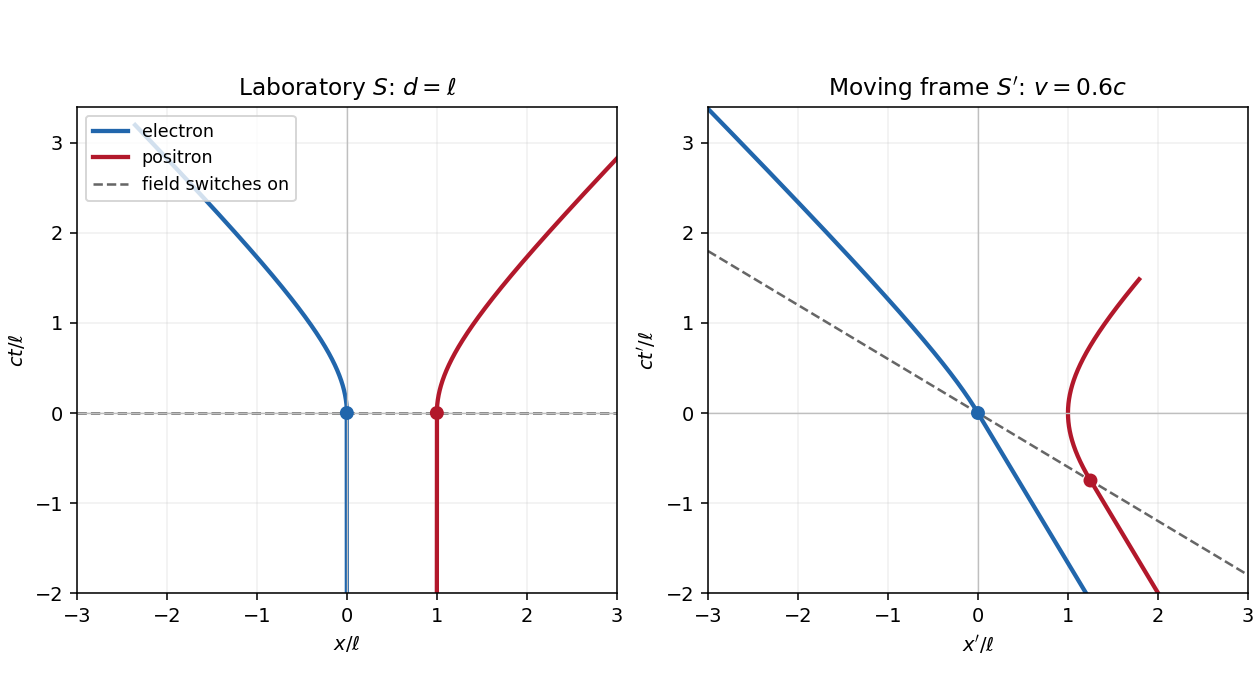
Write for the Lorentz factor of the inertial frame , distinguishing it from the particles' changing Lorentz factors. Apply the Lorentz transformationto each world line in a. Both particles initially have velocity in . The switching events have coordinatesThus the Positron starts accelerating earlier in . Its velocity first becomes less negative, vanishes when its laboratory velocity reaches , and then becomes positive. The electron continues at until , then accelerates toward . The relativistic velocity-addition formula makes this precise:The electric field parallel to the Lorentz boost has unchanged magnitude, but its switching surface is , rather than everywhere.
In the laboratory, the total three-momentum is zero for all : the two Lorentz forces cancel at equal laboratory times. In , each active force is still , since this is one-dimensional motion with a parallel electric field. Define . For the total three-momentum, evaluated at equal , isThis follows by integrating from its switching event and from its later switching event. During the interval between them only the Positron feels the prescribed electric field, so momentum conservation for the particle pair fails. Once both forces act, the total three-momentum is constant again.
The equal-time momentum of an externally driven particle pair illustrates a distinction. The sum of particle four-momenta at a fixed pair of events is always a four-vector. However, a fresh sum at equal time in each inertial frame generally uses different events. Here transforming an equal- laboratory sum would give , which varies with ; this differs from the equal- answer above. For example, with and , the late-time equal- sum is , whereas transforming the equal- sum gives . This is a concrete failure of treating the pair's equal-time sums as components of a single frame-independent four-vector.
A closed system's total four-momentum, including the electromagnetic field and the apparatus supplying it, is conserved and independent of the choice of spacelike integration surface under the usual isolated-system boundary conditions. The particles alone exchange energy and momentum with an external system, so neither that independence nor universal particle-only momentum conservation is guaranteed.
Past exam of the symmetry and relativity course of the University of Oxford 2021 1 a Solution 2026-10-25
Let be the magnitude of the electron's electric charge, , , and . The Lorentz force is , so the electron and Positron acquire opposite momenta:Using the relativistic energy-momentum relation, , and integrating from rest gives the world linesFor , the world lines are vertical at on a spacetime diagram. They join smoothly to the accelerated branches with zero initial velocity. At small , and ; at large , their velocities approach , respectively. Each accelerated world line is a branch of a hyperbola, since and . The electric field separates the opposite electric charges in this orientation. The asymptotes are lightlike, while every finite-time tangent is timelike.

Past exam of the symmetry and relativity course of the University of Oxford 2019 4 e Solution 2026-10-25
For a free massless Weyl spinor, yes: each component obeys the massless Klein-Gordon equation. In units, take either chiral Weyl equation, for exampleApply its opposite-sign partner. The Pauli matrix multiplication identity makes the antisymmetric part vanish against the symmetric pair of spatial derivatives, soThus componentwise. This does not turn the field into a scalar: its components still mix under a Spinor representation of the Lorentz group. The second-order equation is a necessary consequence of the first-order equation, but does not by itself impose the chiral helicity relation.
There is no unconditional massless-wave conclusion from merely being a two-component spinor, or from the null bilinear of part d. For example, has a null bilinear at every point, yet for . Massive free two-component chiral fields coupled through a mass term instead obey the massive Klein-Gordon equation; interacting fields can have additional terms. The affirmative result therefore uses the free, massless dynamics.
Past exam of the symmetry and relativity course of the University of Oxford 2019 4 d Solution 2026-10-25
Write . The Pauli matrices giveHenceTherefore , with for : the bilinear is a future null Lorentz four-vector, and gives the zero vector.
For , the transformed components are and . Thus , while the two squared magnitudes acquire factors and . Substitution givesThe matrix preserves the Minkowski metric and is an active boost along of rapidity , with velocity . Relative to the passive standard-boost convention of part i, its velocity parameter has the opposite sign.
For , and , so . ConsequentlyThis is an active right-handed spatial rotation through about . The minus sign follows from the specified positive exponent; the familiar positive-angle spin rotation uses . The doubled angle exhibits the Lorentz spinor double cover: and give the same four-vector.
Past exam of the symmetry and relativity course of the University of Oxford 2019 4 c Solution 2026-10-25
A relativistic two-component spinor is an element of a two-dimensional complex representation of the special linear group , the double cover of the proper orthochronous Lorentz group. A Weyl spinor transforms in either or ; parity interchanges the two chiralities. It describes a chiral spin- degree of freedom. A free massless Weyl field has one particle helicity and the opposite antiparticle helicity.
The number of components alone does not prove zero mass. A massive Dirac field has two coupled two-component chiral fields, and a nonrelativistic Pauli spinor describes the two spin states of a massive spin- particle. A Majorana mass term can also be written using a two-component field and its complex conjugate. Thus a single independent free massless Weyl equation is a dynamical assumption, not part of the bare algebraic definition of a two-component spinor.
Past exam of the symmetry and relativity course of the University of Oxford 2019 4 b Solution 2026-10-25
Restoring units, the decaying Yukawa potential is with range . For ,The geometric factor belongs in the potential ratio; the exponential alone is the additional suppression relative to massless exchange. Using givesThe following are ratios of potential magnitudes to the magnitude at , with the same coupling held fixed:
| Mediator | ||
|---|---|---|
| Massless scalar |
For example, the pion's nuclear exponential factor is , whereas the Higgs nuclear exponent is about . The huge atomic suppressions are most reliably reported through logarithms, not through floating-point exponentiation that silently underflows to zero. These are potential energy ratios, not force ratios or absolute comparisons of different interaction strengths.
Past exam of the symmetry and relativity course of the University of Oxford 2019 4 a Solution 2026-10-25
Use and the mostly-plus Minkowski metric. Then the source's Klein-Gordon equation is . For a plane wave , substitution givesThus a real propagating wave vector requires , or on restoring units. The positive-energy branch has a rest-energy threshold . At , ; frequencies below the mass threshold give evanescent spatial dependence rather than real-wave-vector propagation. Both signs of occur in the classical equation; a real scalar field combines complex-conjugate modes. Its group velocity is and is subluminal, though the positive-branch phase speed exceeds one when .
For a static spherically symmetric scalar field, the equation outside the source isSetting gives , soDecay at infinity selects , the Yukawa potential. It is singular at the origin and describes a point source distributionally; a source-free solution regular at the origin and decaying at infinity must be zero. For , , and decay sets the constant to zero.
Past exam of the symmetry and relativity course of the University of Oxford 2019 3 d Solution 2026-10-25
The scalar contraction of the electromagnetic field tensor isWith orientation , define the dual electromagnetic field tensor by . Direct substitution givesThe first is a Lorentz scalar; the second is a pseudoscalar, invariant under proper Lorentz transformations such as boosts and rotations. Under spatial inversion changes sign while does not, so reverses sign. For example, has product before inversion and afterwards. Thus the unrestricted statement including improper transformations needs this qualification.
For the spacetime integral, assume a globally regular electromagnetic four-potential on ordinary Minkowski space and sufficient boundary decay. Using and ,ConsequentlyThe magnetic helicity boundary term controls the integral. If its surface flux vanishes and the magnetic helicity vanishes at both temporal ends, thenCompactly supported smooth potentials are one sufficient version of the intended falloff assumption. The local identity is exact, but vanishing fields at spatial infinity alone is insufficient. For a concrete counterexample, take and, in dimensionless coordinates,where changes smoothly from zero to one and has compact temporal support. Both electric fields and magnetic fields vanish rapidly at spatial infinity, butThe counterexample leaves a final magnetic field and therefore fails the extra temporal boundary condition. It shows exactly why the printed integral cannot follow from a merely spatial reading of “at infinity”; vanishing of the full boundary term is the needed hypothesis.
Past exam of the symmetry and relativity course of the University of Oxford 2019 3 c Solution 2026-10-25
Use and the mostly-plus Minkowski metric fixed in part a. The electromagnetic four-potential and its covariant form areDefine the electromagnetic field tensor by . Since and ,Raising both indices changes the signs of its time-space entries. The lower-index signs agree with [ref]; the signature and index placement must be kept consistent.
For a passive boost to a frame moving with , transform the tensor asFor example, and . Reading off all entries givesFor an arbitrary boost velocity , rotational covariance gives the Lorentz transformation of electromagnetic fieldsHere all velocities are in units. Equivalently the parallel components are unchanged and the perpendicular components have the cross-product expressions multiplied by .
Past exam of the symmetry and relativity course of the University of Oxford 2019 3 b Solution 2026-10-25
To prove the vanishing component theorem for a Lorentz four-vector, first suppose in every inertial frame. An infinitesimal boost along spatial direction gives . It too vanishes for every , so each . If instead a specified spatial component vanishes in every frame, spatial rotations first imply that all three spatial components vanish in a chosen frame, and a boost in the specified direction then forces . ThereforeA physical consequence is that conservation of energy in every inertial frame implies full four-momentum conservation: apply the result to the difference between outgoing and incoming total four-momenta.
The statement fails for general tensors. A nonzero antisymmetric rank-two tensor has in every frame, because antisymmetry is preserved. For an off-diagonal component, the nonzero Minkowski metric is another counterexample: in all orthonormal Lorentz frames, while is certainly not zero. The transformation law can preserve structural zero components without forcing the entire tensor to vanish.
Past exam of the symmetry and relativity course of the University of Oxford 2019 3 a Solution 2026-10-25
An invariant has the same value when the same physical event or state is described in different inertial frames. A conserved quantity has the same value as the physical system evolves, subject to its equations and isolation conditions. These are different comparisons. The invariant mass of a heated object can change with time, while an isolated system's conserved energy has different numerical values in boosted frames.
Under a Lorentz transformation , a Lorentz four-vector transforms asA covector transforms by the inverse matrix, . A general tensor has one corresponding factor for each index; for example,Contraction with the Minkowski metric produces Lorentz scalars; it does not by itself make those scalars conserved.
There are unlisted articles, also show them or only show them.