
Propositional interpolation 2026-10-14
If , eliminate the letters private to byEvery assignment satisfying satisfies one disjunct of . If an assignment satisfies , change only the eliminated letters to its witnessing assignment. The modified assignment satisfies and hence , whose letters were unchanged. Thus , and the propositional completeness theorem gives the two derivations. The interpolant uses only common letters; an empty common vocabulary is handled by logical truth constants.
For and initially pristine gas, and the formed stellar mass is . If a fixed initial mass function supplies surviving tracers per unit formed mass, then and until the current gas abundance. Complete exhaustion gives a uniform normalized metallicity distribution function on . This is uniform in linear metallicity, not in its logarithm.
Bipartite three-uniform hypergraph 2026-10-14
A three-uniform hypergraph is bipartite when its vertex set has a partition into two parts such that every hyperedge meets both parts. All such triples on parts of sizes number . For fixed total order this is maximized by balanced parts.
In a gauge-preserving regularization and consistent renormalization convention, the proper-vertex Ward-Takahashi identity in QED equates the vertex and electron wave-function renormalization constants. With and , the vertex coefficient gives , proving the displayed charge relation in . Gauge invariance restricts counterterms but does not forbid charge running.
Edge coloring as scheduling 2026-10-14
Suppose each job occupies two distinct resources for one whole slot, and each resource can serve at most one job in that slot. Make resources vertices and jobs edges. Two jobs conflict exactly when their edges share a vertex, so a valid schedule is a proper edge colouring. Each slot is a matching in a graph; the chromatic index is the minimum number of slots. The colour labels specify the slots, rather than physical colours. This model assumes all jobs are available initially, with equal duration, interchangeable slots and no additional conflicts. The school-timetable motivation in Graph Theory by Reinhard Diestel (author-hosted Colouring preview, opening paragraphs, pp. 123–124) uses this resource-pair interpretation.
Here is a complete example. Two technicians must each use three instruments once. Each job needs its technician and its instrument simultaneously. The six jobs are the edges of the complete bipartite graph :Within each , the two jobs use different technicians and different instruments, so is a matching in a graph. The three matchings in a graph together cover every job exactly once. Technician has three jobs, so fewer than three slots cannot suffice; the displayed schedule uses three. This is an optimal proper edge colouring with chromatic index three, witnessed by both a schedule and a resource-workload lower bound.
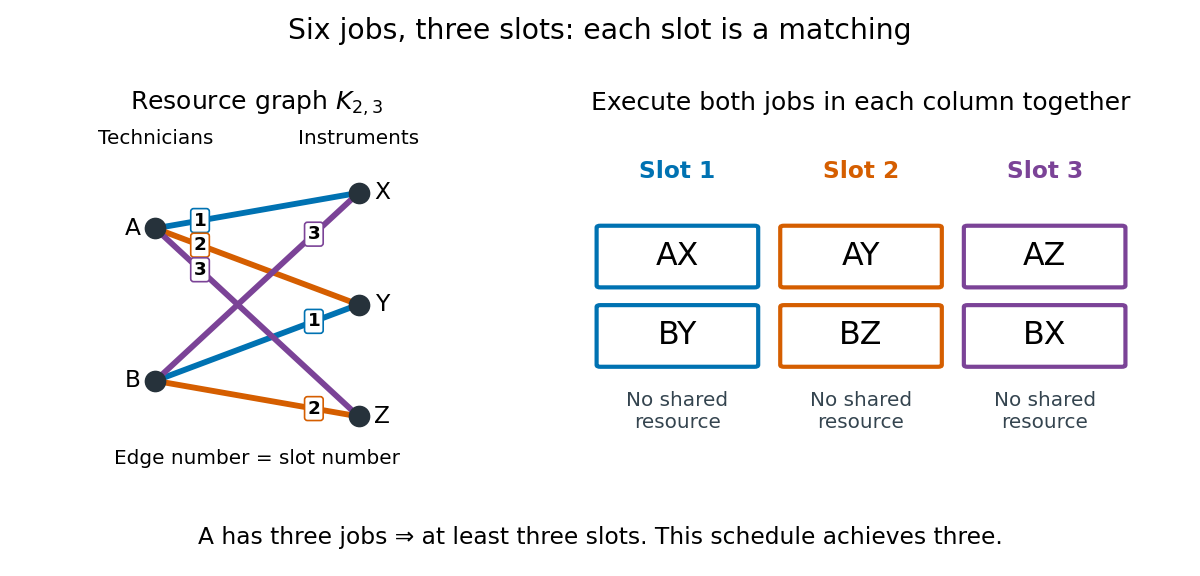

Repeated jobs requiring the same resource pair become distinct parallel edges of a multigraph, rather than one edge. Additional restrictions change the problem: prescribed allowed slots lead to list edge coloring, while unequal durations, deadlines, or jobs needing more than two resources require a richer scheduling model. Selecting a largest matching in a graph solves a single-round question; a shortest complete schedule must organize all jobs across rounds.
Projective embedding 2026-10-14
A projective embedding realizes a variety as a closed subvariety of projective space. A very ample line bundle gives such an embedding through its global sections.
Veronese surface 2026-10-14
The complete system of quadratic forms maps to a smooth surface of degree four in . The six coordinates are . It occurs as a degree-two image of a K3 surface and, after taking a projective cone, in the plane-quintic exception to the K3 linear system dichotomies.
The pullback of along a continuous circle homomorphism is a compact central extension of the circle. Its lifts commute: a scalar commutator is a continuous alternating bicharacter, which vanishes on a dense cyclic subgroup and hence everywhere. Average a rank-one positive operator over this compact extension. The resulting nonzero compact operator has a finite-dimensional invariant eigenspace, and commuting unitaries have a common eigenvector there. Its continuous character has central weight one; dividing the lifts by that character yields an honest continuous circle representation.
Top Ext detects finite projective dimension 2026-10-14
Let be a nonzero finitely generated module over a commutative Noetherian ring. Take a length- resolution with finite projective terms. If its top Ext functor with coefficients in vanished, the dual of its last injection would be surjective. The dual of a finite projective module is projective, so that surjection splits. Finite projective modules are isomorphic to their double duals, so dualizing gives a splitting of the original injection. The resolution then shortens, contradicting minimality of . When , a nonzero coordinate of a finite free module containing as a summand gives a nonzero map .
For the line-projectivization of a rank- complex bundle, . The Whitney sum formula for Chern classes gives as a formal power series. Comparing coefficients proves the formula. Since has rank , its degree- Chern class vanishes and yields the monic projective-bundle relation.
// Target: geometry-and-topology.bigb
Projectivization by quotients 2026-10-14
This convention for a projective bundle parametrizes one-dimensional quotients of the fibres of a vector bundle . Its universal quotient is , and . Tensoring by a line bundle on the base leaves the projective bundle unchanged but tensors its universal quotient by the pullback of that line bundle. The alternative convention of holomorphic projectivization by lines replaces by its dual and reverses the tautological sign.
The profinite topology on has basis the residue classes , . These classes are both open and closed, since their complements are finite unions of other residue classes. Set for . Then and every is nonempty. An integer in their intersection would make divisible by every , forcing , impossible. Thus the open complements form an increasing cover with no finite subcover. The topology is Hausdorff because distinct integers are distinct modulo a sufficiently large integer, but is not compact.
For a continuous function , is differentiable at zero with , because . At any nonzero point , is differentiable exactly when is: one direction uses the product rule, and the converse applies it to near .
Maximal external point 2026-10-14
A maximal external point of a finite set has no other point strictly larger in every coordinate. This weak nondominance differs from a maximal element in the product order when coordinate ties exist: for example passes the weak test against but is not maximal in the product order. In an independent continuous-coordinate random sample, ties have probability zero, so the two notions coincide almost surely.
Two isospectral manifolds remain isospectral after taking a Riemannian product with the same closed factor: eigenvalues add, with multiplicities given by the product Laplacian eigenspace decomposition. For nonisometric closed connected factors , choose . Every closed product geodesic of length less than has constant projection to , since a nonconstant closed geodesic shorter than the injectivity radius is impossible. The short coordinate geodesics of the small flat torus span exactly its tangent factor at every point. Any product Riemannian isometry must preserve that intrinsically defined smooth distribution and its orthogonal complement, hence restrict to an isometry of the original factors. Thus these products are still nonisometric. Taking to be four-dimensional tori proves the higher-dimensional stabilization statement without assuming a cancellation theorem for arbitrary products.
On the probability simplex, . The Cauchy-Schwarz inequality gives , with equality only when all coordinates are equal. Thus the displayed centroid is the unique closest point to the origin. It is also equidistant from all coordinate vertices, since .
Every abstract subgroup of finite index in a finitely generated pro-p group is open. Fixed-generator commutator collection in nilpotent groups makes the abstract commutator subgroup closed. The resulting abelian quotient is a quotient of a finite power of the p-adic integers, so its subgroup of th powers is closed and of finite index. Thus the algebraic is open and every abstract index- subgroup is open. An arbitrary finite quotient is a finite p-group; induction on its order, using a normal subgroup of index and the Schreier lemma, gives the assertion. The normal core reduces nonnormal finite-index subgroups to this case.
Uniform pro-p group 2026-10-14
A finitely generated powerful p-group in the category of pro-p groups is uniform if all successive indices in its lower p-series are equal. Equivalently it is torsion-free. If its generator number is , the successive indices are , the power map carries bijectively onto , and an ordered minimal generating set gives unique coordinates with in the p-adic integers. For , powerfulness means .
For a finitely generated pro-p group, its profinite Frattini subgroup has finite elementary abelian quotient. Continuous group homomorphisms to are precisely the linear functionals on this quotient. The topological generation criterion identifies a minimal generating set with a basis, giving the displayed equality. Finite generation is essential when generator number means the least cardinality of an unrestricted dense generating family.
Free pro-p group 2026-10-14
For finite , this is the pro-p completion of the free group on . Every function from to a pro-p group extends uniquely to a continuous group homomorphism. More generally one can require a basis tending to the identity and impose the universal property for maps with that convergence condition; alternatively the pro- completion of the abstract free group represents unrestricted maps from an arbitrary set. These infinite-rank conventions should not be conflated when interpreting generator cardinalities.
There are unlisted articles, also show them or only show them.