
Upward skip-free random walk 2026-10-14
An upward skip-free random walk has integer-valued increments bounded above by one. Arbitrarily large downward jumps are permitted, but a first crossing of a nonnegative integer level from below must land exactly at . This removes the overshoot from the stopped likelihood ratio under exponential tilting and permits the exact geometric maximum of an upward skip-free random walk. For a real threshold , the first crossing is the crossing of , so the overshoot-free formula must use that integer level.
In a random transposition shuffle on a six-cycle, the shorter circular distance between two distinguished labels takes values . The symmetry of the cycle and exchangeability of other labels make this a lumped Markov chain. Counting the fifteen possible transpositions gives transition matrix . Its stationary distribution is and , where each row of is this stationary distribution. Consequently the probability of opposite labels after steps from adjacent labels is .
Cumulant composition for a random sum 2026-10-14
For a random sum of independent claims, conditioning on the count gives and therefore the displayed cumulant-generating function. Write and . The chain rule gives , , and . In raw severity moments , the third cumulant is . Positive exponential moments justify two-sided differentiation near zero; finite ordinary moments alone suffice for the corresponding left derivatives when claims are positive.
Poisson-lognormal random-effect model 2026-10-14
Let , with . The lognormal distribution of the random mean gives marginal mean . The law of total variance gives , strictly larger than when . Thus independent observation-level random effects produce overdispersion even though the conditional Poisson distributions have variance equal to their means.
Ramsey number for triangles 2026-10-14
Every red-blue edge coloring of the complete graph contains a monochromatic triangle in a graph, and some coloring of contains none. Together the five-cycle Ramsey coloring and six-vertex monochromatic triangle argument giveThe threshold is exact: one carefully chosen coloring establishes the lower bound, while the upper bound must handle every coloring.
A familiar interpretation uses six people and colors each pair red if they know one another and blue if they do not. Assuming the relation is symmetric and every pair falls into exactly one case, there are either three mutual acquaintances or three mutual strangers. The conclusion concerns all three pairs within the group, not merely two relationships through a common person. There is no prediction about which color wins or which three people form the group.
The small size makes exhaustive verification practical. The complete graph has edges, giving red-blue colorings of labeled vertices; exactly 12 have no monochromatic triangle in a graph. They are the choices of a red cycle graph of length five, whose blue complement graph is another five-cycle. The complete graph has edges, giving colorings. Checking all triples in every coloring finds none without a monochromatic triangle in a graph; in fact the minimum number is two. These counts can be reproduced by assigning one bit to each unordered pair and testing whether the three bits of each triple agree. The monochromatic-triangle counting formula gives a separate explanation of the stronger minimum-two conclusion.
Let a power series have finite radius of convergence . If its terms were bounded in complex modulus at a point with , say , choose with . ThenThe comparison test for series with a convergent geometric series would give absolute convergence at , contradicting its position outside the convergence disc. Hence the terms are unbounded at every such . The argument also works when and gives a stronger obstruction than the usual term test for divergence.
Inside both convergence discs, the triangle inequality gives absolute convergence of the sum. Suppose and the sum had radius . At any modulus between and , subtracting the absolutely convergent second series from the absolutely convergent sum would give absolute convergence of the first series outside its radius of convergence, a contradiction. Interchanging the two series covers .
If the terms of a power series at a nonzero point are bounded by , then . A convergent geometric series and the comparison test for series give absolute convergence at every point strictly inside that circle. Consequently terms at every point outside the radius of convergence must be unbounded. This conclusion is stronger than merely saying that those terms fail to tend to zero.
Boundary convergence of a power series 2026-10-14
Knowing the radius of convergence does not settle convergence on its boundary. The three power seriesall have radius one, but behave differently on .
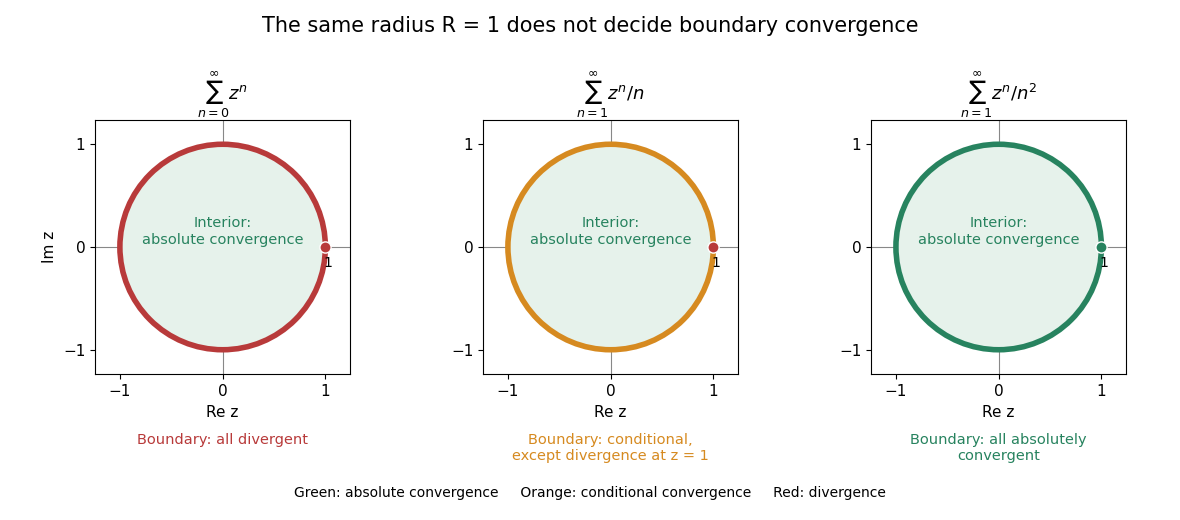
The same radius of convergence permits three different behaviours on the unit circle
. Green denotes absolute convergence, orange conditional convergence, and red divergence. All three series converge absolutely in the open unit disk. On its boundary, the geometric series diverges everywhere; the series converges conditionally except at ; the series converges absolutely everywhere. Details.
For the geometric series, boundary terms all have complex modulus one, violating the term test for divergence. For the second series, absolute values give the divergent harmonic series at every boundary point. At the series itself is harmonic and diverges. At any other point on the unit circle, its geometric partial sums obeyThe Dirichlet test with the decreasing sequence therefore gives conditional convergence. In particular, gives the negative of the alternating harmonic series, with sum . For the third series, the convergent p-series bounds the absolute values at every boundary point, giving absolute convergence by the comparison test for series.
At , the rational function is well defined and equals , yet its geometric series diverges there. A formula for a function and a particular series representation can have different domains. Likewise, applying termwise differentiation of a power series preserves the radius but need not preserve the boundary convergence.
Right radical of a bilinear form 2026-10-14
The right radical is . If is the matrix of a bilinear form, this condition is . For from the left radical example, the right radical is . The left radical and right radical differ here because the bilinear form is neither symmetric nor alternating. For a symmetric bilinear form or an alternating bilinear form, reversing a zero pairing preserves zero and the two linear subspaces coincide.
Left radical of a bilinear form 2026-10-14
The left radical is . If is the matrix of a bilinear form, this condition is , so its coordinate vectors form . For , the bilinear form has left radical .
For a negligible-mass ideal-gas envelope above a core of mass , with constant luminosity and Kramers' opacity law, division of hydrostatic equilibrium by radiative diffusion gives . Taking the outer pressure constant to be negligible yields , where , and . Hydrostatic equilibrium then gives , so with . The radiative-zero choice is exact for a vanishing-temperature boundary at infinity and a deep-envelope approximation for a very extended finite star. It is not implied by small surface temperature alone at a specified finite radius.
Radiative conductivity 2026-10-14
In the optically thick radiative diffusion in a star approximation, the heat flux is . The conductivity depends on opacity, mass density and temperature. It relates a material temperature gradient to energy transport and must not be confused with the emergent effective temperature.
Limiting absorption principle 2026-10-14
Select outgoing waves as a limit of a problem with weak absorption. With time convention use ; with use . The resulting Green function and transform-contour prescriptions determine which poles represent incoming or outgoing waves. This is especially useful when real-axis singularities obscure a Wiener-Hopf factorization.
Internal-wave envelope radiation condition 2026-10-14
For a slowly switched-on plane internal gravity wave in the half-space , the method of multiple scales gives transport of its amplitude at the vertical group velocity. For , . Initially undisturbed fluid and forcing at the bottom require . The outgoing radiation condition therefore selects when , although the vertical phase velocity is downward.
Integrated zero count 2026-10-14
Under the hypotheses of Jensen's formula, ensures that the radial zero-counting function vanishes for sufficiently small positive . Integrating each zero's contribution separately givesThe values of at its finitely many jump points do not change the integral. For , every zero in the smaller open disc supplies at least per unit of multiplicity of a zero, soThe second inequality bounds the circle log-mean of a holomorphic function by the logarithm of the largest boundary complex modulus, recovering the Jensen zero-count bound. An upper bound on boundary growth and a fixed nonzero centre value therefore constrain interior zeros. The factor also explains why the same estimate becomes weaker as the smaller radius approaches the boundary.
For constant adiabatic exponent and a star whose central mass density is its maximum, the homologous radial fluid displacement makes the derivative term in the weighted stellar pulsation Rayleigh quotient vanish. The remaining quotient is times a positive weighted average of . Since , , proving the bound. For , the same trial quotient is negative and proves radial instability; the inequality with the central density must not be extended with its sign unchanged.
Rademacher function 2026-10-14
On with Lebesgue measure, the functions , , are independent symmetric Rademacher random variables. Every prescribed pattern for the first functions occupies a dyadic interval of measure . Their closed span in is isomorphic to the l2 sequence space by the Khintchine inequality.
Canonical projection of a quotient set 2026-10-14
The canonical projection of a quotient set is the function . It is surjective: every set element of is for some . Two set elements have the same image exactly when they are related by the equivalence relation. Its fibers are precisely the equivalence classes:Here the left side is the preimage of a singleton subset of the quotient set; its members are the original set elements in the class . In the diagram, the three arrows arriving at start at , and .
For , a nonzero uniform real state with obeys . Real amplitude sidebands grow at , while phase sidebands grow at . The maximum amplitude growth coefficient is , attained at . Thus nonzero uniform states cannot have modulation bifurcations if the smallest allowed slow wavenumber exceeds . For a physical domain of length and , this gives . The zero state is an exception: it has sideband thresholds for every positive allowed wavenumber, so an assertion including all uniform states would be false.
There are unlisted articles, also show them or only show them.