
In take and . Then and , but has determinant and a negative eigenvalue. In contrast, for commuting positive elements is positive in the commutative function algebra supplied by continuous functional calculus. The obstruction is noncommutativity, not a failure of the scalar inequality.
Positive cone of a C-star algebra 2026-10-14
The positive elements of a C-star algebra form a norm-closed proper convex cone. For and , continuous functional calculus gives , forcing the real spectrum of to be nonnegative. The same bound with one fixed upper norm bound proves norm closedness under limits; scaling by nonnegative real scalars preserves positivity. If both and are positive, their spectra lie in , and spectral radius norm equality for normal elements forces . This cone defines the order precisely when .
Positive definiteness 2026-10-14
The strict positivity of a quadratic form on every nonzero vector. A real symmetric matrix has positive definiteness exactly when its associated quadratic form does, making it a positive-definite matrix. A Hermitian form is positive definite when its value on is real and strictly positive for every nonzero vector.
Think of a positive-definite quadratic form as an energy cost for a displacement: every direction costs something, and zero cost identifies the origin. For example, the real symmetric matrixis a positive-definite matrix because the two squares can vanish together only at . The mixed term couples the coordinates, but cannot overwhelm their positive contributions: and . The graph is a bowl, and its positive level sets are ellipses with axes along the eigenvectors, rather than along the original coordinates.
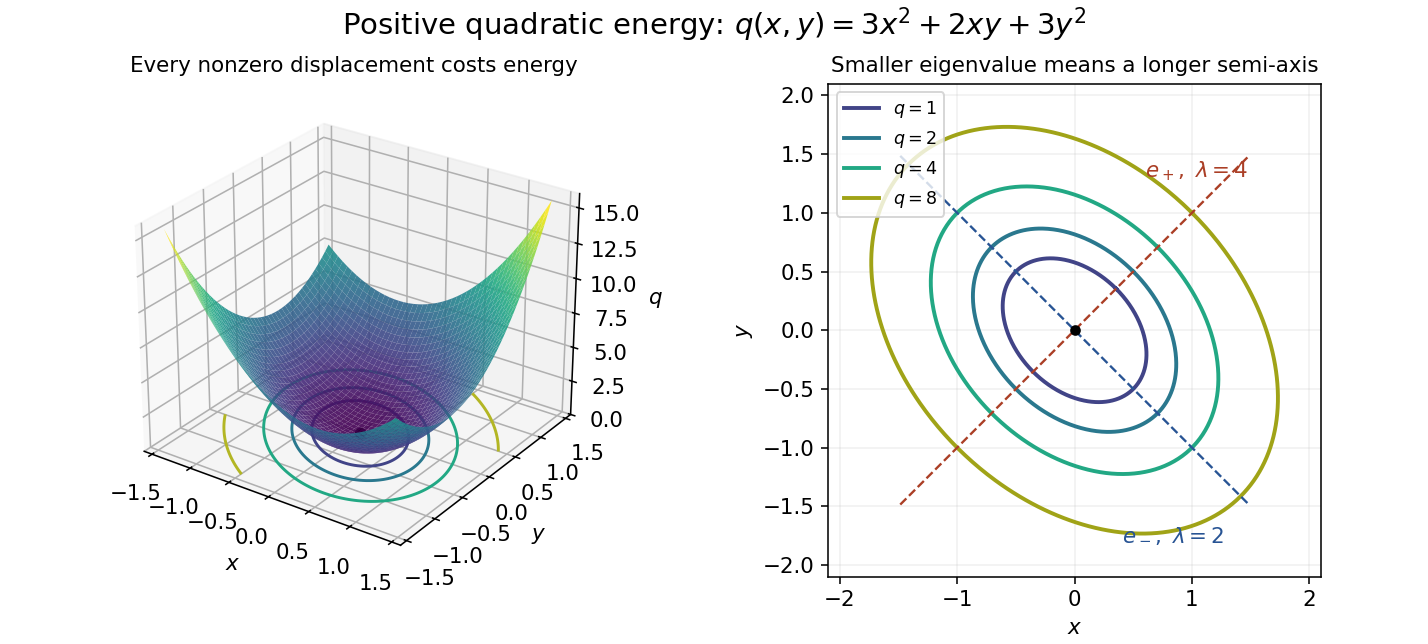
Positive quadratic energy bowl and elliptical level curves
. Details. 
The real and complex settings require different symmetry assumptions. For a real symmetric matrix use with ; for a complex Hermitian matrix use with , where is the conjugate transpose. The latter expression is real, so strict positivity is meaningful. A complex quadratic form such as has no such positivity: it vanishes at and takes negative real values at . A Hermitian form uses complex conjugation, which changes this example to .
For a real matrix without a symmetry hypothesis, its quadratic form depends only on its symmetric part of a matrix:Positive eigenvalues of alone do not establish positive definiteness of this quadratic form. For example, has both eigenvalues equal to , yet . The relevant test is positivity of the symmetric part of a matrix, not the spectrum of an arbitrary matrix.[ref]
Antipodal alternating-simplex parity lemma 2026-10-14
An antipodal simplicial map from a regular antipodal triangulation of a sphere to has an odd number of positive alternating -simplices. For each -simplex, the number of positive alternating facets is odd exactly when the simplex is positive or negative alternating; otherwise it is even, including collapsed images. Count these incidences in one hemisphere: interior facets contribute twice, boundary facets once. Antipodal pairing then gives , starting with one positive vertex on . In particular, no such map exists when .
Effective porosity 2026-10-14
Effective porosity is the pore-volume fraction accessible to connected transport under the specified measurement or model. It excludes isolated pore volume and may also exclude poorly exchanging regions on the transport timescale, so for total porosity . In a simple mobile-volume model the mean pore velocity is ; the assumptions behind that model matter when interpreting tracer arrival times. A sample with total porosity but mobile pore fraction and Darcy flux has mobile mean pore velocity . Woessner and Poeter discuss the role of connectivity and slowly exchanging pores.[ref]
For a nonnegative random constant individual hazard , write . The population survivor function is and its hazard is . Under the integrability needed to differentiate, , soThe conditional distribution is weighted by . This proves decreasing population hazard without any decrease in individual hazards and explains survival selection in a heterogeneous population.
For monotone missing data, let indicate observation and let be the product of the conditional retention probabilities through visit . Under sequential missing at random, conditioning on the complete response history makes these retention probabilities depend only on the history already observed at each decision. Therefore . Weighting a working-independence generalized estimating equation by restores its mean-zero property. This needs correct retention probabilities, positivity and regularity; uncertainty must account for estimating the weights.
Milnor–Moore theorem 2026-10-14
For simply connected , rational Hurewicz homomorphism identifies with the primitive elements of a Hopf algebra of and induces an isomorphism of graded Hopf algebras. The bracket on homotopy is the Samelson product. The underlying algebra theorem says that a connected graded cocommutative Hopf algebra over characteristic zero is the universal enveloping algebra of its primitive Lie algebra. These statements let a free tensor algebra of loop-space homology detect a free graded Lie algebra of homotopy.
Character group 2026-10-14
The character group of a topological group that is an abelian group consists of its continuous group homomorphisms to the circle group, with pointwise multiplication. For a finite group, all characters are continuous and their values are roots of unity, so this agrees with the character group of a finite abelian group.
Pontryagin dual group 2026-10-14
For a locally compact Hausdorff Abelian group , its Pontryagin dual is the group of continuous unitary characters, with pointwise multiplication and the compact-open topology. Its topology agrees with the Gelfand topology of the L1 convolution algebra. It is again a locally compact Hausdorff Abelian group.
// Target: analysis.bigb
For a gas-pressure-supported polytrope of index five with uniform mean molecular weight, . A specific stellar energy-generation rate therefore integrates to . Substituting gives the displayed formula, convergent for . At its dimensionless coefficient is approximately . The scale factor is a volume, , rather than an area.
A level-one modular form with rational Fourier coefficients is a weighted homogeneous polynomial with rational coefficients in the normalized Eisenstein series . Subtract its constant coefficient times a same-weight monomial. The remainder is a cusp form; divide it by . The valence formula for the modular group shows that has no interior zeros, so this quotient is holomorphic and has rational coefficients. Induction on weight proves the assertion. Euler's Bernoulli number formula for even zeta values then gives the corresponding rational weighted polynomial in the unnormalized lattice Eisenstein sums .
Let be weighted homogeneous of modular weight , and suppose as a holomorphic function. Apply the modular group matrices . At a fixed point in the complex upper half-plane, this gives for every integer . A polynomial with infinitely many roots vanishes identically, so every . Within one modular weight, the monomials reduce to powers of , after taking out a common factor. This ratio is nonconstant, as its Fourier expansion begins , so its powers are linearly independent. This proves algebraic independence even when the generators are regarded as analytic functions rather than elements of a formal graded ring.
In characteristic zero, averaging over a compact group, or over a Zariski-dense compact form of a complex reductive group, gives a degree-preserving projection onto the polynomial invariant ring. Its module property is for invariant . This property turns finite ideal generation in the ambient polynomial ring into finite algebra generation of the invariant subring.
Choose finitely many homogeneous positive-degree invariants generating the ideal generated by all positive-degree invariants in the ambient polynomial ring. Such a finite set exists because a polynomial ring is Noetherian. Apply the Reynolds operator on a polynomial invariant ring to an expression for any homogeneous invariant in that ideal. Its coefficients become invariants of smaller degree, so induction proves that the chosen set generates the entire invariant ring as an algebra.
The action has invariant monomials exactly when their two exponents differ by a multiple of . Every such monomial is a product of . Reducing by leaves the monomials , and with ; their images are distinct monomials in , proving that this is the only relation. The map is finite and its fibres are the finite-group orbits, so the hypersurface is the geometric quotient.
// Destination: ringed-space.bigb
Polynomial group growth from orbit packing 2026-10-14
A properly discontinuous group action by isometries of a finitely generated group on a complete -dimensional Riemannian manifold of nonnegative Ricci curvature yields the displayed group growth bound. Distinct orbit points are uniformly separated, while a word of length moves a basepoint by at most . Pack disjoint equal-volume small balls about the orbit points into and apply the Bishop-Gromov inequality. A finite point stabilizer contributes its order to the bound; freeness is unnecessary.
A finitely generated group of isometries acting properly discontinuously on a complete connected -dimensional Riemannian manifold with nonnegative Ricci curvature has polynomial growth of a group of degree at most . Choose so distinct points of an orbit are separated by more than . Let be the largest displacement of the base point by a generator. The radius- word metric ball maps into the metric ball of radius , with fibers of size the finite stabilizer . Disjoint radius- balls around these orbit points have equal volume and fit inside the ball of radius . The Bishop-Gromov inequality bounds their number by , giving the displayed estimate.
Tree on a Polish space 2026-10-14
A tree on is a subset of closed under initial segments. It is closed when each finite level is closed in the corresponding product topology, and well-founded when it has no infinite branch. A countable-basis approximation tree, with nested sets of shrinking diameter, reduces a closed well-founded tree on a Polish space to a countable well-founded tree and bounds its height by a countable ordinal.
Period domain 2026-10-14
Fix a lattice, a bilinear polarization and Hodge numbers. The period domain consists of the Hodge filtrations with these dimensions satisfying orthogonality, opposition and positivity. It is an open subset of its compact dual of a period domain, described algebraically by the dimensions and orthogonality conditions alone.
There are unlisted articles, also show them or only show them.