
Away from the separable differential equation givesOn the interval containing , one has , so the positive initial value selects . Substitution of gives . ThusThe zero solution omitted by division by cannot satisfy the initial value. Although the selected solution tends to zero as , its derivative diverges there; it does not extend through that point as a classical differentiable solution.
Use the product substitution for a first-order equation . The product rule gives , turning the equation into . Consequently , so .
Multiply the two defining Gamma integrals. For the nonnegative product integrand allows Tonelli's theorem:Use , , so , and the positive quadrant becomes , . The Jacobian determinant has absolute valueAfter including this factor, the transformed integral separates:This proves the beta-gamma identity,All changes of variables are made inside the open positive domains; their boundaries do not contribute to the integrals.
Write and set . Since and ,In the last integral put , giving . This yields , and part (a) interchanges the arguments. HenceThe equal-argument beta integral identity holds for every positive real , not only positive integers.
In the integral for , put , so and the endpoints are interchanged. ThenThus exchanging the positive parameters leaves the Euler beta function unchanged. Positivity ensures convergence at both endpoints of this improper integral.
Let . Taking a dot product with reduces the vector equation to . If , this determines a unique scalar and hence a unique vector:Direct substitution verifies it, so necessity has also produced sufficiency. The formula includes , when .
If , the reduced scalar equation becomes . When , there is no solution. When , all solutions are with arbitrary : their dot product with is indeed . Since forces , this is an entire affine line, not a single point. These alternatives are the solvability of an affine rank-one vector equation.
Put and . Taking the dot product of the original equation with eliminates and gives . ThusNext take its cross product with . The term disappears, and the vector triple product identity givesInsert this expression back into . The two longitudinal terms cancel, leaving . ConsequentlyThe denominator is strictly positive for every real , including . Substitution using the same triple-product identity verifies the solution and establishes uniqueness. This is the cross-product operator with a longitudinal rank-one term.
Rearrange to . A fourth root has modulus and an argument one quarter of . Therefore all four solutions areTheir arguments differ by , so they are distinct. Raising any of them to the fourth power returns .
First take . The forward object reaches at its th move, while the reverse object reaches that label at its th move. If the forward object wins after reverse moves, then . The final choice is forward; among the preceding choices, exactly are reverse. By the negative binomial stopping argument, this case has probability .
Sum these mutually exclusive cases and equate the result to part (e), using parts (b) and (d). This proves the success-failure stopping identity here:The right side splits the same race into a special meeting at and all meetings beyond ; the left side splits it according to the number of reverse moves at the winning time.
At , both sides are zero with an empty sum and . At , the event has probability one; the right side equals . The printed left side includes and is outside the usual nonnegative-upper-index combinatorial definition. With the explicit generalized convention , its term is one and all terms vanish, so the identity also holds at that endpoint. Without this convention the displayed sum is undefined there; the zero-target race must instead be stated separately. All identities extend to by their polynomial forms.
Let be the meeting label. If , the forward-moving object has already crossed while the reverse-moving object has not yet reached it, so the forward object wins the race to . If , the reverse object passed first. If , the required event is exactly the special meeting from part (d).
These disjoint possibilities giveThis includes the endpoints: for the probability is , and for it is , with the initial positions understood in the unwrapped convention.
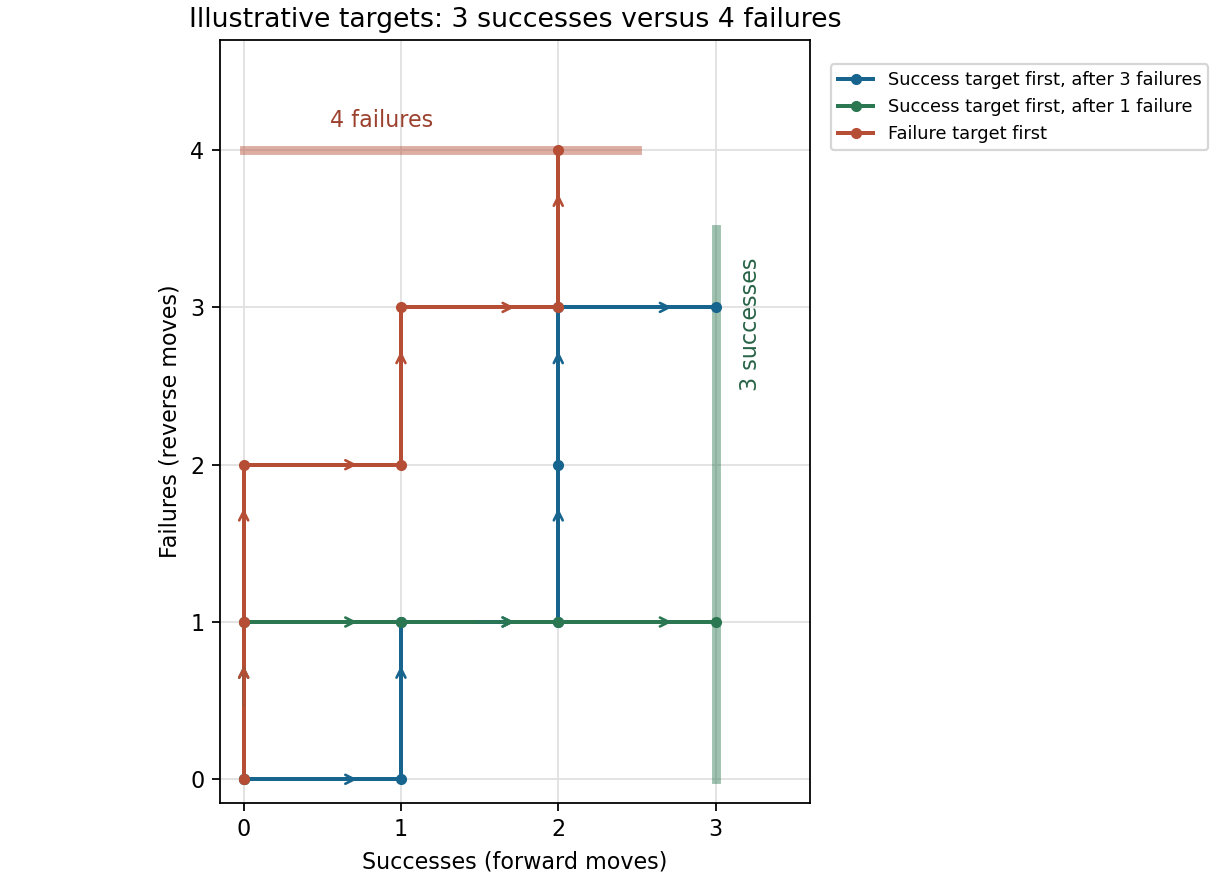

For the forward-moving object to have been waiting at the meeting position, the last move must be a reverse move. The preceding choices must then contain exactly forward moves and reverse moves. Choosing their order givesAt the probability is zero, since the reverse-moving object was already at that unwrapped position initially. At the displayed formula is , consistent with the forward object waiting at its initial position throughout. Equivalently, use the binomial convention to include this endpoint in the same formula without a negative power of .
There are unlisted articles, also show them or only show them.