
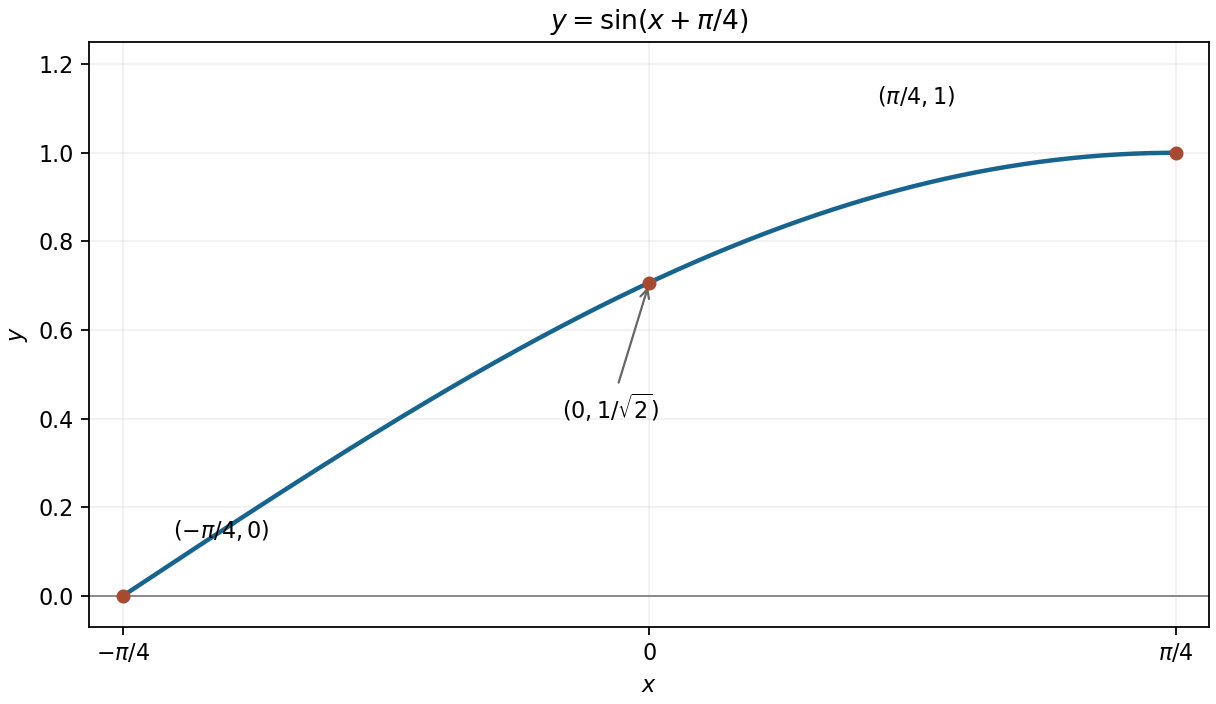
The sine addition formula gives . On the requested interval the shifted angle runs from to , so the graph rises from through to .
Its derivative is nonnegative and reaches zero only at the right endpoint. Its second derivative is , so the rising arc is concave downward and ends with a horizontal tangent.
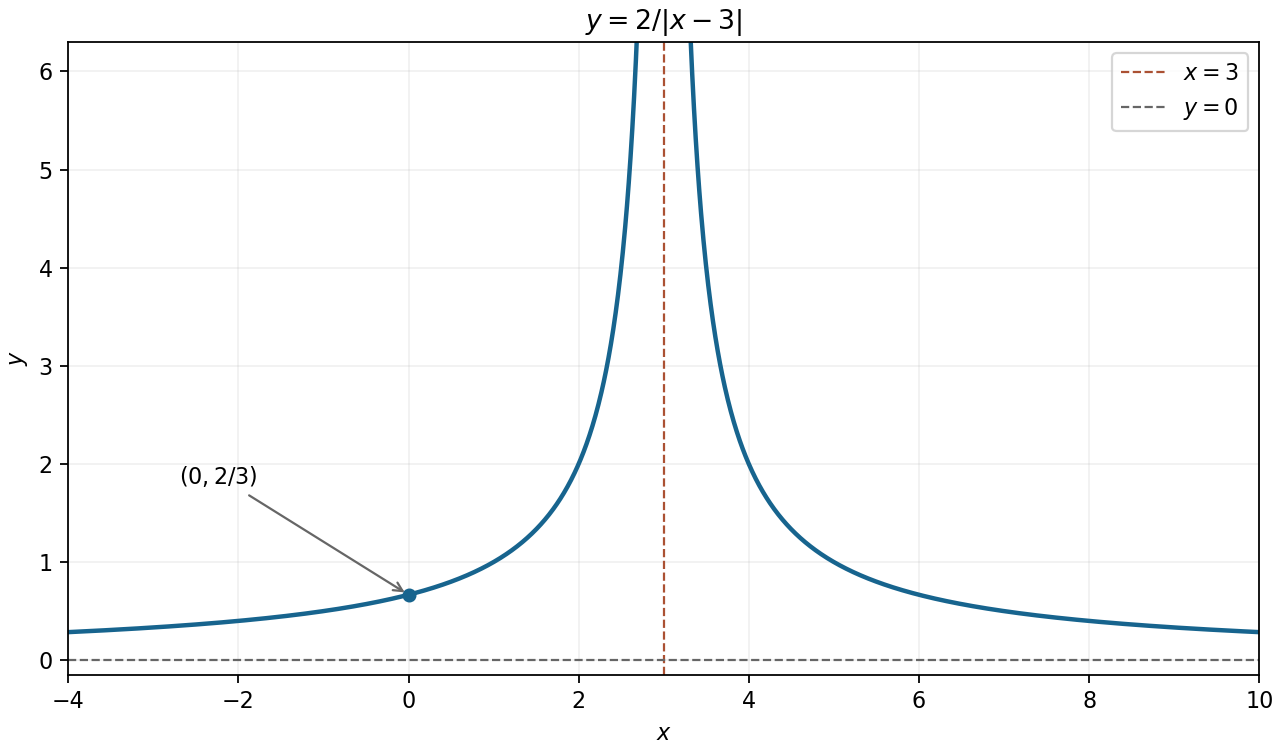
The domain of a function excludes . Both branches are positive, with a vertical asymptote at approached from both sides with value , and horizontal asymptote at either infinity. The graph is symmetric about because it depends only on .
For , the formula is and the derivative is positive; for , it is and the derivative is negative. It passes through and has no zeros.


The Gaussian function is even and is odd, so their product is an odd function. Moreover , whose integral on the real line is finite. Thus the improper integral is absolutely convergent, not merely a symmetric principal value, and the contributions of its two half-lines cancel:
For , use integration by parts with and . ThenDifferentiating the answer checks cancellation of the extra constant term from .
For absolute convergence, examine . When , the ratio of successive terms tends to , so the ratio test proves convergence; at every term is zero. For , the terms do not tend to zero.
At either boundary , the absolute-value series is the divergent harmonic series. Thus for real the complete answer isThe original series at is conditionally convergent by the alternating-series criterion, but it is not absolutely convergent and is correctly excluded here.
Seek a separated nonzero solution . Division by on intervals where the factors are nonzero gives . Write and , with both factors zero at their endpoints .
For , a nonpositive gives only the zero solution under the two endpoint conditions: linear functions vanish identically when , and the hyperbolic solutions do likewise for . For , the endpoints force with positive integer and . Applying the same argument to gives and , with positive integer .
The only positive integer pairs satisfying are and . By superposition,To establish that this is the most general sufficiently regular solution, expand in the complete product Fourier sine series on the square. Substitution, or integration by parts against each sine mode, gives for every coefficient. Hence only the two displayed modes remain; all boundary terms vanish because of the given zero values. This is the eigenvalue- case of the Dirichlet eigensystem of a rectangle. The zero solution is included when .
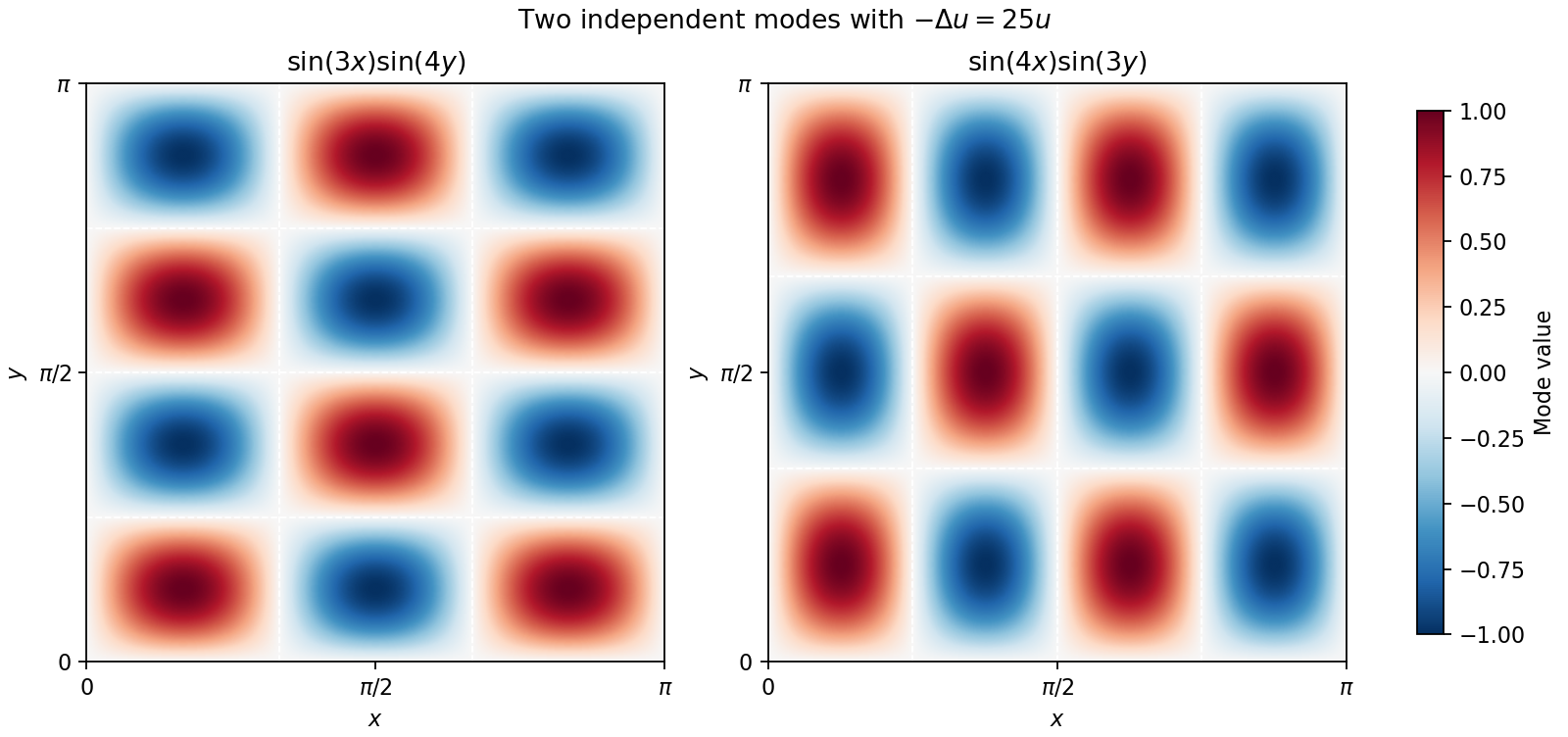
The two independent zero-boundary modes sharing Laplacian eigenvalue 25 on the square
. Details. 
The partial derivatives are and . At they have values and . The first-order Multivariate Taylor polynomial therefore gives the changeThus the requested linear approximation is ; it is the change from , not the new function value itself.
If with continuous second partial derivatives of , then , . The symmetry of second derivatives requiresThis is a necessary condition for an exact differential. With continuously differentiable coefficients it is also locally sufficient, and is globally sufficient on a simply connected open domain; a domain with holes can require additional global information.
Differentiate the Airy ordinary differential equation to obtain . Combining part (a)'s derivatives yieldsTo make this vanish for an arbitrary Airy profile, the time powers must agree: , giving . Their common coefficient must then vanish, giving , hence . ThereforeFor the two terms cancel exactly:This is an Airy similarity solution of the linear dispersive equation. The Airy equation here is the linear partial differential equation , the reduced equation specified in the question; it is distinct from the profile's Airy ordinary differential equation. The construction works for every linear combination of its two independent profiles, including zero. No condition at is supplied, and this singular time is excluded. With real cube roots the final formula can also be used separately on .
Homogeneous equation. Its characteristic equation is . The two independent solutions are and , soForced equation. A particular solution is , since its second derivative minus its first derivative equals . Thus and . The derivative condition at one gives , so . The value condition then gives , so . HenceBoth initial conditions and the forced equation follow directly on substitution.
There are unlisted articles, also show them or only show them.