
Use the lower limit for the inner integral:HenceThe prefactor is the probability that interruption occurs; the remaining exponential is its conditional positive tail. This is the positive difference of independent exponential waiting times. The exponent is dimensionless because both and are measured in minutes.
For a small rectangle of side lengths , independence makes its probability approximately . Thus the joint probability density function is the productAdding the probabilities of disjoint small rectangles covering a region of integration, and taking their sizes to zero, gives the double integral of this product over that region. Without independence, the two marginal distributions alone would not determine the joint probability density function.
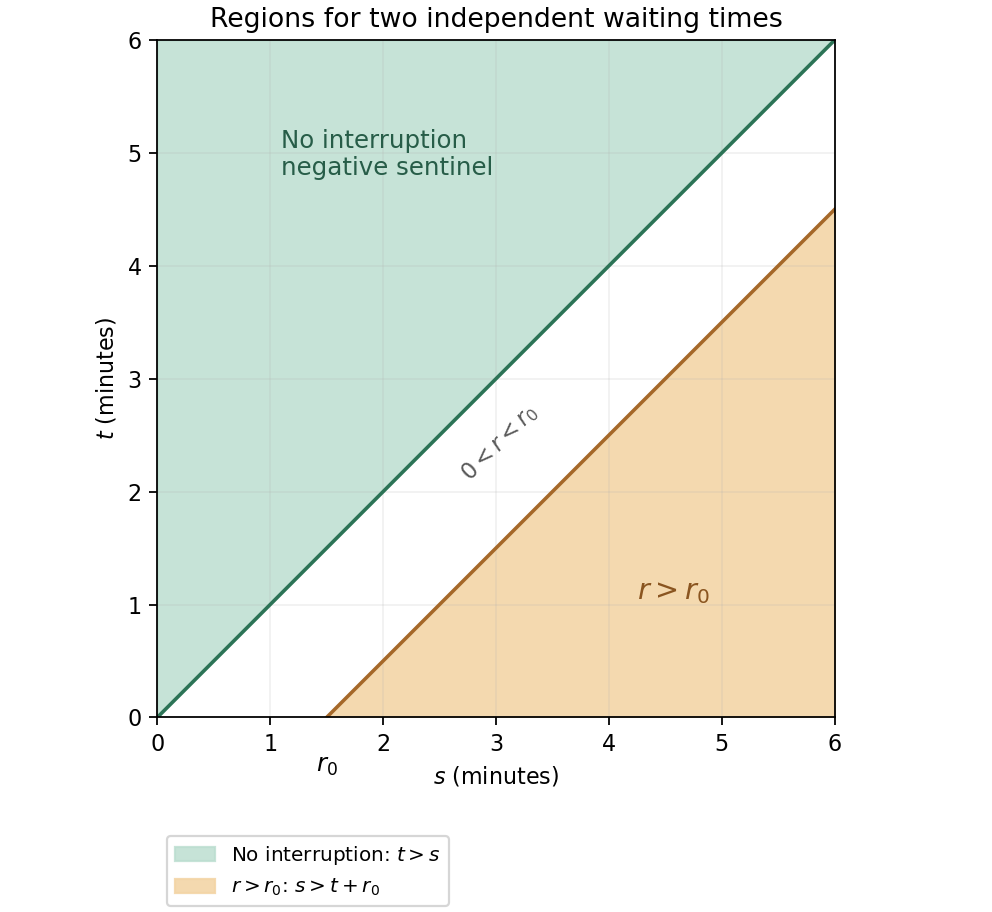
Take on the horizontal axis and on the vertical axis, both nonnegative. There is no interruption when the noise occurs after the scheduled ending, namely . This is the part of the first quadrant above the diagonal . Equality has probability zero, so assigning the boundary either way does not affect the calculation.
The same original diagram below also marks the region used in part (e); its lower boundary offset is an illustrative positive choice of .

Write for the mean in minutes. An exponential distribution with that mean has rate , so its probability density function isThe density has units of inverse minutes, ensuring that its integral is a dimensionless probability.
The cubic Taylor polynomial about isIf has a continuous fourth derivative near , Taylor's theorem gives equal to this polynomial plus . With continuous derivatives only through third order, the corresponding remainder is . An equality with an infinite Taylor series would require additional convergence information, rather than just the existence of these four terms.
Differentiate the product in the definition of . Using the identity in (b),The last expression is , soAlso separately. This is the Hermite polynomial derivative recurrence in the physicists' normalization.
Let , so . Differentiate this identity times, for . By the Leibniz rule, only the first two derivatives of the linear factor can contribute:Rearranging provesThe case is the starting identity , treated separately without introducing a negative derivative order.
In the physicists' Hermite polynomial convention, begin by differentiating the Gaussian function:The defining prefactor then givesThe derivative-based definition uses nonnegative integers; negative orders are not part of this polynomial definition.
Divide the objective area by , which does not change its maximizer, and use with constraint . The Lagrange multiplier equations areAt a nondegenerate cylinder , the second gives . Eliminating it gives . Hence satisfies . Select its positive root:This is the sphere-inscribed case of optimal aspect ratios of closed cylinders. One may check maximality from : its derivative has the sign of , so it changes from positive to negative at the selected root.
Fix the total area at . Apply Lagrange multipliers to with constraint . The two derivative equations areSince , the second gives . Substitution in the first gives . The constraint then yields . ThereforeFor completeness, eliminating makes on . Its derivative changes from positive to negative at the calculated radius and its volume tends to zero at both domain endpoints. Thus this stationary cylinder is indeed the maximum. It is the fixed-area case of optimal aspect ratios of closed cylinders.
In cylindrical coordinates, the two surfaces meet when , giving and . The solid has , , and . With volume element ,The upper-minus-lower height is nonnegative throughout that radial interval.
There are unlisted articles, also show them or only show them.