
Every seven-element subset of the hundred individually identifiable tiles is equally likely. Choose three of the thirty-four vowels and four of the sixty-four consonants; the favourable draw has no blank tiles. ThusThis is a multivariate hypergeometric distribution count, including the implicit factor for blanks. Dividing by instead would incorrectly condition on having drawn no blanks.
The shorter circular arc lies in the - plane and can be written , . The first field is , whose dot product with is one. HenceThe second field is radial while the circular tangent is perpendicular to the radius, so . Thus the first field gives different values, and , along the two paths, whereas the conservative second field gives the same endpoint difference.
As a check using Stokes theorem, the arc followed by the reversed segment encloses area in the plane. The constant curl has upward component two, giving circulation , exactly the difference above.
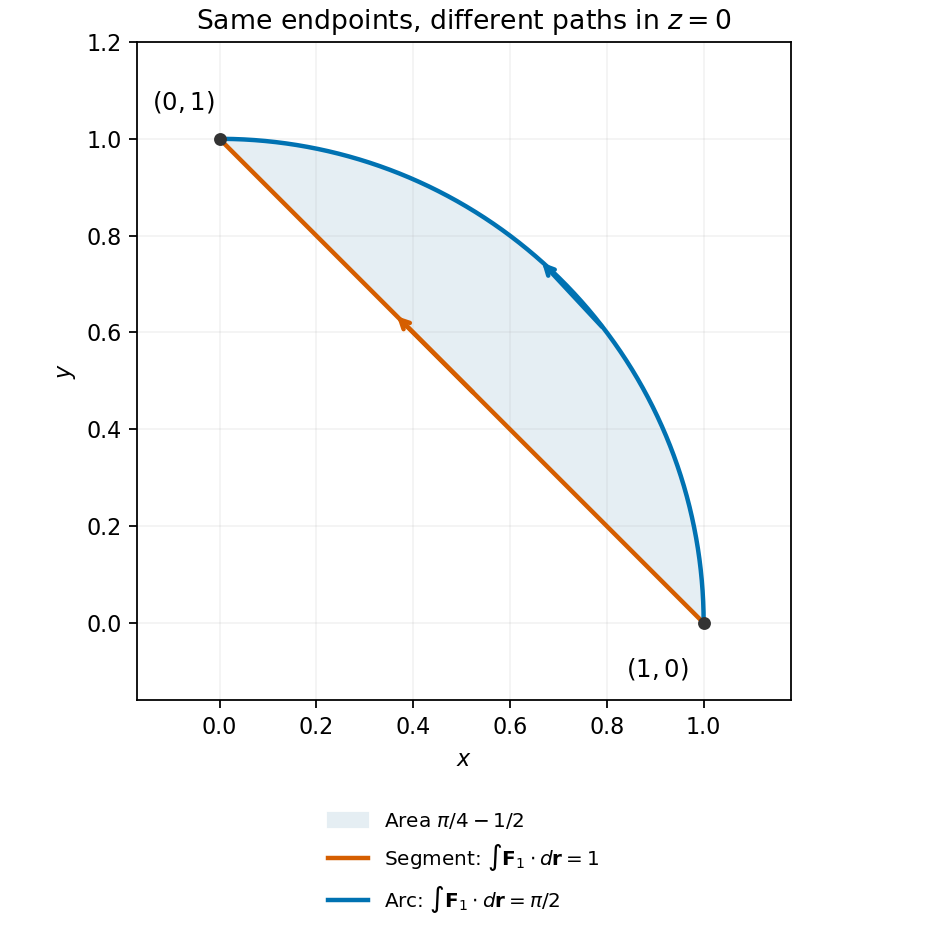
Straight and circular paths with the same endpoints, enclosing the area responsible for their circulation difference
. Details. Parametrize the segment by , , so . For the first field, and its dot product with the tangent is one. ThereforeFor the second field, use the fundamental theorem for line integrals. The endpoints both have , so their potential values agree andDirectly, its parameter integrand is , which changes sign under and integrates to zero.
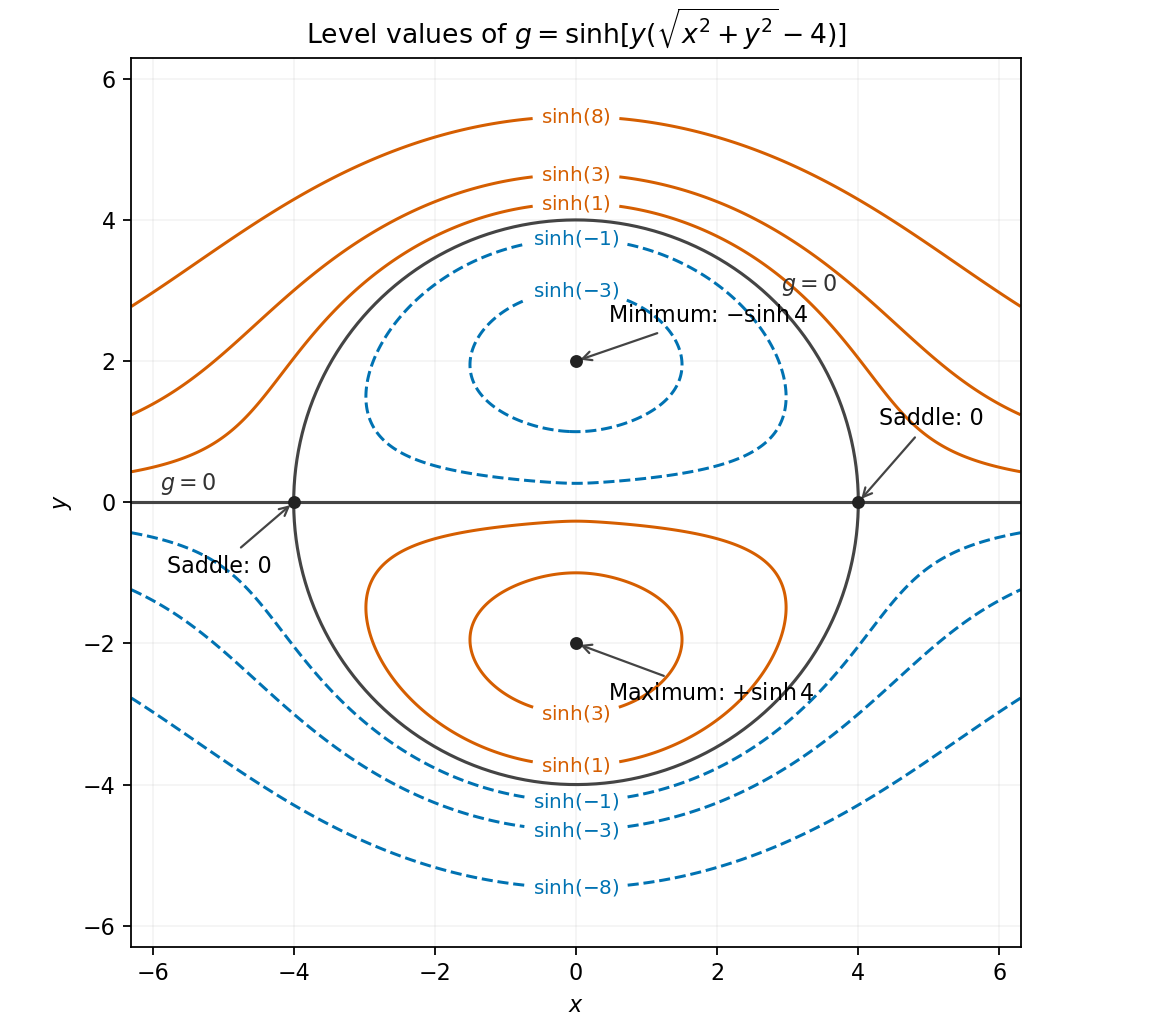
Write , where . Because this hyperbolic function has strictly positive derivative , stationary points under an increasing outer function have the same positions and types for and . For ,The first equation requires or . If , the second gives . If , it gives . These are all the nonzero stationary points. At the origin, , so its gradient is ; the origin is not stationary.
At the Hessian matrix of is , and at it is . At and its Hessian matrices are respectively and . ThereforeThe extrema are local: is unbounded above and below on the full plane.
For the level curve geometry, a level is . In particular, the zero level curve is the union of the entire axis and the circle , crossing at the two saddle points. Inside the circle, above the axis and below it; outside, these signs reverse. Levels between and zero have closed loops around the upper minimum as well as unbounded lower-half-plane components. Reflection across the axis reverses the sign and gives the loops about the lower maximum. At the two extremal heights, the corresponding closed loop shrinks to its extremum. These features determine the sketch.


As printed, the function is undefined at the origin. For , its gradient isThe scalar prefactor is positive, and , so this gradient never vanishes. Thus there are no stationary points on the stated domain. Its infimum is three, approached as , but that value is not attained there.
If the intended definition includes the natural extension , that extension has a unique strict global minimum at the origin, with value three. Indeed, off zero, and proves differentiability at zero with zero gradient. More strongly, subtracting three gives the radial Gaussian flat function: every derivative of that difference vanishes at the origin. The vanishing Hessian matrix does not turn this minimum into an inflection point. These are two different domain interpretations; the extension must be stated rather than silently inserted.
The stated condition is equivalent to . Therefore the solution from (b) obeysFor nonzero initial data this is a circle centred at the origin with radius . The sign of chooses its direction of traversal. If , the same algebra gives only the stationary origin, a degenerate radius-zero case rather than a genuine circular orbit.
Set . Each coordinate satisfies the harmonic oscillator equation, so the general solution isThe four initial data give , , and . ThusThis is the position component of the isotropic harmonic oscillator flow. Substitution also gives the constant energy .
Differentiate the sum of kinetic energy and potential energy using the dot product product rule:The equations of motion make the bracket zero. Hence the mechanical energy is constant in time. The central restoring force can exchange kinetic and potential energy but supplies no change in their sum.
Read the squared semiaxis lengths from the denominators in the standard equation obtained in (b). With the positive choice of there,Since , the horizontal semiaxis is the larger. Thus these are the semi-major and semi-minor axes, respectively.
Multiplying the polar equation by its denominator gives . Squaring and using yieldsTake . Completing the square givesThe standard ellipse equation is consequentlywhose centre is . Squaring has introduced no unwanted branch: on this ellipse the minimum of is , so follows with the correct positive sign.
In plane polar coordinates, is distance from the origin and is the angle from positive toward positive . The conversion to Cartesian coordinates isConversely , with the angular coordinate undefined at the origin.
There are unlisted articles, also show them or only show them.