
The sphere of centre and radius has equationLet be the distance between the centres. A nondegenerate circle of intersection of two spheres exists exactly whenThe upper inequality excludes disjoint or externally tangent spheres. The lower excludes strict containment and internal tangency. It also excludes coincident centres, which give either no intersection or an entire common sphere rather than one circle. These inequalities are sufficient because a triangle with side lengths then exists with nonzero area, and rotating its third vertex about the line of centres traces a circle.
Expand the vector triple product in Cartesian components. Its first component iswhere adding to both products introduces cancelling terms. Likewise the other two components areTogether these proveNow use the cyclic property of the scalar triple product and the just-proved identity:This proves Lagrange's identity in the requested form,
By Bayes' theorem, provided ,If , singing has probability zero and the stated observation cannot occur in this model; that conditional probability is undefined.
Let denote singing, and denote male and female. Equal population counts give . The law of total probability therefore yields
The direction vectors are and . Their scalar product is . Both are nonzero, so the lines are perpendicular:
The initial condition gives , hence . ThusThe displayed interval is the maximal connected interval containing the initial point ; the solution of a differential equation diverges at .
For , the separable differential equation gives . Integrating gives , orEach solution is considered on an interval not containing its pole. The additional stationary solution is excluded by the stated condition.
The double-angle trigonometric identity gives , or . Preserve both factors: contributes the endpoint, while contributes the interior solution. In the specified interval,
Put . The double-angle trigonometric identities imply . Since is in the first quadrant, the positive square root is required. The half-angle identities then give the requested expression in terms of :
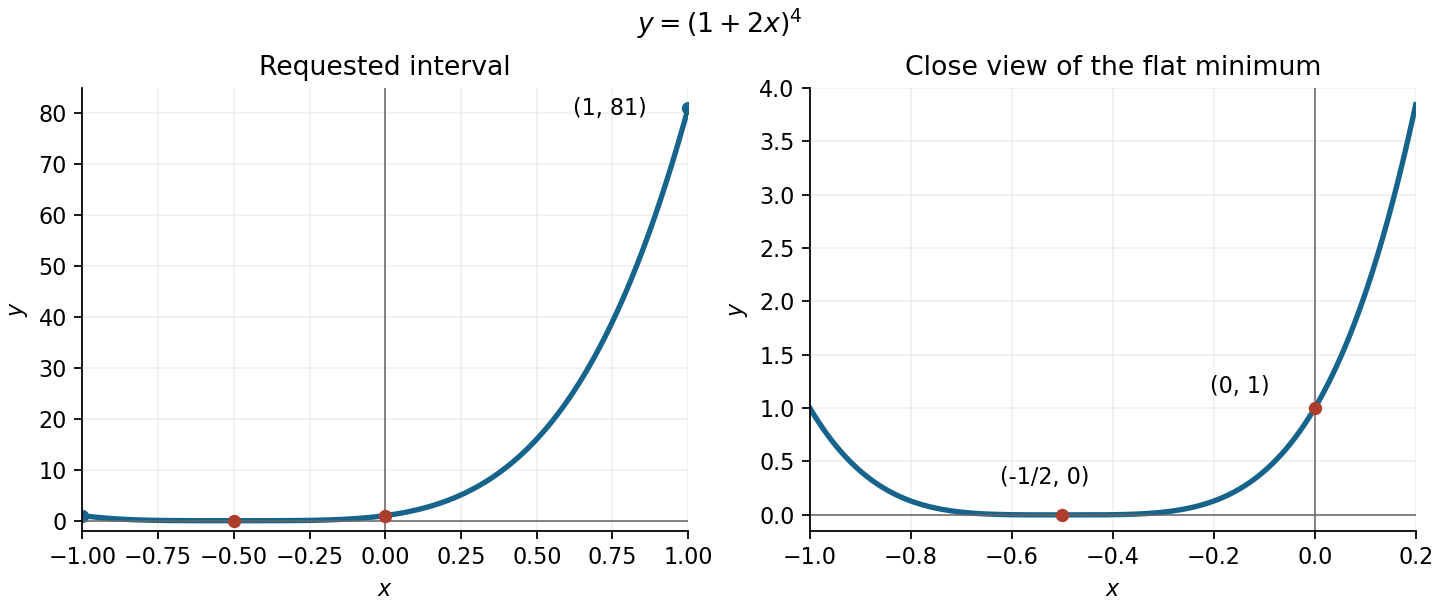
The function graph is a horizontally shifted and scaled fourth power. It is nonnegative and touches the horizontal axis at its fourfold polynomial root. The axis intersections areThe derivative is , so the graph decreases to its flat local minimum at and then increases. Its endpoint values on the requested interval are and . The original sketch includes a closer view of the minimum so that the small values are visible beside the much larger right endpoint.

Writing the polynomial as , direct evaluation gives and . A polynomial is continuous, so the intermediate value theorem guarantees a polynomial root between them. Trying the integer gives , hence is a root.
There are unlisted articles, also show them or only show them.