
Set . The hyperbolic cosine equation becomes , hence . Its two polynomial roots are , both negative. Taking every value of the complex logarithm yieldsSince , their real logarithms have opposite signs. All solutions are thereforeThe positive real constant is also , the inverse hyperbolic cosine of . Substitution gives for both signs and every integer .
A constant real part means , so its level sets are the concentric circlesTheir radii are strictly positive. The real part is independent of the logarithm's branch, so there is no branch ambiguity in these circles.
For , the equation is . If , complete the square to obtainThese circles have centres on the real axis and are tangent to the imaginary axis at the excluded origin. Positive puts the circle to the right, negative to the left. The separate case gives the punctured imaginary axis . The sketch uses an open marker at the origin to emphasize that is never defined there.
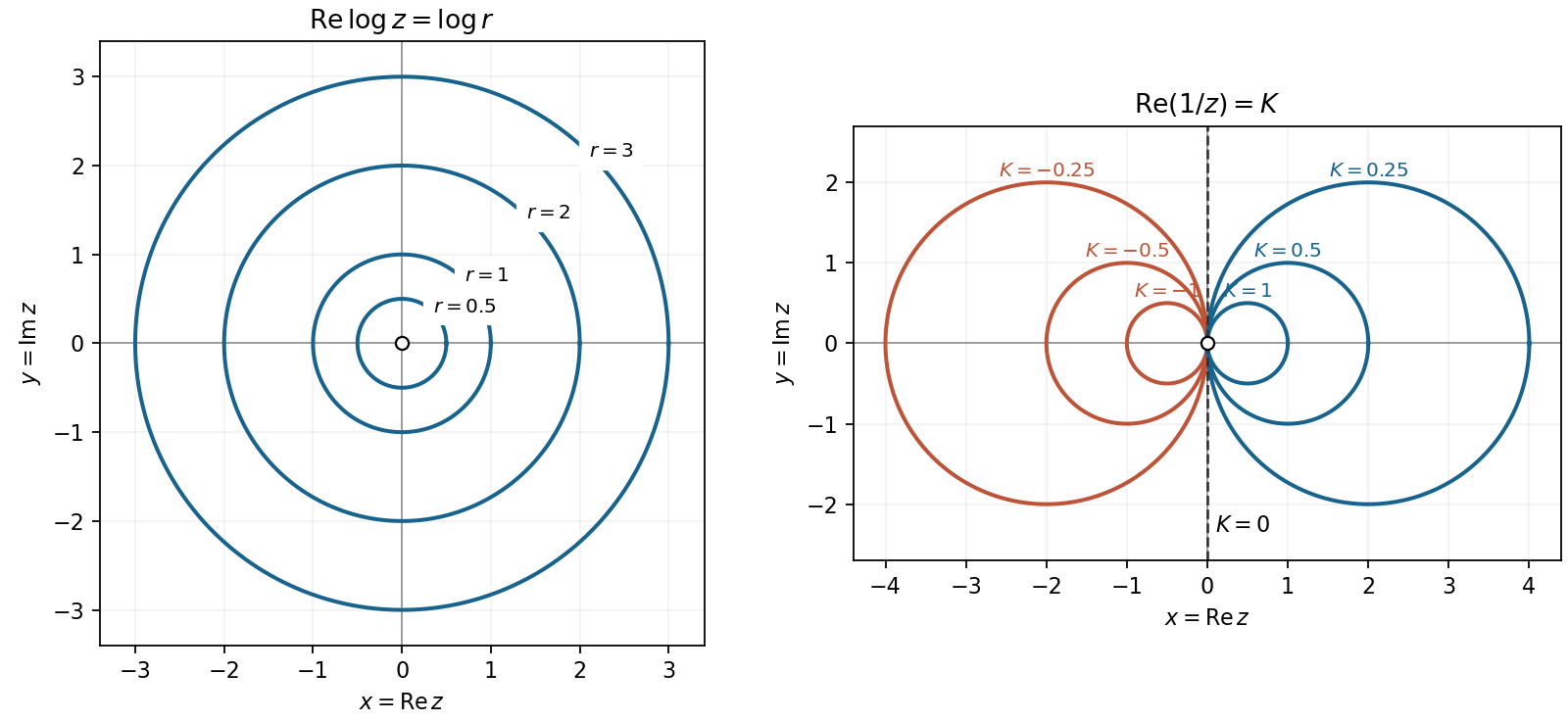
Constant real-part contours of the complex logarithm and reciprocal
. Details. 
In polar coordinates, , , with . Thus the polar form of a complex number isHere is its complex modulus; for , the complex argument is determined modulo . At the angle is undefined, although every value of gives the same point when .
On the negative half-line, an antiderivative of is . The fundamental theorem of calculus therefore givesThe negative sign agrees with the negative integrand throughout the interval.
Differentiation of the finite sum involves no convergence issue. The derivative has the Fourier cosine series
Use the double-angle identity . The Fourier series is already a finite trigonometric sum:In the usual Fourier sine series convention, , all other vanish, and all cosine coefficients and the constant coefficient vanish.
The fundamental theorem for line integrals evaluates this conservative vector field integral by the change in potential. At the initial point . At the final point , so the exponential factor is one, andThe detailed shape of the path does not affect this line integral.
The potential is smooth everywhere, so its mixed partial derivatives commute. The curl of a gradient therefore vanishes:
The characteristic polynomial is , with eigenvalues . A real diagonal form can have only real eigenvalues, so it requires . Conversely, when , the rotation matrix is already . Thus
Yes. The matrix is a real symmetric matrix, so the spectral theorem for real symmetric matrices provides an orthonormal basis of real eigenvectors and hence a real diagonal form. Explicitly its characteristic polynomial is , with distinct real eigenvalues
Write . Alice wins on her st turn if complete rounds fail and then she succeeds. These disjoint events give the geometric seriesConsequentlyThe probability of never obtaining a winner is . The small advantage over comes from taking the first turn.
There are unlisted articles, also show them or only show them.