
Work by W. A. Wenzel 2026-10-18
Sun valve 2026-10-18
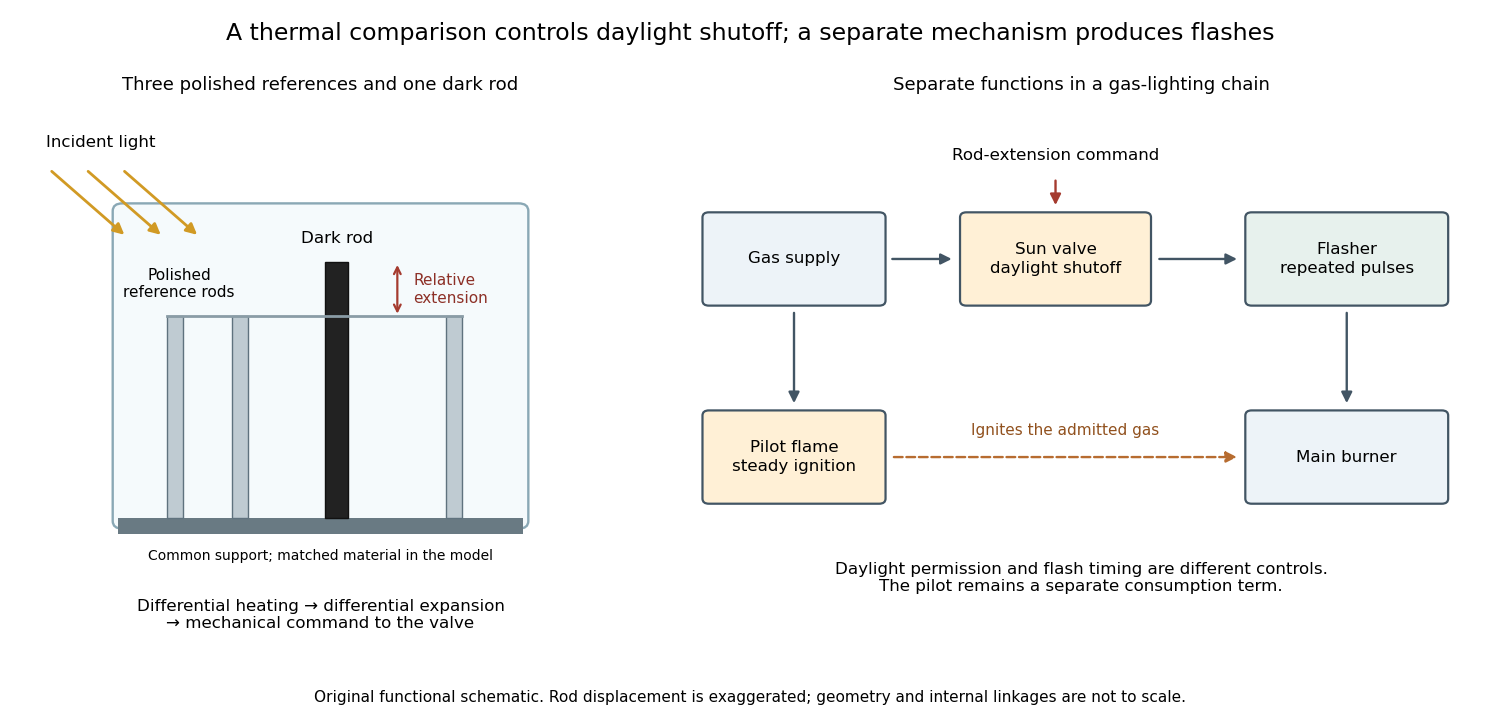
A sun valve automatically restricts a gas light's supply in daylight and allows it again as illumination falls. In Gustaf Dalén's design, a blackened rod and three polished rods respond differently to sunlight. Their relative thermal expansion operates the gas valve through a membrane; a pilot flame permits relighting. The museum dates this design to 1907.[ref]
Gustaf Dalén – Beacon Lighting by Tekniska museet. Sun valve: date, black rod, three polished rods, membrane and daylight/night operation
The useful comparison is between two thermal responses. Both kinds of rod expand when warmed; a dark surface can absorb more incident radiant power, so its temperature rises more. Comparing their extensions can reject a common ambient-temperature change while responding to illumination. The mechanism converts light into heat, heat into a difference of length, and that difference into a change of gas flow. Differential thermal model of a sun valve makes those assumptions quantitative.

Work by V. McNeil Coffield 2026-10-18
Work by V. E. Barnes 2026-10-18
By Yen-Chi Chen, explicitly named on the lecture page. Authored notes in UW STAT 535: Statistical Machine Learning, Autumn 2026, hosted on the University of Washington faculty website. No separate lecture publication or revision date is established.
Cited passages: The Bootstrap, resampling procedure; High level idea of how bootstrap works, conditional empirical sampling law; Bootstrap and Statistical Functionals, conditional variance and consistency; Failure of the bootstrap, uniform-endpoint counterexample.
Work by Uppsala University 2026-10-18
Work by University of Waterloo 2026-10-18
Work by University of Washington 2026-10-18
Work by University of Michigan 2026-10-18
Work by University of Groningen Created 2026-10-18 Updated 2026-11-05
Work by University of Chicago Library 2026-10-18
Work by University of California, Santa Cruz 2026-10-18
Second Created 2026-10-18 Updated 2026-11-05
The second, symbol , is the SI base unit of time. Its definition fixes the unperturbed frequency of the ground-state atomic transition between levels split by hyperfine structure in caesium with mass number to exactly . One second therefore corresponds to that many cycles of the specified electromagnetic radiation.[ref]
The International System of Units (SI), ninth edition, SI Brochure. §2.3.1: definition of the second through the caesium transition frequency
A practical atomic clock realizes the reference by interrogating atoms and controlling a reference oscillation. Magnetic fields, motion and environmental effects require corrections: an exact unit definition does not make every physical realization free of measurement uncertainty.
Barn (unit) 2026-10-18
There are unlisted articles, also show them or only show them.