
Work by Alan D. McNaught 2026-10-18
Work by Alan Coulson 2026-10-18
Work by Alain Aspect 2026-10-18
Work by Al-Khwarizmi 2026-10-18
Work by Akira Tonomura 2026-10-18
Surface coverage 2026-10-18
In a one-molecule-per-adsorption site description, surface coverage is , with . For a macroscopic sample at chemical equilibrium, usually denotes the mean occupied fraction. Inferring it from total uptake also requires the capacity of a complete monolayer.
Langmuir adsorption model 2026-10-18
Consider an ideal gas in chemical equilibrium with homogeneous, identical adsorption sites at fixed temperature. Each intact molecule occupies one site; only one monolayer is allowed. Occupation of distinct sites is independent: neighboring bound molecules do not change binding or release rates. The simplest Langmuir adsorption model has one adsorbing chemical species, no splitting of molecules, and no competitors. Irving Langmuir's 1918 paper treats simple adsorption alongside more complicated cases; its scope exceeds this particular model.[ref]
The Adsorption of Gases on Plane Surfaces of Glass, Mica and Platinum by Irving Langmuir. Langmuir, The Adsorption of Gases on Plane Surfaces of Glass, Mica and Platinum, 1918, theoretical part: Case I and subsequent cases
The derivation is a balance between arrivals finding vacancies and departures from occupied adsorption sites. Let be the arrival-and-binding rate per vacant site and the departure rate per occupied site. Thus has units of inverse pressure per unit time, whereas has units of inverse time. The mean surface coverage obeysAt chemical equilibrium, setting the two terms equal givesThe product is dimensionless. Here is the adsorbing gas's partial pressure, expressed in modern bar, with , and is expressed in . The pascal is the SI unit of pressure. This dimensional is not itself a dimensionless thermodynamic equilibrium constant. A larger gives greater surface coverage at the same and temperature, but does not specify how quickly chemical equilibrium is reached: multiplying both rate coefficients by the same factor leaves unchanged.
Choose , , and as illustrative parameters at one fixed temperature, without assigning a particular material. At , substitution gives, respectively,Solving gives : the three half-occupation pressures are , , and . For , reaching instead requires , or . If the complete-monolayer capacity is stipulated to be , then predicts at . This last number is an original hypothetical example, not a measured uptake.
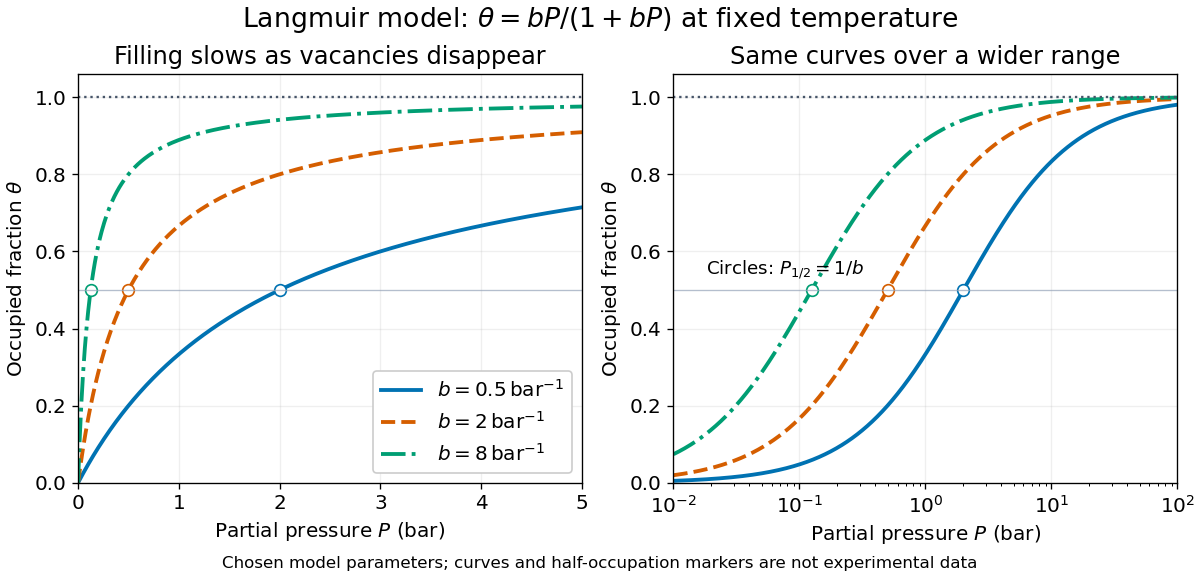
Langmuir isotherms for three chosen values of
. Original model curves at fixed temperature, with in modern bar and , , and . Open circles mark the calculated half-occupation points, not experimental observations. The panels show the same curves on linear and logarithmic pressure axes; the horizontal dashed line marks complete-monolayer capacity. No curve is historical data or a fit to a particular material. Details.
The shape follows directly from the finite number of adsorption sites. For , : nearly every arriving molecule finds a vacancy. For , : vacancies become scarce. More formally,Thus surface coverage rises with diminishing slope and approaches one only as . This saturation is a site-capacity limit, not a claim that the gas has reached its condensation pressure. A second layer, different site binding strengths, interactions between bound molecules, or a changing surface invalidate parts of the setup. A good fit alone does not establish identical adsorption sites: a restricted pressure range can hide such differences. The Langmuir adsorption model is useful because it makes the capacity and the pressure scale of filling separate, testable quantities.
Gibbs adsorption equation 2026-10-18
For the simple one-solute interface convention, surface excess per molecule is related to the derivative of surface tension with respect to the logarithm of solute activity by the displayed equation. For ideal dilute behavior one may use concentration ratios in place of activity ratios. In molar units, . A local molecular area estimate is . Ionic surfactants can require counterion and activity factors; the simple single-component expression must not be transferred to them without specifying those constraints.
Work by Adrien-Marie Legendre 2026-10-18
Carry (arithmetic) Created 2026-10-18 Updated 2026-10-20
In positional notation with integer base , a carry transfers units in one position into one unit in the next position during addition. Each such transfer lowers the sum of the numeral digits by .
Work by Adam Riess 2026-10-18
Sonic boom 2026-10-18
A sonic boom is the sound associated with shock waves from a body moving at a supersonic Mach number. The weak-wave Mach cone describes a propagation geometry rather than the finite pressure signature determining the sound strength.
Ultrasound Created 2026-10-18 Updated 2026-10-24
Ultrasound is sound above the conventional upper limit of human hearing, approximately . In a crystal, ultrasonic travel-time measurements determine long-wavelength elastic wave speeds, which are the small-wavevector slopes of the corresponding acoustic phonon branches.
List of accelerator technicians 2026-10-18
Work by Abdus Salam 2026-10-18
Work by Abdelhanin Aassime 2026-10-18
Work by Aage Niels Bohr Created 2026-10-18 Updated 2026-10-24
Paschen-Back effect 2026-10-18
In the Paschen-Back effect, the external magnetic field interaction becomes large compared with the spin-orbit interaction that holds and coupled. Then ceases to be a good approximate quantum number; become more useful, with leading electronic shifts . In the ideal complete-decoupling limit an electric-dipole interaction preserves , so its spin contribution cancels between the levels and orbital triplet spacing can reappear. Intermediate fields require mixing the coupled states. This is a change of coupling regime, distinct from the weak-field anomalous Zeeman effect; still larger fields require additional terms beyond this linear model.
Anomalous Zeeman effect 2026-10-18
The anomalous Zeeman effect is Zeeman splitting whose pattern is not the simple orbital triplet. Spin and spin-orbit interaction make the upper and lower Landé g-factors differ. The same weak-field formula still applies when its assumptions hold: “anomalous” does not mean nonlinear in the magnetic field.
For example, take an electronic transition with and , neglecting hyperfine structure. With , the formula above gives and . The two allowed transitions have dimensionless shifts , while the transitions give . Thus there are four frequencies, even though each level contains only two magnetic quantum numbers. This is an independent worked deduction; it should not be substituted for the unresolved widths in the 1896 experiment.
Landé g-factor Created 2026-10-18 Updated 2026-10-20
The Landé g-factor is the dimensionless electronic magnetic splitting factor relating a level's magnetic dipole moment to its total angular momentum. In the approximation where total orbital angular momentum and total spin couple to , take the orbital factor as one and the electron spin factor as . For ,This follows by projecting onto and using . At , it gives ; at and , it gives . A level instead has zero first-order electronic shift; the formula's zero denominator must not be used. This is distinct from the statistical weight of an atomic level , sometimes also written .
There are unlisted articles, also show them or only show them.