
Work by Audrey Cottet 2026-10-18
NaCl conventional cell and coordination Created 2026-10-18 Updated 2026-11-05
Ordinary solid sodium chloride has the rock salt structure. Choose a conventional cube of side with chlorine anions at the corners and face centers, and sodium cations at the edge centers and cube center. Corner sites are shared by eight cubes, face sites by two and edge sites by four. The unit cell counts are thereforeThere are four formula units per conventional unit cell, rather than four separate NaCl molecules.[ref]
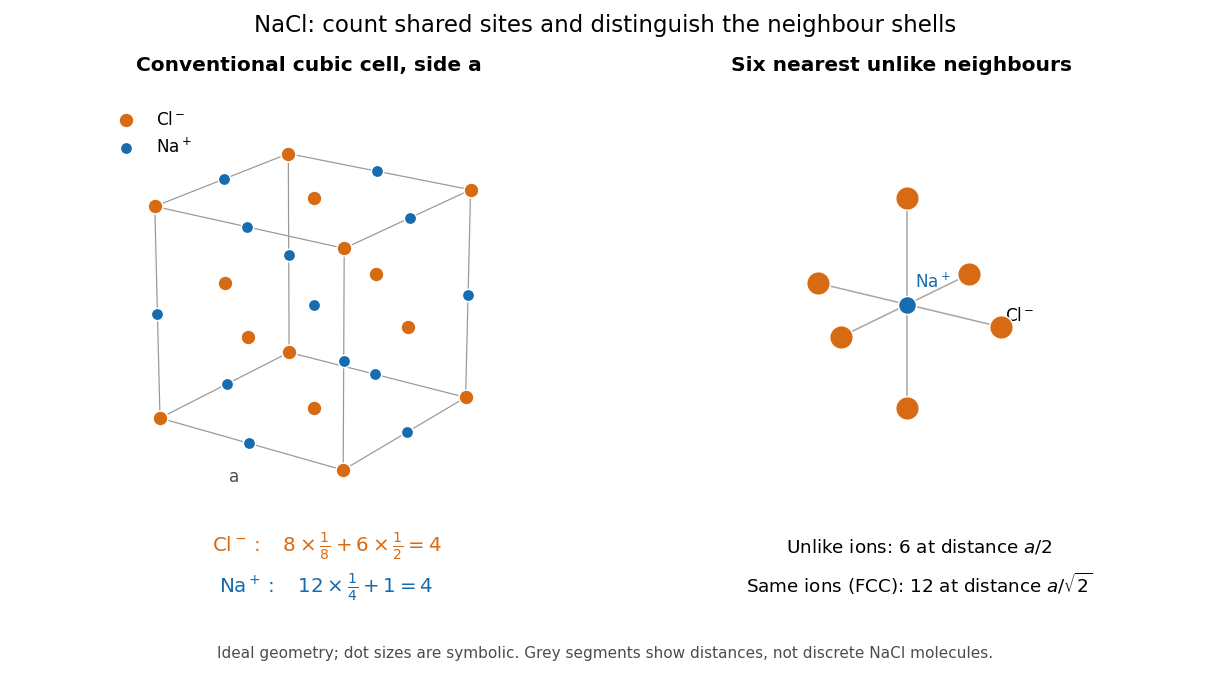
NaCl conventional-cell accounting and the six nearest unlike neighbors
. Original ideal rock salt structure geometry. The left panel includes all boundary sites before sharing is accounted for; the right panel isolates one sodium cation and its six nearest chlorine anions. Grey segments indicate distances, not discrete molecules. Marker sizes do not encode ionic radii. Details.
The Bravais lattice is a face-centered cubic lattice. One choice of primitive lattice translation vectors and atomic basis isThe determinant gives a primitive unit cell volume of ; that cell represents one cation and one anion. Four such volumes make the conventional cube. The union of all ion positions resembles a primitive cubic lattice of step only if the chemical labels are discarded: translation by exchanges unlike ions and fails to preserve the chemical structure.
Each ion has six nearest unlike neighbors at distance , along the positive and negative directions of the three cube axes. Thus the coordination number is six. Within either same-species face-centered cubic lattice, the nearest same-ion neighbors instead number twelve: their displacements are permutations of , all of length . Since , those twelve are a more distant shell in the complete sodium chloride structure. The number twelve describes the same-ion FCC lattice neighborhood; six describes the nearest unlike-ion neighborhood.
Isobaric thermal stability of a heated ideal gas Created 2026-10-18 Updated 2026-11-05
Let the net cooling per unit mass of an ideal gas be , with positive constants . At fixed pressure and composition, is constant, so . At a thermal equilibrium , . The specific heat capacity at constant pressure gives . Thus with the displayed growth rate. The equilibrium is stable for , unstable for , and marginal at linear order for . In particular, optically thin Bremsstrahlung with is unstable under this heating law and the isobaric constraint. Fixed-density perturbations have a different criterion.
Binary black hole Created 2026-10-18 Updated 2026-11-05
A binary black hole is a binary system whose two components are black holes. Gravitational waves carry away orbital energy and angular momentum, gradually reducing the separation; sufficiently close systems progress through inspiral, merger and the settling of the final black hole. The increasing orbital angular velocity produces a signal whose gravitational-wave frequency rises, called a chirp. In GW150914, two LIGO interferometers recorded a signal sweeping from about 35 to 250 hertz in September 2015. Comparing that measured gravitational wave strain with general relativity waveforms inferred the component masses and the merger's properties. This permits the study of systems that need no luminous surrounding gas to be detected.[ref]
Work by Arthur Leonard Schawlow 2026-10-18
Work by Arthur Holly Compton 2026-10-18
Work by Arthur Eddington 2026-10-18
Work by Arthur B. McDonald 2026-10-18
Work by Arthur Ashkin 2026-10-18
Work by Arno Allan Penzias 2026-10-18
Work by Arjun G. Yodh 2026-10-18
Arithmetic series 2026-10-18
An arithmetic series adds the sequence terms of an arithmetic progression. Its -th partial sum is , with the empty sum convention . For ,Thus the total is the number of sequence terms multiplied by the arithmetic mean of the two endpoints. The formula also covers decreasing and constant arithmetic progressions.[ref]
1 Algebraic and Analytic Methods. NIST Digital Library of Mathematical Functions, §1.2(ii) Finite Series, equation 1.2.10: arithmetic progression sum and last-term definition
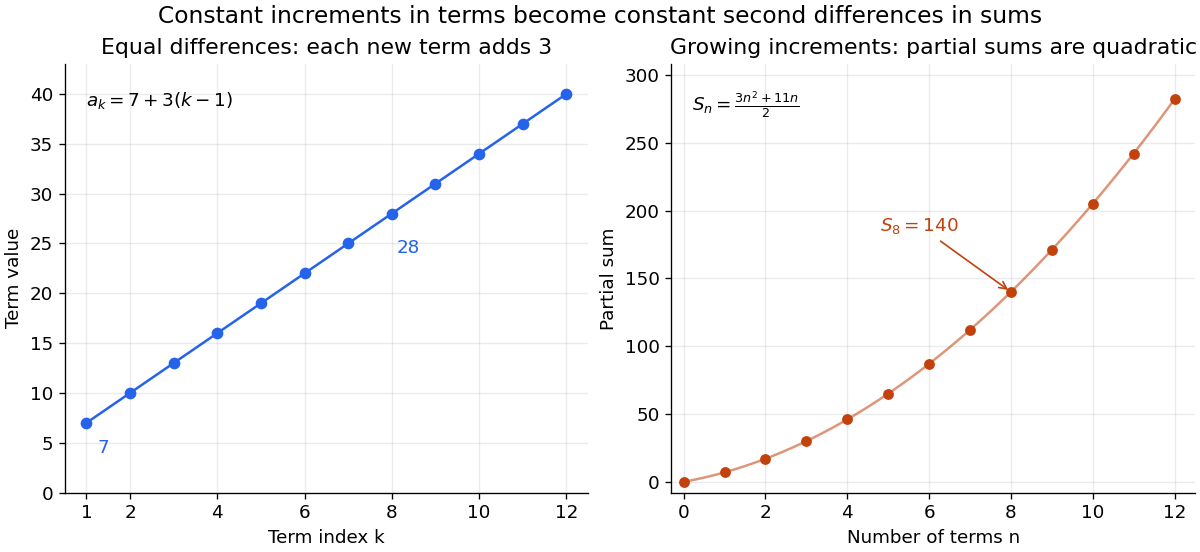
For the eight-entry example, the sum is , and the arithmetic mean of all eight entries is . A decreasing example gives . Negative values cause no algebraic difficulty: has sum .
The triangular number is the special case , giving . More generally, an equal increase in each successive allocation makes the total grow as a quadratic function of the number of allocations. The eight-entry example hasIts first four entries add to , its first eight to , and its first twelve to . The sequence terms lie on a straight line when plotted against their sequence indices, while the partial sums follow a quadratic function.

Counting terms of an arithmetic progression 2026-10-18
Starting at and repeatedly adding a nonzero common difference , a proposed final value is reached at positionif and only if this expression is a positive integer. For , , and , it gives . The quotient counts increments, while the initial entry adds one to the number of sequence terms. The proposed value gives , which is not an integer, so it is never reached by these updates. The test also handles decreasing arithmetic progressions; when , the repeated value alone cannot determine a length.
Work by Antony Hewish 2026-10-18
Work by Anton Zeilinger 2026-10-18
Work by Anthony James Leggett Created 2026-10-18 Updated 2026-10-24
Work by Ansel Cochran Anderson 2026-10-18
For the electronic transition, neglect hyperfine structure and use weak-field LS coupling. The Landé g-factors are and , so a transition from to shifts by .
With propagation perpendicular to the magnetic field, linear polarization parallel to the field drives the electric-dipole selection rule . The two shifts are . Perpendicular linear polarization is an equal-amplitude combination of the two field-axis circular components, driving transitions with and shifts . Each geometry therefore selects a doublet, with twice the separation in the perpendicular-polarization case. Equal line heights within a pair require equal lower-state populations and an unsaturating probe; line positions do not require that extra population assumption.
Sodium D-line Zeeman pattern 2026-10-18
Neglect hyperfine structure and use a magnetic field weak compared with the spin-orbit interaction. The sodium D doublet has transitions and . Their Landé g-factors are , and respectively. With denoting upper and lower magnetic labels, the photon shift isThe first transition has four allowed shifts ; the second has six, . The most blue-shifted component of the second is , with shift . The apparently larger shift is excluded by the electric-dipole selection rule. The level lies above , so in this weak-field model the component also has the shortest wavelength of the whole doublet. [ref]
https://physics.nist.gov/PhysRefData/Handbook/Tables/sodiumtable5.htm. NIST, Energy Levels of Neutral Sodium, ordering of the two 3p fine-structure levels
Work by Anne L’Huillier Created 2026-10-18 Updated 2026-10-24
There are unlisted articles, also show them or only show them.