
Noncentral chi-squared distribution Created 2026-10-06 Updated 2026-10-14
If are independent standard normal random variables and , then has a noncentral chi-squared distribution with degrees of freedom and noncentrality . For it reduces to the chi-squared distribution. Squaring a shifted signed normal Wald statistic gives the case .
Gauge change of the Chern-Simons three-form Created 2026-10-06 Updated 2026-10-14
For an anti-Hermitian connection one-form, normalize the Chern-Simons three-form by and use . Its change is . On a closed three-manifold the first term integrates to zero, while the latter is an integer with the fundamental matrix trace. Hence the integral is defined modulo integers; integer-level exponentials are invariant under large Yang-Mills gauge transformations.
For a rank- complex vector bundle, let for the tautological line on its projective bundle. The Leray-Hirsch theorem gives the free basis over base cohomology. The uniquely determined coefficients in the displayed monic relation define the integral Chern classes. The line normalization uses the Euler class of the canonically oriented underlying real two-plane bundle, and uniqueness makes this definition intrinsic and natural under pullback. No choice of a trivializing cover or classifying map remains in the definition.
Whitney sum formula for Chern classes 2026-10-06
The Total Chern class of a direct sum of complex vector bundles is the product of their total Chern classes. In each degree, . The degree-zero class is one, classes beyond the bundle rank vanish, and a trivial bundle has total class one.
Chern number Created 2026-10-06 Updated 2026-10-14
On a compact oriented -manifold without boundary, an integral product of Chern classes of total complex degree pairs with the fundamental class to give a Chern number. A unitary connection supplies Chern-Weil theory representatives, but the integer is independent of that connection. The Second Chern number on a four-manifold is one important example; the integral of the First Chern class over a closed surface is another.
For one particle species in chemical equilibrium under , chemical balance gives , hence . Elastic imposes no such constraint. In an expanding universe the number-changing reaction must remain fast compared with the Hubble parameter; after chemical freeze-out a nonzero chemical potential can develop even if elastic collisions maintain kinetic equilibrium.
Chemical disequilibrium Created 2026-10-06 Updated 2026-10-18
A chemical system is out of local chemical equilibrium when reaction adjustment cannot keep pace with transport, imposed changes or external driving. Comparing the chemical relaxation time with transport and irradiation times identifies plausible departures. Disequilibrium chemistry in an exoplanet atmosphere combines this principle with mixing, horizontal advection and atmospheric photochemistry.
Cantelli inequality Created 2026-10-06 Updated 2026-10-14
Cantelli's inequality uses a mean and variance to control deviations in one specified direction. For a real random variable with expected value , finite variance , and ,Applying the same statement to gives the lower tail probability bound . No independence or particular probability distribution is required. If , the random variable equals almost surely and both positive-threshold tail probabilities are zero.
For variance one and a threshold two above the mean, the upper-tail probability is at most . Applying the two-sided Chebyshev's inequality to contain that upper event would give the weaker bound . For the standard normal distribution, the actual upper tail probability at two is about , much smaller than either bound. Yet the two-point probability distribution in equality in Cantelli's inequality attains , showing why the smaller Gaussian value cannot be promised from these two moments alone.
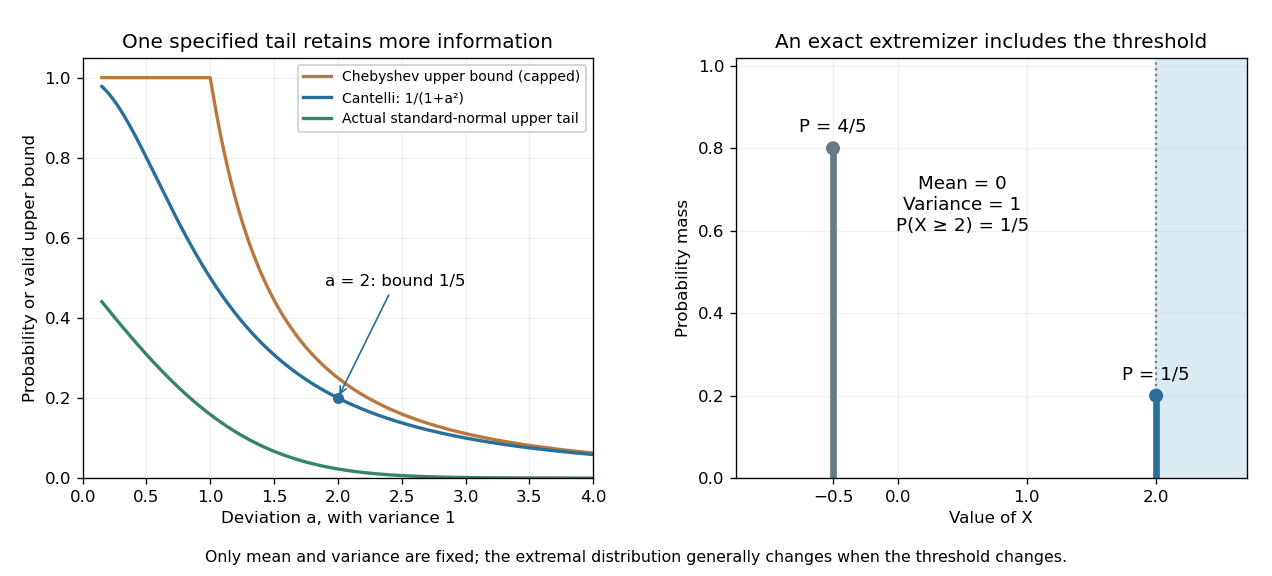
Cantelli's inequality sharpens a variance-only upper-tail bound and is exact for a two-point probability distribution
. Left: actual upper tail probabilities for the standard normal distribution are compared with Cantelli's inequality and the capped two-sided Chebyshev's inequality used as an upper-tail bound. Right: masses at and at two have mean zero and variance one. The upper mass is included by the non-strict threshold . These are specified mathematical models, not observations. Details.
A short explanation is to centre and choose a nonnegative shift . On , the square is at least , so Markov's inequality givesThe best shift is , giving the displayed bound. Choosing the shift before squaring exploits the direction of the deviation; squaring the unshifted random variable treats both directions together. This shifted-square proof is also the strategy requested in the University of Utah's 2005 qualifying problem on Cantelli's inequality. [ref]
https://quals.math.utah.edu/topics/borel-cantelli-lemmas/. University of Utah Mathematics, 2005 question 4: shifted-square Cantelli bound
.The one-sided improvement should be used for a one-sided question. Adding upper and lower bounds by the union bound gives for . When , that is at least the Chebyshev's inequality bound ; when , both two-sided expressions exceed one and must be capped. The separate one-sided bounds generally cannot be attained simultaneously by the same probability distribution.
Dimension-six Higgs Yukawa misalignment 2026-10-06
An operator contains three factors of . Its contribution to the mass matrix is proportional to , while its single-Higgs coupling is three times the corresponding mass-over-v contribution. With the normalization , the mass-basis coupling is . Nonzero off-diagonal coefficients permit charged-lepton flavour-violating Higgs decays.
Unitarity of the charge-conjugation matrix 2026-10-06
For and , the Dirac adjoint transforms as . Anticommuting the components of the fermion bilinear gives . Invariance of the scalar bilinear therefore fixes .
If , transposition shows that commutes with every gamma matrix. Irreducibility of the complex Dirac representation and the Schur lemma make it scalar. Transposing again yields , so .
Operator conjugation of a chiral field component Created 2026-10-06 Updated 2026-10-14
The unitary charge-conjugation operator acts on field operators and commutes with numerical chiral projectors, so . This component is left-chiral. The algebraic conjugate of an already projected spinor instead satisfies , because its adjoint carries the opposite projector. Keeping the two operations separate avoids a false chirality conclusion.
Characters of a C-star algebra respect the involution Created 2026-10-06 Updated 2026-10-14
For a self-adjoint element , the exponentials are unitary. A continuous algebra character therefore satisfies for every real , forcing to be real. Decomposing an arbitrary element into real and imaginary self-adjoint parts proves the displayed identity. Thus every algebra character is a star-preserving scalar homomorphism; commutativity of the whole algebra is not needed for this fact.
Ground-model club containment lemma 2026-10-06
Koszul complex Created 2026-10-06 Updated 2026-10-14
The Koszul complex on has term and differential . Its degree-zero homology is . For a regular sequence it is exact in positive degrees, hence a Koszul resolution of that quotient. The variables of a polynomial ring form a regular sequence, so this resolves the coefficient field in length equal to the number of variables.
Double complex Created 2026-10-06 Updated 2026-10-14
A double complex has modules and differentials lowering either index, each squaring to zero and anticommuting with the other. The total chain complex has term and differential the sum of the two differentials. For the tensor product of two chain complexes, a sign on the second differential ensures anticommutation. If the double complex is in the first quadrant and one direction has homology only in degree zero, its total homology is computed by the surviving degree-zero complex. Applying this twice to two free resolutions proves the balanced calculation of the Tor functor.
Sphere chain complex 2026-10-06
Disk chain complex 2026-10-06
For , the chain complex with copies of in degrees and identity differential. It is acyclic; a map from it chooses an arbitrary degree- element and its boundary.
Tensor product of chain complexes 2026-10-06
The tensor product of homologically graded chain complexes has differential . The sign makes the two mixed terms in cancel. Total degree is the sum of the two degrees.
Graded Hom complex of chain complexes Created 2026-10-06 Updated 2026-10-14
A graded Hom functor construction consists of maps shifting degree by . One homological convention is . Its degree-zero cycles are chain maps, and its degree-zero boundaries are null-homotopic chain maps, so its zeroth homology is the module of chain homotopy classes. This convention differs by degree-dependent signs from the alternative convention .
There are unlisted articles, also show them or only show them.