
Category of groups 2026-10-06
The category of groups has groups as objects and group homomorphisms as morphisms. Its product is the direct product of groups, and its coproduct is the free product, as expressed by the universal property of a free product.
Monoidal category 2026-10-06
A category equipped with a monoidal tensor product, a monoidal unit object, and natural associators and unitors satisfying the pentagon and triangle axioms.
Model category 2026-10-06
A complete and cocomplete category with designated model weak equivalences, model fibrations and model cofibrations, closed under retracts. Weak equivalences satisfy two-out-of-three; maps admit the two cofibration/fibration factorizations, and either acyclic class has the required lifting property against the opposite class. These axioms organize homotopy-theoretic calculations abstractly.
Right lifting property 2026-10-06
Coherent category Created 2026-10-06 Updated 2026-10-07
A coherent category has finite limits, pullback-stable regular-epi/mono image factorizations, and finite unions of subobjects stable under pullback. Each subobject lattice is distributive. These structures interpret all constructors of coherent logic.
The electromagnetic four-potential has a vanishing temporal momentum and a Gauss law constraint in gauge theory. Gauge reduction leaves two transverse canonical pairs. Their canonical commutation relations give the photon creation and annihilation operators. Covariant Gupta-Bleuler quantization instead retains auxiliary polarization modes and selects the same physical state space by a subsidiary condition and null-state quotient.
Weyl ordering 2026-10-06
Weyl ordering symmetrizes position and momentum factors in a classical polynomial before promoting them to an operator. Its phase-space symbol corresponds to midpoint time slicing of a phase-space path integral. In particular, the Weyl symbol of is , whereas its normal ordering symbol is .
Variational problem Created 2026-10-06 Updated 2026-10-07
A variational problem seeks a stationary point or minimizer of a functional on a specified function space. For a symmetric coercive bilinear form and bounded linear functional on a real Hilbert space, minimizing is equivalent to the weak formulation for every test vector. The Lax-Milgram theorem gives a unique solution, and proves unique minimization. Specifying the admissible space and its boundary constraints is part of the problem.
Relativistic kinetic theory 2026-10-06
Relativistic kinetic theory describes particles by a scalar phase-space distribution function on the future mass shell. Its Boltzmann equation uses geodesic streaming and a collision operator. Integrating its momentum moments supplies a kinetic stress-energy tensor and particle-number currents. An orthonormal tetrad makes the local momentum integrals identical in form to those of special relativity.
Linear Boltzmann equation Created 2026-10-06 Updated 2026-10-07
A linear kinetic transport equation with velocity-integral gain and nonnegative loss coefficient . Its characteristic integral formulation combines the damped free-transport evolution with the Boltzmann Volterra operator. A uniform square-integrable velocity kernel yields bounded gain on and a globally convergent Volterra series for the linear Boltzmann equation on every finite time interval.
Reissner-Nordstrom spacetime 2026-10-06
The four-dimensional charged spherically symmetric electrovacuum solution has radial function . For , its outer and inner horizon radii are . A complete two-ended spatial bridge has a maximal Cauchy development ending at smoothly extendible inner Cauchy horizons in the exact solution.
Penrose inequality Created 2026-10-06 Updated 2026-10-13
The Penrose inequality compares asymptotic energy and an appropriate horizon or enclosing area in geometrized units. Its physical motivation uses censorship, positive radiated energy, settling to a Kerr black hole, and Hawking's area theorem. The area variable requires care: the area of an arbitrary apparent horizon on non-time-symmetric data does not give a universally valid inequality. The Riemannian Penrose inequality uses the relevant outermost minimal surface under nonnegative scalar curvature.
Prime-power binomial divisibility 2026-10-06
For a prime number and integer , every interior binomial coefficient in row is divisible by . The polynomial identity iterates under the Frobenius endomorphism to . This concerns divisibility by , not necessarily by .
Lucas's theorem 2026-10-06
For a prime number , the binomial coefficient modulo factors into the corresponding digit binomial coefficients in the base-p expansions of the nonnegative integers . Pad both expansions to the same length and use when . The identity follows by factoring into digit powers and using the Frobenius endomorphism; digit uniqueness identifies each coefficient.
Hockey-stick identity 2026-10-06
For nonnegative integers , the binomial coefficients satisfyThe identity follows by mathematical induction: adding the next term combines two adjacent binomial coefficients through Pascal's identity. An equivalent form is , a diagonal sum in Pascal's triangle. It provides closed forms for sums of binomial coefficients without expanding individual factorials.
Pascal's triangle Created 2026-10-06 Updated 2026-10-18
Row of Pascal's triangle consists of the binomial coefficients , beginning with row . Boundary entries are one, and Pascal's identity says each interior entry is the sum of the two entries above it. The hockey-stick identity evaluates sums along its diagonals.
The highlighted entry in the binomial coefficient illustration is . Split two-person teams according to whether they contain the fifth person: six choose both members from the other four, and four contain the fifth person together with one of those four. Thus . All entries can be generated by the same local rule, so a large table of counts needs no repeated enumeration of its subsets.
Reading row seven. Label the entries in each row from on the left through on the right. Rows zero through seven are shown below. The highlighted entry comes from and . Starting with row zero , the edges remain one and Pascal's rule determines every interior entry, so mathematical induction uniquely determines the whole array.
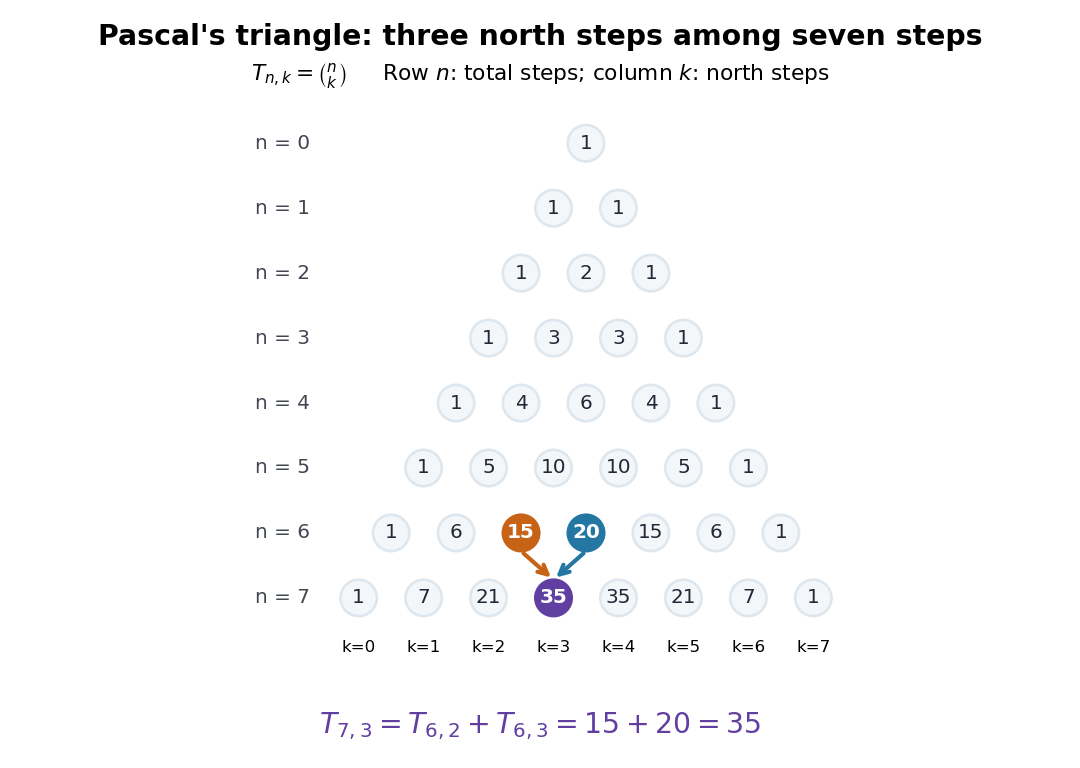
Rows zero through seven of Pascal's triangle, with
. The index increases from left to right in each row; it counts north steps in the north-east lattice path interpretation. Each row index counts all steps. Details.
The triangular and rectangular layouts describe the same entries. For a north-east lattice path ending at , set and , so . The predecessor has indices , while has indices . Thus the grid's west and south arrivals are exactly the triangle's two parents. This change of indices explains why the north-east lattice path recurrence and Pascal's rule agree.
There is also a global check on the local construction: row sums to . Every subset of an -element set appears exactly once among the classes of sizes , and each element has two inclusion choices by the rule of product. In row seven, . Replacing every subset by its complement reverses the row, explaining . The binomial theorem packages the whole row as the coefficients of .
Blaise Pascal's Traité du triangle arithmétique, published in 1665, presents an arithmetic array and connects it to combinations, games of chance, and powers of binomial expressions. This makes the connection between a counting table and several applications visible in the original work. [ref]
https://archive.org/details/bub_gb_UqgUAAAAQAAJ. Pascal, Traité du triangle arithmétique, 1665 edition
The University of Cambridge's account of the treatise explains its 1654 composition and the organization of these applications. [ref]https://api.repository.cam.ac.uk/server/api/core/bitstreams/9bfbc9c8-fa56-4694-b96d-fc18db0f562f/content. Cambridge University Library, account of Pascal's treatise
Self-delimiting binary code Created 2026-10-06 Updated 2026-10-13
Codimension-two bifurcation 2026-10-06
A codimension-two bifurcation requires two independent parameter conditions to hold simultaneously. Simultaneous stationary and Hopf bifurcation thresholds require both kinds of critical mode in the reduced amplitude equation. A crossing of modes at different wavenumbers is different from a zero-frequency double-zero degeneration of one fixed-wave-number cubic.
Supercritical bifurcation 2026-10-06
A supercritical branch emerges on the parameter side where the original state loses stability. In the cubic Landau amplitude equation with , the nonzero branch lies at and is stable to radial amplitude perturbations. Continuous phase symmetry still leaves a neutral phase direction. The direction of a branch and its stability should both be checked in a general problem of bifurcation theory.
Subcritical bifurcation Created 2026-10-06 Updated 2026-10-13
A subcritical branch emerges on the parameter side where the original state remains stable. In the cubic Landau amplitude equation with , the small nonzero branch lies at and is unstable to radial amplitude perturbations. Higher-order saturation can generate a finite-amplitude stable branch and hysteresis, but this does not follow from a cubic truncation alone.
There are unlisted articles, also show them or only show them.