
Synchronous coupling Created 2026-10-06 Updated 2026-10-31
A synchronous coupling drives two processes with the same fresh random inputs. For example, recursions and use the same input at each step. This can reveal synchronous contraction of a random affine recursion even when independently simulated trajectories would conceal the relationship.
A synchronous coupling drives two solutions of a stochastic differential equation by the same Brownian motion. Their difference has noise coefficient . A dissipativity inequality for the drift and this coefficient gives the mean-square contraction of synchronously coupled diffusions.
Stochastic domination of probability measures Created 2026-10-06 Updated 2026-10-14
On a finite partially ordered state space, means for every real-valued order-preserving function . Equivalently, every increasing subset has no larger probability under than under . A coupling supported on pairs with proves this relation. This concerns order of probability laws, rather than stochastic asymptotic order notation.
Post-freeze-out relic abundance Created 2026-10-06 Updated 2026-10-14
For after freeze-out, the exact limit is . The frequently used estimate additionally neglects the initial inverse abundance.
Separately conserved visible and dark entropy Created 2026-10-06 Updated 2026-10-14
After thermal decoupling in cosmology, two homogeneous sectors that evolve adiabatically without entropy injection satisfy and , hence their entropy density ratio is fixed. At a common relativistic temperature before decoupling, . Internal annihilations can change each sector's temperature and effective entropy degrees of freedom without changing its total comoving entropy.
Reheating 2026-10-06
Reheating transfers the inflaton energy into other particles after cosmic inflation, eventually establishing a hot thermal bath. It requires interactions in addition to a background scalar potential. The duration and averaged equation-of-state parameter of reheating affect the number of e-folds between a chosen scale's horizon exit and the end of inflation.
de Sitter approximation Created 2026-10-06 Updated 2026-10-14
Approximately constant positive Hubble parameter gives a nearly de Sitter spacetime expansion in flat slicing. Its scale factor can be approximated by with negative conformal time increasing toward zero. Slow variation of the expansion rate limits the accuracy of this approximation.
Compact convex set 2026-10-06
A compact convex set is a compact set that is also a convex set. If is nonempty, its support function is finite in every direction. For such a nonempty , every exterior point admits a strictly separating hyperplane: minimize over , and put . Convexity and differentiation along the segment from to any give , while . This is the separation used to recover spatial support from Fourier growth.
Face of a convex set 2026-10-06
A convex set is a face of if , with and , implies . A singleton face is an extreme point. A face of a face is a face of the original convex set.
Recession cone 2026-10-06
The recession cone of a nonempty convex set consists of directions for which for every and . For a linear polyhedron it is exactly . A nonzero recession direction gives an unbounded ray, so a bounded nonempty polyhedron has recession cone . This excludes spurious zero-scale feasible points in the Charnes-Cooper transformation.
Half-space representation of a closed convex set Created 2026-10-06 Updated 2026-10-14
A closed convex set in a finite-dimensional Euclidean space is the intersection of all containing closed half-spaces. For a point outside a nonempty set, its Euclidean projection onto a convex set gives a separating normal. Applied to an epigraph, this turns geometric separation into affine lower bounds and is a key step in the Fenchel-Moreau theorem.
Conic optimization 2026-10-06
Optimization of a linear function subject to affine constraints and membership in a closed convex cone. Choosing the positive semidefinite cone gives semidefinite programming; other choices include copositive optimization and completely positive optimization. Dual cones produce scalar-product bounds on feasible objectives.
Convex positively one-homogeneous functional 2026-10-06
This is a proper convex function that has degree-one positive homogeneity, with . It need not be even or nonnegative; linear functionals are examples. Its subdifferential satisfiesThe two tests and prove equality; the subgradient inequality then gives the global upper bound. Conversely that bound and equality prove the subgradient condition. Hence a subgradient at also supports every nonnegative multiple of . Requiring gives an absolutely one-homogeneous functional.
Chambolle–Pock algorithm Created 2026-10-06 Updated 2026-10-14
For a saddle point problem , one update ordering isThe proximal operators treat both nonsmooth convex terms, while the extrapolation couples the primal and dual variables. The primal objective is , with the convex conjugate. A dual-first ordering is obtained by exchanging roles; consistent indexing is needed when comparing the formulas.
Minkowski addition Created 2026-10-06 Updated 2026-10-14
The Minkowski sum of subsets of a vector space collects the result of vector addition for every possible pair:Think of fixing a point of , making a translation of the whole of by , and then taking the union of these copies over every . The points of specify displacement vectors; they need not be the centre of a shape. Minkowski addition applies to nonconvex sets too. It is different from set union: for on the real line, but .
For axis-aligned rectangles in the Euclidean plane, the coordinate intervals add separately:Every coordinate between and can be split into one coordinate in and another in , and likewise for the vertical coordinate. Thus a rectangle plus a rectangle gives a square of area , although the two input areas total only . The Minkowski sum adds possible displacements, so its area need not be the sum of input areas.
For closed Euclidean disks centred at the origin, the triangle inequality gives . Conversely, if , split any as . Therefore , including the case . Disks of radii and give a disk of radius , with areas . For disks with centres , the resulting centre is . These two examples lead to the root-of-area comparison in the Brunn-Minkowski theorem.
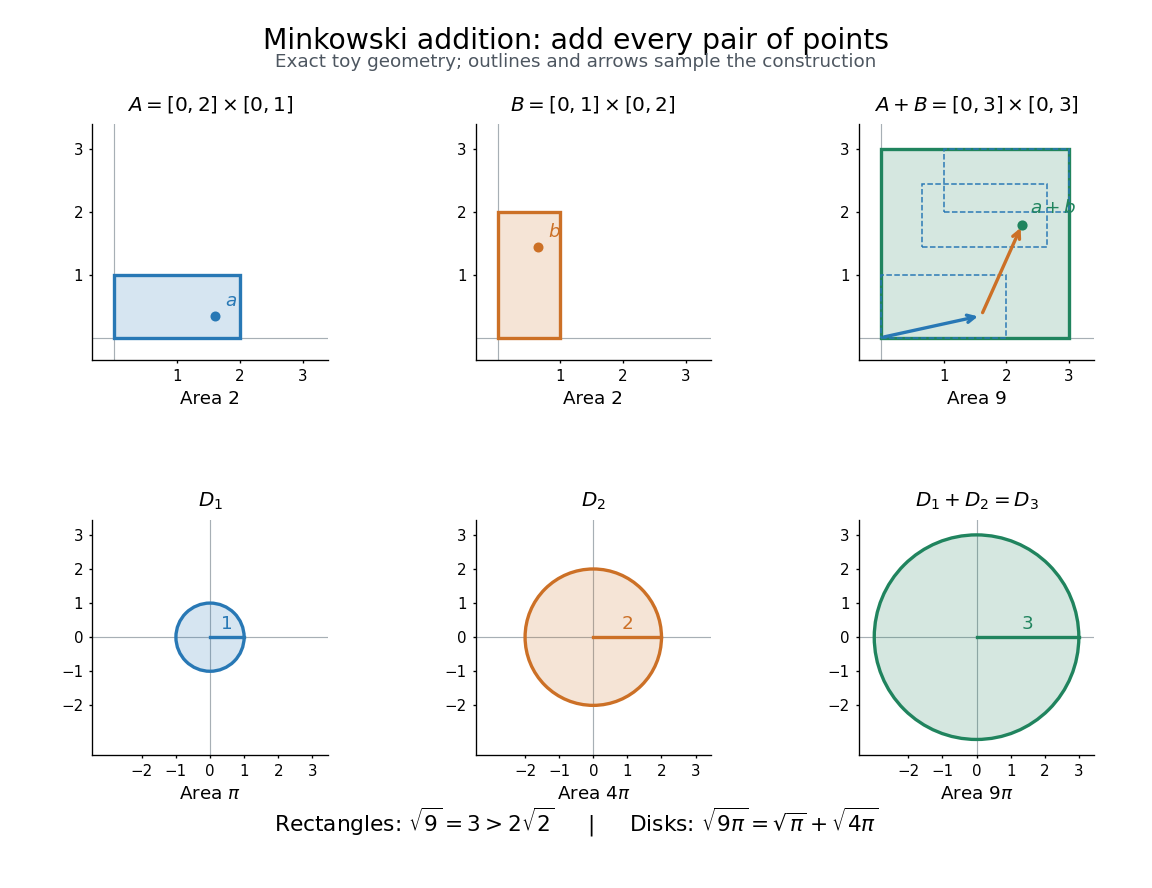
Minkowski addition of two rectangles and of two closed disks: exact toy shapes, sample displacement arrows, and the square-root-of-area comparison
. Details. 
Minkowski addition is commutative and associative because vector addition is. Its identity is the singleton , and . For displacement vectors and , translations and uniform dilations satisfywhere uses scalar multiplication. A Minkowski sum of convex sets is convex: a line segment between and is obtained by adding the corresponding points of the line segments in and . Closure requires care; see sum of two closed sets need not be closed and sum of a compact set and a closed set.
Long-wave convection equation with broken Boussinesq symmetry Created 2026-10-06 Updated 2026-10-14
A reduced long-wave convection model can combine linear damping, destabilizing second derivatives, stabilizing fourth derivatives and gradient nonlinearities. In the displayed normalization the quadratic coefficient breaks Boussinesq symmetry, while the cubic gradient term dissipates the mean-square temperature. The linear dispersion relation is , with critical wavenumber at . Smoothness and spatial averaging hypotheses must be specified before applying the energy method on an infinite interval.
The map is a conformal map from onto the unit disc. A principal square root first maps the slit parabolic region to a vertical strip, and a scaled tangent followed by squaring maps the strip to a slit disc. Evenness in the square-root variable gives a holomorphic extension across the removed axis, filling the target slit.
Conformal inversion of a quadrant Created 2026-10-06 Updated 2026-10-14
The map sends the open second quadrant inside the unit circle bijectively to the open first quadrant outside it. Radius becomes and argument becomes . Its derivative is nonzero on the source, so it is a conformal map. Rotation combined with reciprocal inversion similarly maps other quarter-disc regions.
Kolmogorov complexity 2026-10-06
Kolmogorov complexity measures the length of a shortest effective description of an object. Fixing an optimal description machine gives an invariant quantity up to an additive machine-dependent constant. Plain Kolmogorov complexity is especially convenient for counting descriptions shorter than a binary string.
Productive set 2026-10-06
A set is productive when a partial computable function returns an element of outside any computably enumerable subset supplied by its index. The function must halt for every index of a subset of , including finite subsets. Productive sets are not computably enumerable.
Bounded simulation of a computation Created 2026-10-06 Updated 2026-10-07
A bounded simulation records whether a specified deterministic program has halted, with a specified output, within a given finite number of steps. This is a primitive recursive predicate of the program code, input and time bound. Peano arithmetic can verify genuine finite computation certificates and prove that two different outputs cannot both be the first halting output.
There are unlisted articles, also show them or only show them.