
Worldsheet Majorana fermion 2026-10-05
Each real chiral fermion has conformal weight and contributes to the central charge. The Ramond sector and Neveu–Schwarz sector differ by periodic versus antiperiodic boundary conditions.
Superconformal ghost 2026-10-05
The commuting beta-gamma system produced by worldsheet supersymmetry gauge fixing has conformal weights and central charge per chiral sector.
Rigid worldsheet supersymmetry boundary term 2026-10-05
In flat conformal gauge, take and rigid transformations , , with . The Majorana Grassmann bilinear interchange and Clifford algebra combine the variations intoThe identity is off shell. The integrated action is invariant when its boundary flux vanishes, for example on a closed worldsheet or with compatible supersymmetric endpoint conditions. Constant spinors and ordinary derivatives here refer to flat gauge; arbitrary curved worldsheets require covariant spinor derivatives and the locally supersymmetric completion.
Worldsheet gravitino Created 2026-10-05 Updated 2026-10-06
The worldsheet gravitino is the fermionic vector-spinor gauge field for local worldsheet supersymmetry, paired with the worldsheet metric in two-dimensional supergravity. In a locally supersymmetric string action it couples to the worldsheet supercurrent. Fixing its gauge and the bosonic conformal gauge leaves the usual flat rigid transformations on embeddings and worldsheet Majorana fermions; it should not be silently omitted when claiming an arbitrary curved-worldsheet locally supersymmetric action.
Run of a word Created 2026-10-05 Updated 2026-10-14
Bessel transition for an exponentially decaying oscillator Created 2026-10-05 Updated 2026-10-14
An oscillator with frequency leaves the WKB approximation when becomes order one. The shifted variable changes its leading undamped equation to . With this is the order-zero Bessel differential equation. Large- Bessel functions match the earlier oscillations, while the small- constant and logarithmic solutions become a constant and a linear function of late time.
Receiver-averaged Wigner distribution Created 2026-10-05 Updated 2026-10-14
For receiver-dependent Green functions and aperture weight , define . Its inverse separation Fourier transform is the kernel of the time reversal operator on the source plane.
Vanishing odd correlators of a free Gaussian field Created 2026-10-05 Updated 2026-10-14
A centered free field in a Gaussian vacuum has only pair contractions, so every odd correlator vanishes by Wick theorem. Equivalently, number parity reverses the field while preserving the vacuum. This statement applies to smeared or regulated fields; it does not assert that unregulated coincident products exist. Interactions or a nonzero field mean can invalidate it.
Euclidean action Created 2026-10-05 Updated 2026-10-20
A Wick rotation from real time to imaginary time replaces the oscillatory weight by . For a real scalar with positive kinetic normalization, . Positivity of its kinetic term does not ensure convergence if the potential is unbounded below. Fermionic integrals instead use independent Grassmann fields and need not define a positive measure.
Supersymmetric relation between quartic and Yukawa couplings Created 2026-10-05 Updated 2026-10-07
In a canonical Wess–Zumino model with cubic superpotential , eliminating the auxiliary field gives and . Thus the coefficient of the quartic scalar field interaction is the squared modulus of this convention for the Yukawa coupling.
The weak topology and norm topology of a separable Banach space generate the same Borel sigma-algebra. A countable norming family makes every norm ball weakly Borel measurable, and separability makes every norm-open set a countable union of such balls. The reverse inclusion follows because the weak topology is coarser.
Weakly bounded set 2026-10-05
A subset of a normed vector space is weakly bounded when for every . It is norm bounded: its canonical embedding into the bidual is a pointwise bounded family of functionals on the complete continuous dual space, so the Uniform boundedness principle applies. The converse is immediate. A weakly compact set is weakly bounded because each scalar evaluation has compact image.
Countable separating family metrizes a weakly compact set Created 2026-10-05 Updated 2026-10-07
If a countable family in separates points of , the displayed metric induces the weak topology on every weakly compact set . The coordinate map into the countable product of scalar lines is continuous and injective; a continuous injection from a compact space into a Hausdorff space is a homeomorphism onto its image. Equivalently, uniform convergence of the metric series makes the identity from weak to metric continuous. Compactness is essential: point separation alone need not generate the weak topology on an arbitrary bounded set.
Vanishing moment Created 2026-10-05 Updated 2026-10-14
A vanishing moment is a cancellation condition: positive and negative parts of an analyzing function balance when weighted by a monomial. Having vanishing moments means that the first such balances hold, starting with the unweighted integral:Consequently a wavelet ignores local polynomial trends of degree of a polynomial less than . A smooth feature is close to its Taylor polynomial, so only the small Taylor remainder contributes to its detail coefficient. A jump discontinuity cannot be approximated this way across its edge; its jump response of a localized analyzing function can remain large relative to details from a smooth region.[ref]
Wavelet Bases. Wavelet Bases, §7.2.1, printed p. 206, equation (7.69) and the paragraph explaining cancellation of Taylor polynomials
These are ordinary absolutely convergent integrals, not a prescription for assigning values to divergent expressions. A sufficient assumption isIt makes and all for integrable functions. Being square-integrable alone does not ensure these weighted integrals exist. For a square-integrable function with compact support, the Cauchy-Schwarz inequality guarantees every such weighted integral is finite. Saying exactly vanishing moments additionally requires an existing, nonzero next integral ; the usual phrase “has ” allows more cancellation.
Interval-adapted wavelet basis 2026-10-05
An interval-adapted wavelet basis is an orthonormal basis of made of a finite coarse scaling function family and resolution-indexed wavelets. A localized construction modifies only a bounded number of functions near each endpoint at every level. Boundary modification must preserve nested refinement spaces and the required vanishing moments; simple restriction of a whole-line basis does not do so.
Tensor-product wavelet basis Created 2026-10-05 Updated 2026-10-14
Wavefront error 2026-10-05
A wavefront error is the difference in optical path length from a reference wavefront, often an ideal plane or sphere. Its root mean square should specify the illuminated pupil and which modes, such as constant phase or image displacement, have been removed.
Optical path length Created 2026-10-05 Updated 2026-10-14
An optical path length measures how much propagation wave phase a path accumulates, expressed as the distance that would accumulate the same wave phase in vacuum. A centimetre in a uniform medium with refractive index has optical path length , although its geometric length remains . This makes optical path length useful whenever two contributions must arrive with matching wave phases, from an optical lens to a Michelson interferometer. [ref]
For a specified path at fixed angular frequency , the optical path length is the line integralHere is geometric arc length, and is the phase refractive index, evaluated at the same frequency everywhere. The propagation interpretation assumes a stationary linear medium with isotropy, a real positive scalar refractive index and negligible loss, on a valid geometrical optics branch. The path can curve; at sharp interfaces apply the appropriate matching conditions to each segment. A prescribed curve has a mathematical line integral, but it predicts a propagation wave phase only when it represents the physical branch. [ref] Optical fibers can require a mode wavenumber rather than the bulk refractive index along a guessed light ray. [ref]
Fix the vacuum wavelength , with frequency and vacuum wavenumber . In a locally uniform medium the wavelength is , while the frequency stays unchanged at a stationary interface. With the convention , propagation from a specified starting wave phase contributesThe relative reference includes launch wave phases and any extra wave phase from mirrors, beam splitters or coatings. Thus is a propagation contribution, not an absolute detector wave phase independent of the apparatus. If the reference contributions stay fixed, a change in optical path difference changes the phase difference by . Using the material wavelength again in this formula would count the refractive index twice. [ref]
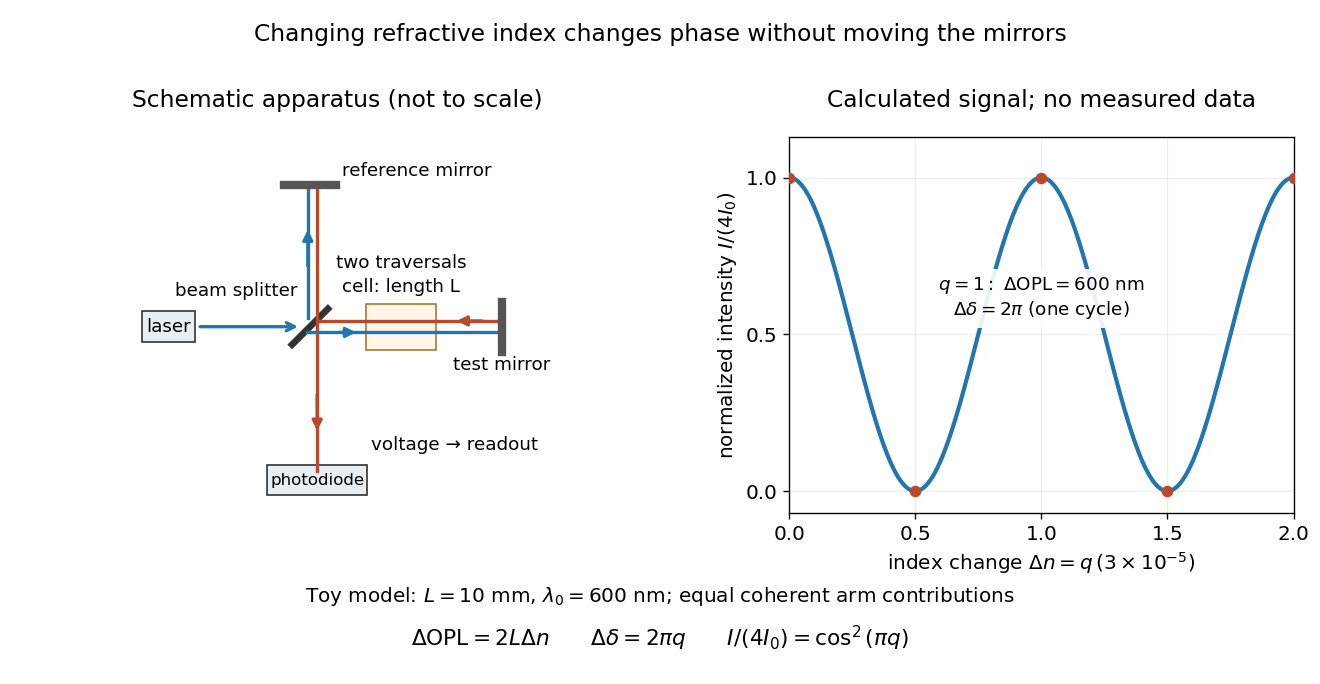
Optical path difference in a Michelson interferometer: apparatus schematic and a calculated phase difference readout
. Details. 
A motivating measurement turns invisible optical oscillations into a slowly changing electrical signal. MIT's teaching experiment uses a laser, a beam splitter, two returning mirrors, an amplified photodiode, an oscilloscope and a calibrated mirror actuator driven by a function generator. The returning beams overlap on the photodiode; one channel records detector voltage and another the actuator drive. The measured observable is the changing light intensity, including its maxima and minima, rather than direct timing of an optical cycle. A calibrated displacement per drive voltage and the spacing of the extrema relate geometric motion to the phase difference. The guide infers the laser wavelength from known actuator calibration; conversely, with independently known vacuum wavelength and ambient refractive index, the same relation calibrates mirror motion. These two unknowns cannot both be inferred from fringe spacing alone. [ref]
For a proposed change-of-medium measurement, keep the mirrors fixed and put a transparent cell of internal length in one arm. Compare its contents at refractive indices and , leaving its windows in place. At normal incidence the two traversals giveHere is the signed number of whole interference fringe cycles plus any resolved fractional cycle, counted continuously. A mirror displacement instead gives ; distinguish this double-pass factor from a single pass in a Mach-Zehnder interferometer. OpenStax's gas-cell worked example provides the same double-pass reasoning; it is a teaching calculation rather than a published measurement dataset.[ref]
An exact toy calculation makes the sensitivity visible. Stipulate , and . Then and : a full interference fringe cycle, despite unchanged geometric lengths. For a continuous change , let and choose the initial detector phase difference to be zero. Equal coherent detected arm contributions of light intensity predictThe plot is this stipulated model: gives a minimum, restores a maximum, and the reference level is chosen by adjustment of the apparatus. It contains no measured values or assigned properties of a real gas. The equivalent mirror travel in vacuum is per cycle. A single endpoint light intensity cannot distinguish from ; the continuous fringe count carries the missing information.
For an interpretable cell measurement, establish the initial phase difference with a small calibrated mirror scan, then track slow changes through successive interference fringes. Measure the dark signal and each arm separately, keep photodiode gain within its linear range, align both beams on the same region and match their linear polarizations. Monitor interferometric visibility and keep arm delays within the useful optical coherence time. Record cell length, contents, pressure and temperature; return to the starting condition to check drift. Changes in window deformation, cell length, external air or mirror position also change optical path length, so a reference cell or an independently monitored mechanical path is needed to isolate the contents' refractive index. These controls are deductions from the model, not a claim that the illustrated apparatus was operated. Loss of fringe count leaves a whole-cycle ambiguity; at an intensity extremum the first derivative with respect to phase difference vanishes, so a scan around phase quadrature is more sensitive to small changes. Broadband illumination, unstable optical coherence, vibration and strong loss can invalidate a simple one-frequency inference.
p-Wasserstein distance 2026-10-05
For and probability measures with finite th absolute moments,where is the ground metric and ranges over transport plans. For this is the second Wasserstein distance.
Kantorovich–Rubinstein theorem 2026-10-05
On a Polish space , probability measures with finite first moments satisfyThe supremum runs over functions with Lipschitz constant at most one. Fixing ensures integrability from the moment assumption.
There are unlisted articles, also show them or only show them.