
Axiom of power set Created 2026-09-24 Updated 2026-10-14
Axiom schema of replacement Created 2026-09-24 Updated 2026-10-14
Function Created 2026-09-24 Updated 2026-10-14
A function assigns exactly one output in the specified codomain to each input in its domain of a function . Its rule may be a formula, a finite table, or another unambiguous assignment. The outputs actually reached form its image of a function . A codomain states where outputs are allowed; the image of a function records where they actually land. Oscar Levin's introduction makes this distinction explicit. [ref]
https://discrete.openmathbooks.org/preview/sec_intro-functions.html. Levin, Discrete Mathematics: An Open Introduction, Functions
.For example, , , has the entire real line as its domain of a function and codomain, but its image of a function is . Both and give the output : several inputs sharing an output is permitted. Assigning two distinct outputs to one input is not permitted. A partial function can be undefined at some elements of a larger specified source set; an ordinary function on must be defined at every element of .
Three properties describe how a function uses its target. An injective function never sends distinct inputs to the same output. A surjective function reaches every member of its specified codomain. A bijection does both, pairing each source element with exactly one target element. These are different requirements, as finite arrow diagrams show.
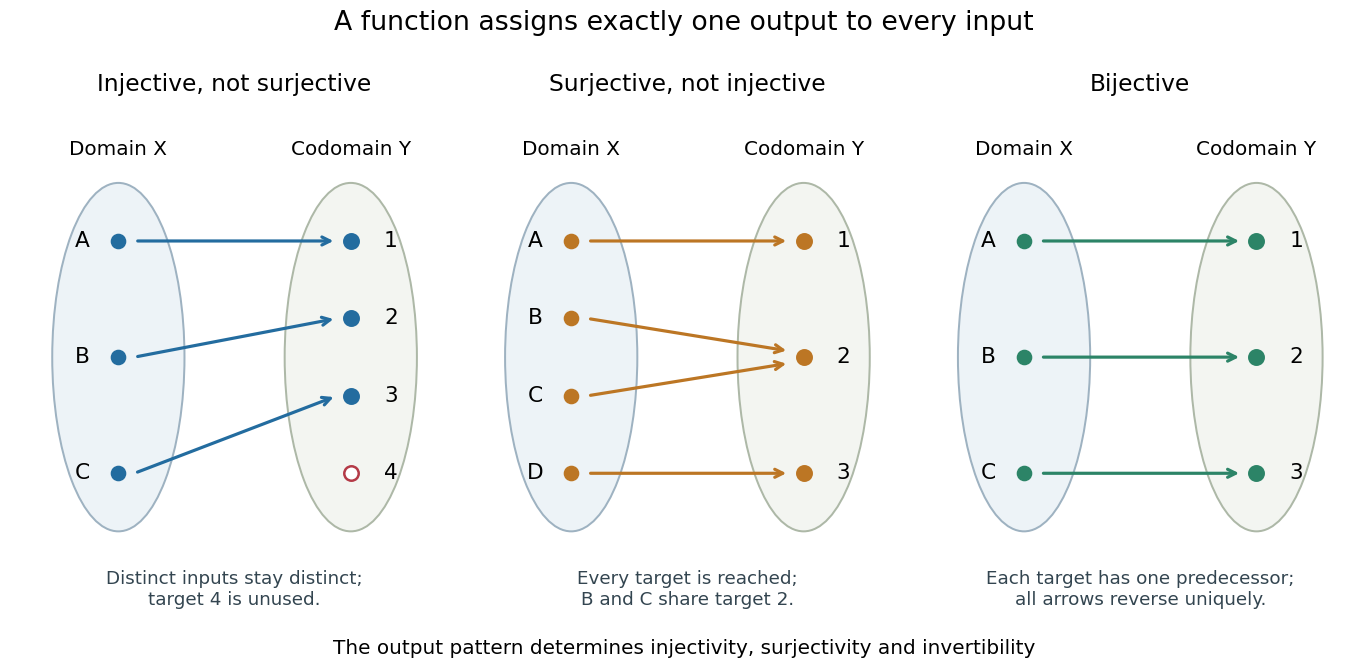

The chosen codomain matters even when the formula does not change. The function from to is not surjective, whereas the same rule from to is surjective. Both fail injectivity. Further restricting the domain of a function to makes it a bijection onto , with square root as its inverse function.
Functions make transformations composable: if and , their function composition is . Identifying each intermediate codomain prevents attempting to feed an output into a rule that is not defined there. When a transformation is a bijection, an inverse function recovers the original input without ambiguity. This is useful whenever information must be transported or a calculation reversed.
Binary relation Created 2026-09-24 Updated 2026-09-24
Set Created 2026-09-24 Updated 2026-10-14
A set is a collection of distinct objects regarded as its set elements. Membership, written , is the basic question: is one of the objects in ? For example, : repeated entries and their written order do not change a set. A multiset retains multiplicities, while a tuple retains positions as well. Choosing the right object therefore determines which distinctions the mathematics remembers.
A set can collect possible outcomes of a probability space, vertices of a graph, or allowed inputs of a function. The empty set contains none; a subset selects members of a previously given set; the power set collects every such selection. These constructions are useful because they can be stated once and reused regardless of what the members represent. In an axiomatic account, rules such as the axiom schema of separation specify which collections exist as sets.
Extensional relation Created 2026-09-24 Updated 2026-10-14
Well-founded relation Created 2026-09-24 Updated 2026-10-14
Transitive set Created 2026-09-24 Updated 2026-10-14
Forcing Created 2026-09-24 Updated 2026-09-24
Forcing extends a model of set theory by adjoining a filter generic for a partially ordered set of finite or otherwise controlled approximations.
Definable power set Created 2026-09-24 Updated 2026-10-05
The definable power set consists of the subsets of definable over the first-order structure by a first-order formula with parameters from . Satisfaction for a set structure makes this a definable operation in ZF. Iterating it produces the constructible hierarchy and the relative constructible hierarchy; their unions are the constructible universe and the relative constructible universe.
Von Neumann hierarchy Created 2026-09-24 Updated 2026-10-03
The von Neumann hierarchy isEvery level is transitive, the levels are increasing, and every set belongs to some level.
Schwarzschild light deflection Created 2026-09-24 Updated 2026-10-14
Proper acceleration of a static Schwarzschild observer Created 2026-09-24 Updated 2026-09-24
A static observer at Schwarzschild radius must maintain the outward proper accelerationIt approaches the Newtonian value at large radius and diverges at the horizon.
Gravitational redshift between static Schwarzschild observers Created 2026-09-24 Updated 2026-10-14
For static observers at radii and , equal Schwarzschild-coordinate time intervals correspond to proper times . Hence
This static-observer relation is a special case of gravitational redshift, not a definition of every gravitational frequency shift.
Schwarzschild event horizon Created 2026-09-24 Updated 2026-10-03
The surface is the future event horizon of Schwarzschild spacetime. Its singularity in Schwarzschild coordinates is removable, whereas is a curvature singularity.
Schwarzschild tortoise coordinate Created 2026-09-24 Updated 2026-10-03
The tortoise coordinate satisfies
Schwarzschild radius Created 2026-09-24 Updated 2026-09-24
Equatorial null orbit in Schwarzschild spacetime Created 2026-09-24 Updated 2026-09-24
Radial Weyl curvature of Schwarzschild spacetime Created 2026-09-24 Updated 2026-09-24
With the curvature conventionthe vacuum Schwarzschild metric satisfiesThe opposite Riemann-sign convention reverses this sign.
Cosmological redshift Created 2026-09-24 Updated 2026-10-14
The cosmological redshift is the stretching of a freely propagating photon's wavelength between emission at cosmic time and reception at in an FLRW metric. For a comoving observer at each endpoint,Here are emitted and received wavelengths, and are the corresponding frequencies. A positive cosmological redshift means that the scale factor grew while the photon travelled. The name describes a shift toward longer wavelengths; it applies to light beyond the visible range as well.
For a computed example, let the scale factor double from to . An emitted wavelength of becomes , giving . The received frequency is half the emitted frequency. This determines a ratio of spatial rulers, not a recession speed: using as an actual velocity at is unjustified. The wavelength panel in the illustration under Hubble's law shows this doubling.
A short derivation follows successive wave crests along a radial null geodesic in FLRW spacetime. Their source and receiver have fixed comoving coordinates, so each crest traverses the same comoving distance:Shift both endpoint times to the next crest while keeping fixed. To first order in the very short periods , this gives . Locally, wavelength equals the speed of light times the crest period, yielding the displayed cosmological redshift relation. These periods are much shorter than the timescale on which the scale factor changes.
The relation isolates the smooth expansion contribution. An observed redshift can also contain a Doppler effect from source or observer peculiar velocity and a gravitational redshift. See combined kinematic and cosmological redshift for the multiplicative combination of endpoint motion and expansion. Treating every observed redshift as pure cosmological redshift can therefore misassign a nearby source's distance.
The useful insight is that a received wavelength ratio records how much the scale factor changed during the photon's journey. Turning that ratio into a distance requires an expansion history, through the Hubble parameter, and a specified convention such as luminosity distance or proper distance in cosmology; the ratio alone supplies neither.
There are unlisted articles, also show them or only show them.