
Principal sl2 subalgebra Created 2026-09-24 Updated 2026-10-14
A principal sl2 subalgebra of a semisimple Lie algebra has semisimple generator . Restriction to it packages a representation's weights into ordinary weight strings.
The infinitesimal embedding is a subalgebra of the semisimple Lie algebra; integrating it to a Lie-group homomorphism is a separate group-level construction.
Casimir element Created 2026-09-24 Updated 2026-10-03
Highest-weight representation Created 2026-09-24 Updated 2026-10-14
A highest-weight representation is generated by a weight vector killed by every positive-root subspace.
Cartan subalgebra Created 2026-09-24 Updated 2026-10-03
For a complex semisimple Lie algebra, a Cartan subalgebra is a maximal abelian subalgebra consisting of semisimple elements. It is also called a maximal torus in this setting.
Simple Lie algebra Created 2026-09-24 Updated 2026-10-05
Borel subalgebra Created 2026-09-24 Updated 2026-09-24
For a choice of positive roots, the corresponding Borel subalgebra is , the sum of a Cartan subalgebra and all positive root spaces.
Semimartingale decomposition Created 2026-09-24 Updated 2026-09-24
A semimartingale has a decomposition into a local martingale and an adapted finite-variation process . Under standard normalizations the decomposition is unique.
Finite-variation process Created 2026-09-24 Updated 2026-10-05
A process has finite variation on compact intervals when every sample path has finite total variation of a function there. Such a process can be integrated pathwise by the Lebesgue-Stieltjes integral.
Action integral for a linear-to-square-root potential Created 2026-09-24 Updated 2026-09-24
Internal effective temperature of a planet Created 2026-09-24 Updated 2026-09-24
The internal effective temperature parametrizes the intrinsic cooling luminosity of a planet through .
Irradiation temperature Created 2026-09-24 Updated 2026-09-24
The irradiation temperature is defined from the incident stellar flux, commonly by before redistribution and albedo factors are applied.
Algebraic concordance of knots Created 2026-09-24 Updated 2026-10-03
Two Seifert forms are algebraically concordant when their difference is metabolic. Stable equivalence classes form the algebraic concordance group.
Seifert matrix Created 2026-09-24 Updated 2026-09-24
A Seifert matrix represents the Seifert form in an integral basis of . Its skew-symmetrization represents the intersection form of the surface and is unimodular.
Elementary logarithmic lower bound for primes in the quadratic-residue classes of two Created 2026-09-24 Updated 2026-09-24
Let count primes at most congruent to modulo eight. Bounding the prime-power divisibility ofabove and its size below gives, for all sufficiently large ,
Euclid proof for infinitely many primes congruent to seven modulo eight Created 2026-09-24 Updated 2026-09-24
If listed all primes congruent to seven modulo eight, then for the odd number is seven modulo eight. Every prime factor is one or seven modulo eight, at least one is seven, and none is among the , a contradiction.
Change of independent variable in a second-order ODE Created 2026-09-24 Updated 2026-09-24
Legendre differential equation Created 2026-09-24 Updated 2026-10-14
The equation has the Legendre polynomial of degree as its normalized regular polynomial solution when is a nonnegative integer.
Reduction of order Created 2026-09-24 Updated 2026-09-24
Given one nonzero solution of a homogeneous second-order linear equation, reduction of order constructs a second by writing it as a variable multiple of the first.
Variation of parameters Created 2026-09-24 Updated 2026-10-18
Variation of parameters replaces the constants in a complementary solution by functions to construct a particular solution.
For the inhomogeneous linear differential equation , assume are continuous functions on an interval , and are linearly independent homogeneous solutions there. With and , variation of parameters constructs the particular solutionThe Wronskian has no zeros on , so these quotients are defined. For , normalize first: , not .[ref]
To derive the formula, write and impose . This auxiliary choice removes extra terms from the first derivative. Substitution into the inhomogeneous linear differential equation leaves . The two linear equations for have determinant , and Cramer's rule givesIntegrating from makes . Arbitrary integration constants contribute only homogeneous solutions; adding supplies the general solution.
For a worked example, use the same homogeneous solutions and the forcing term in . With and ,Consequently the particular solution selected by zero initial conditions isIts value and first derivative vanish at zero. Direct substitution confirms the forcing term: the differential operator annihilates the last two terms and maps to . The two integrals therefore build a response from known homogeneous solutions, even when the forcing term has no convenient elementary guess.
Wronskian Created 2026-09-24 Updated 2026-10-18
For two differentiable functions on an interval , their Wronskian is the functionThe order matters: exchanging and reverses the sign. For sufficiently differentiable functions, the Wronskian is the determinant .[ref]
1 Algebraic and Analytic Methods. NIST Digital Library of Mathematical Functions; §1.13(i), equation 1.13.4 and the following n-argument definition
The Wronskian measures whether the vectors and supply independent value-and-derivative data at that point. For real-valued functions, its absolute value is the area of the parallelogram they span. If a constant linear combination is zero throughout , then too. A nonzero Wronskian at even one point makes this pair of linear equations invertible and forces . Thus a nonzero Wronskian somewhere always proves linear independence of the functions on .
For an explicit example, the exponential functionssolve the same homogeneous linear differential equation on the whole real line: substitution gives and , respectively. Their Wronskian isFor the initial value problem , , the linear combination requires and . Hence , , and . The nonzero Wronskian makes the two initial conditions independently adjustable.
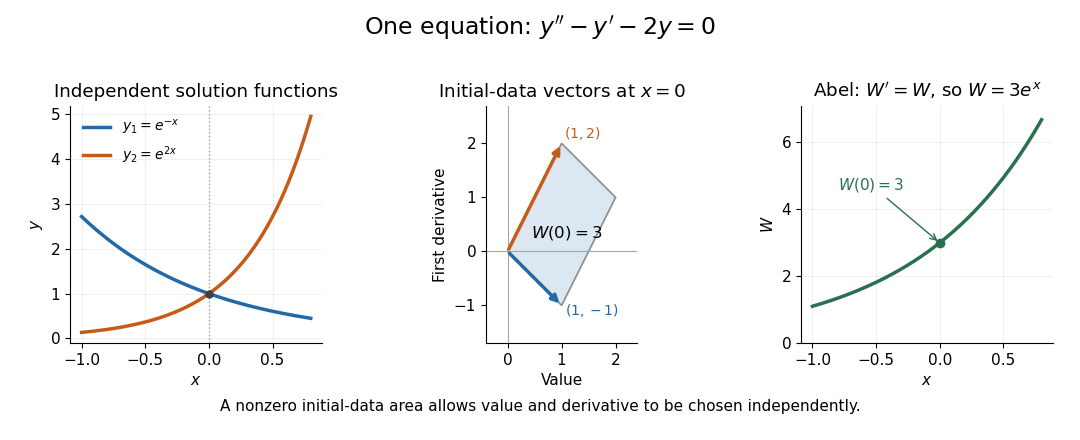
Independent exponential functions supply independent initial data, with Wronskian equal to the oriented parallelogram area
. Details. 
The stronger converse requires a common equation. Suppose solve with continuous functions on one interval . Then the functions are linearly independent if and only if their Wronskian is nonzero at one point, equivalently at every point. If , choose constants , not both zero, making satisfy . The superposition principle makes a solution of a differential equation for the same equation, and the uniqueness theorem for ordinary differential equations forces to be identically zero. This proves linear dependence.[ref]
The Wronskian. 18.03 Supplementary Notes by Haynes Miller; Chapter 15, The Wronskian, printed pp. 72–73: initial-data system (3) and the zero-or-nowhere-zero theorem
For arbitrary differentiable functions, an identically zero Wronskian need not imply linear dependence. Consider, on ,Both functions have three continuous derivatives. On each side of zero, is a constant multiple of , so ; at zero their values and first derivatives are all zero, so the Wronskian is zero there too. Nevertheless evaluated at gives , while evaluation at gives . Hence : these functions are linearly independent on the whole interval. There is no single constant multiplier valid on both sides of the common zero.
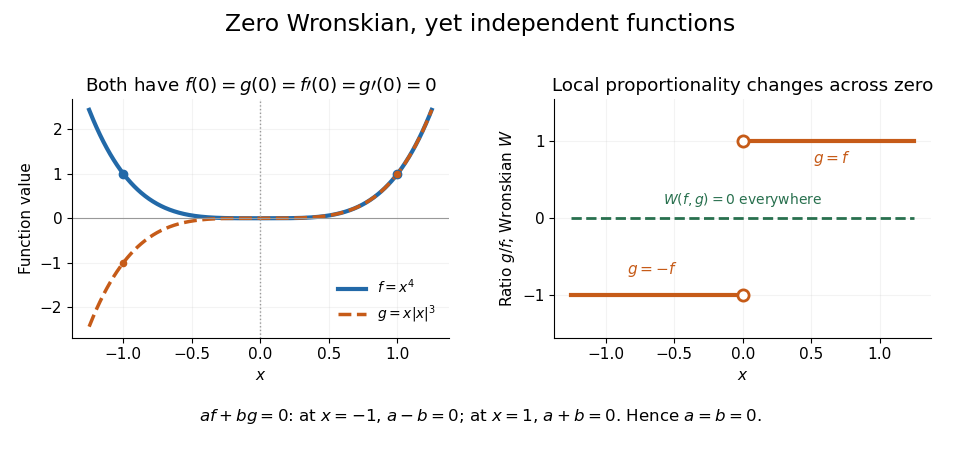
An identically zero Wronskian can coexist with linear independence when the common regular equation hypothesis is absent
. Details. 
These functions cannot both solve any equation with continuous functions throughout : even alone would contradict uniqueness because but is not identically zero. They do solve the singular equation , whose leading coefficient vanishes at zero. Dividing by gives only away from zero; Abel's identity cannot be applied across that point. The example pinpoints why checking the equation and its interval is essential before using a zero Wronskian to infer linear dependence.
There are unlisted articles, also show them or only show them.