
Prime-power ideal Created 2026-09-24 Updated 2026-10-03
Comaximal ideals Created 2026-09-24 Updated 2026-10-14
Intersection of ideals Created 2026-09-24 Updated 2026-09-24
Product of ideals Created 2026-09-24 Updated 2026-10-03
Principal ideal Created 2026-09-24 Updated 2026-10-14
Generating set of an ideal Created 2026-09-24 Updated 2026-10-06
Primary ideal Created 2026-09-24 Updated 2026-10-06
Hyperbolic polygon area Created 2026-09-24 Updated 2026-09-24
For a geodesic hyperbolic -gon of curvature with interior angles , triangulation or the Gauss--Bonnet theorem gives
Hyperbolic Pythagorean identity Created 2026-09-24 Updated 2026-10-14
The identity implies
The identity follows directly from the exponential definitions of the hyperbolic functions.
Small-argument expansion of the hyperbolic tangent Created 2026-09-24 Updated 2026-10-14
Gravitational scattering angle Created 2026-09-24 Updated 2026-09-24
The gravitational scattering angle is the change between incoming and outgoing asymptotic velocity directions.
Huber loss Created 2026-09-24 Updated 2026-10-18
The Huber loss is quadratic near zero and linear beyond a fixed cutoff; its derivative is the clipped Huber score.
For threshold , the Huber loss is the loss functionThe subtraction makes the values meet at ; the slopes also meet, so the Huber loss is continuously differentiable with Huber score as its derivative. It is a convex function, since that derivative is a monotone function. These quadratic and linear pieces define the original clipped location criterion.[ref]
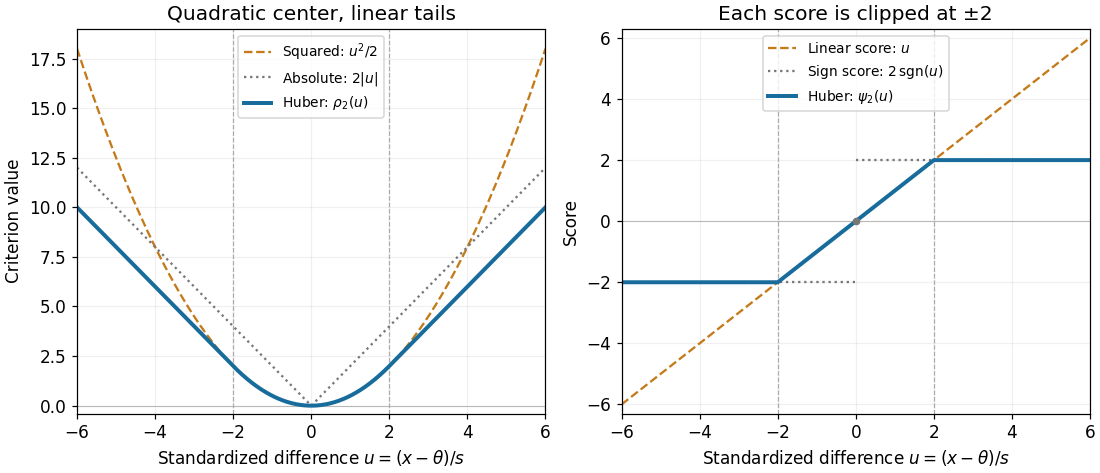

For , , , and , whereas the squared criterion at is . Increasing a standardized difference from to raises the Huber loss by , but raises the squared criterion by . The compromise preserves quadratic sensitivity to small differences while limiting the slope for large ones. This makes the Huber loss useful when ordinary observations should retain their detailed distances yet isolated outliers should exert limited pull.
For a fixed finite dataset and scale, taking large enough that every difference from the sample mean lies within recovers that sample mean. Toward the other extreme, for each fixed , as , connecting the criterion to median minimizes expected absolute loss. The normalization is essential: putting into the unscaled Huber loss gives zero everywhere, not a usable median criterion.
Whitehead theorem Created 2026-09-24 Updated 2026-09-24
A weak homotopy equivalence between connected CW complexes is a homotopy equivalence. The analogous statement holds for Kan complexes.
Hurewicz theorem Created 2026-09-24 Updated 2026-09-24
If a path-connected space is -connected for , then its first potentially nonzero homotopy group maps isomorphically to homology:
Rational homotopy group Created 2026-09-24 Updated 2026-09-24
The rational homotopy group is obtained by tensoring a homotopy group with the rational numbers. It retains the free part and discards torsion.
Loop-space shift of homotopy groups Created 2026-09-24 Updated 2026-09-28
Collapsing a contractible cofibration Created 2026-09-24 Updated 2026-10-05
If is contractible and has the homotopy extension property, the quotient mapis a homotopy equivalence. Extend a contraction of to ; its endpoint is constant on and therefore factors through to supply a homotopy inverse.
Sidorenko conjecture Created 2026-09-24 Updated 2026-09-24
The Sidorenko conjecture states that every bipartite graph satisfiesfor every bipartite host graph . Thus a random map is at least as likely to preserve every edge as the heuristic that treats the edge constraints independently predicts.
Character of the homogeneous polynomial representation of SU2 Created 2026-09-24 Updated 2026-09-24
Holographic D.C. conductivity Created 2026-09-24 Updated 2026-09-24
There are unlisted articles, also show them or only show them.