
Real projective plane Created 2026-09-24 Updated 2026-09-24
Rank-one orthogonal projection Created 2026-09-24 Updated 2026-10-14
Paw graph Created 2026-09-24 Updated 2026-09-24
Ramsey number of a star Created 2026-09-24 Updated 2026-09-24
Off-diagonal graph Ramsey number Created 2026-09-24 Updated 2026-10-06
Linear independence of adjacency powers up to the diameter Created 2026-09-24 Updated 2026-09-24
If a connected graph has adjacency matrix and diameter , thenare linearly independent. For the largest index with a nonzero coefficient, choose vertices at distance ; the corresponding entries of all lower powers vanish, while by the walk count from powers of an adjacency matrix.
Gram-Schmidt orthogonalization for a symmetric bilinear form Created 2026-09-24 Updated 2026-09-24
For a symmetric bilinear form , the same projection formulaproduces a -orthogonal basis whenever the chosen pivots are nonzero. Reordering the input vectors can avoid a zero pivot when a suitable anisotropic vector remains.
QR decomposition Created 2026-09-24 Updated 2026-10-14
A reduced QR decomposition of an matrix over the real numbers with full column rank, , writes , where is with orthonormal columns and is a upper triangular matrix with positive diagonal. Applying the Gram-Schmidt process to the columns of constructs and records the coefficientsThis last column identity is exactly the matrix multiplication . The upper triangular matrix records that the th input uses only the first new directions, while its positive diagonal records the norms of the nonzero orthogonal projection residuals. Since , one also has ; denotes the transpose and the identity matrix. Over the complex numbers, use the conjugate transpose in these identities.
For the three-dimensional Gram-Schmidt process example, the exact matrices areFor example, the last column reconstructs asThe diagonal entries are approximately . Each is a norm of the new direction before it was scaled to length one.
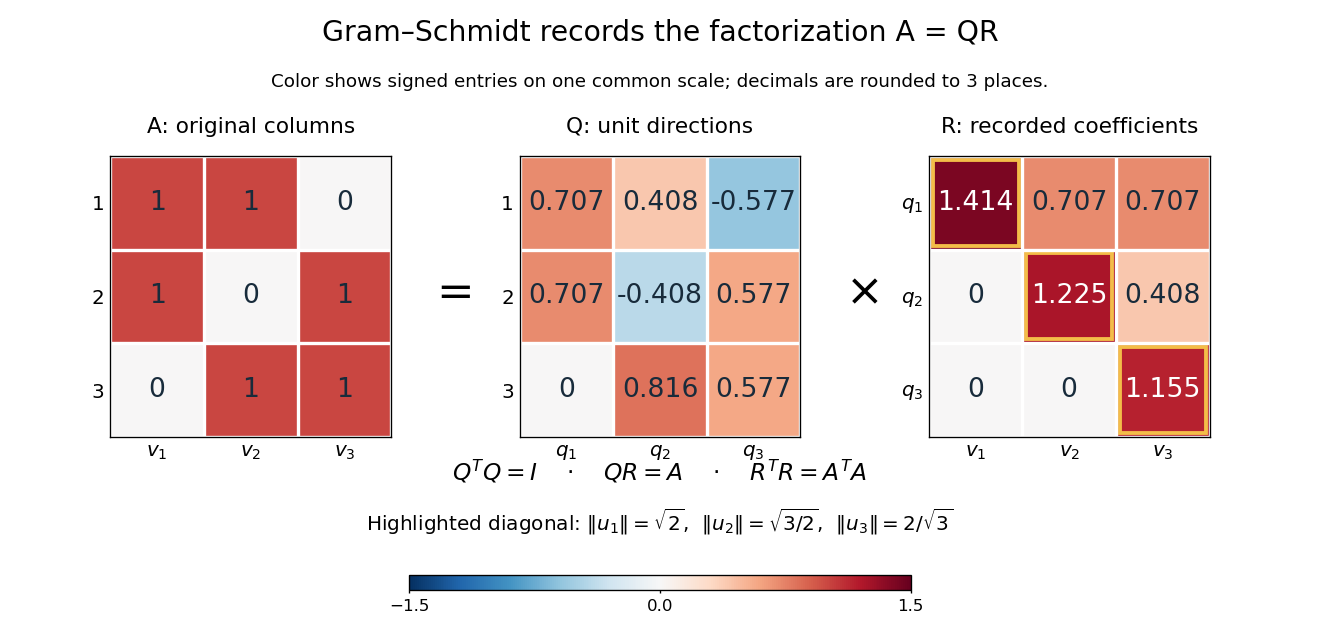
The computed QR factorization: input matrix , orthonormal columns of , and the upper triangular matrix of orthogonal projection coefficients
. Details. 
For a linear least-squares problem, the orthogonal projection of onto the column space of is . Hence the minimizing coefficients solve the linear system by back substitution. Let consist of the first two columns of the example; its reduced factors are and the leading block of . For , the linear system isThus , agreeing with the orthogonal projection computed above, and the minimum Euclidean norm of is . The QR decomposition separates building an orthonormal basis from recovering coefficients in the original basis.[ref]
https://ocw.mit.edu/courses/18-065-matrix-methods-in-data-analysis-signal-processing-and-machine-learning-spring-2018/resources/lecture-9-four-ways-to-solve-least-squares-problems/. Strang, MIT 18.065, Lecture 9: Four Ways to Solve Least Squares Problems
Hilbert series Created 2026-09-24 Updated 2026-10-14
Associated graded ring Created 2026-09-24 Updated 2026-10-14
Gowers-Cauchy-Schwarz inequality Created 2026-09-24 Updated 2026-09-24
Repeated Cauchy-Schwarz inequality gives
Three-party dense coding with a GHZ state Created 2026-09-24 Updated 2026-10-14
Quantum circuit preparation of a three-qubit GHZ state Created 2026-09-24 Updated 2026-10-14
Starting from , apply a Hadamard gate to the first qubit and then controlled-NOT gates from the first qubit to each of the other two qubits.
Bell measurement on one qubit and one leg of a GHZ state Created 2026-09-24 Updated 2026-10-14
Space of germs of holomorphic functions Created 2026-09-24 Updated 2026-10-14
The space of germs over a domain has basic open sheetsfor holomorphic on open . The projection restricts to a homeomorphism on each sheet, and these projections form holomorphic coordinate charts.
Finite geometric series Created 2026-09-24 Updated 2026-10-14
A finite geometric series is a sum of consecutive terms of a geometric progression. With first term and terms, including for the empty sum,Unlike an infinite geometric series, this identity does not need . For example, . The number of terms is five; the largest exponent is four.
The cancellation behind the formula is especially useful to remember: multiplying by the common ratio shifts all terms one place. In , every interior term cancels, leaving . Division by gives the identity when ; at the sum is directly . The same argument works for complex numbers.
For integers and , the shifted version isThere are terms. All powers must be defined; if a negative exponent is present, must be nonzero. At this sum is simply . The finite trigonometric sum uses this identity with a complex exponential as the common ratio.
Finite sums of positive integers in a geometric progression already appear in Euclid's Elements, Book IX, Proposition 35. The argument there compares differences of proportional numbers; Joyce's guide rewrites its conclusion as the modern finite-sum formula. This historical result concerns finite sums, without asserting an infinite limit. [ref]
https://mathcs.clarku.edu/~djoyce/elements/bookIX/propIX35.html. Euclid, Elements IX.35, with David Joyce's guide to the algebraic form
Genus one curve Created 2026-09-24 Updated 2026-10-14
A genus one curve is a smooth projective curve of geometric genus one. Choosing a rational point makes it an elliptic curve.
Affine parameter Created 2026-09-24 Updated 2026-10-03
An affine parameter on a geodesic is one for which the coordinate equation has the form . Its affine changes , with , preserve this form.
Normal section of a surface Created 2026-09-24 Updated 2026-09-24
Ambient acceleration criterion for a surface geodesic Created 2026-09-24 Updated 2026-09-24
For a smoothly parametrized curve on an embedded surface in Euclidean space, the geodesic equations hold exactly when the ambient acceleration is normal to the surface.
There are unlisted articles, also show them or only show them.