
Inflaton Created 2026-09-24 Updated 2026-09-24
Positive semidefinite cone Created 2026-09-24 Updated 2026-10-05
The positive semidefinite matrices form a convex cone because nonnegative combinations preserve nonnegative quadratic forms.
Convex hull Created 2026-09-24 Updated 2026-10-18
The convex hull of a set consists of every finite convex combination of its points. It collects all choices obtainable by mixing the original choices with nonnegative weights summing to one. For in a real vector space,Equivalently this is the smallest convex set containing . Mixing two already mixed points produces another finite convex combination, so the displayed set is convex; every convex set containing must contain all these mixtures.[ref]
Convex Optimization by Stephen Boyd and Lieven Vandenberghe. §2.1.4, printed p. 24: convex hull and smallest containing convex set
In an original planar example, take four points , , , and four additional samples , , , . Their convex hull is the filled convex polygon , including its boundary. None of the samples is , butThe coefficients are nonnegative and sum to one, providing an explicit membership certificate. Geometrically, first form on the line segment , then mix . The additional interior samples do not enlarge the convex hull.
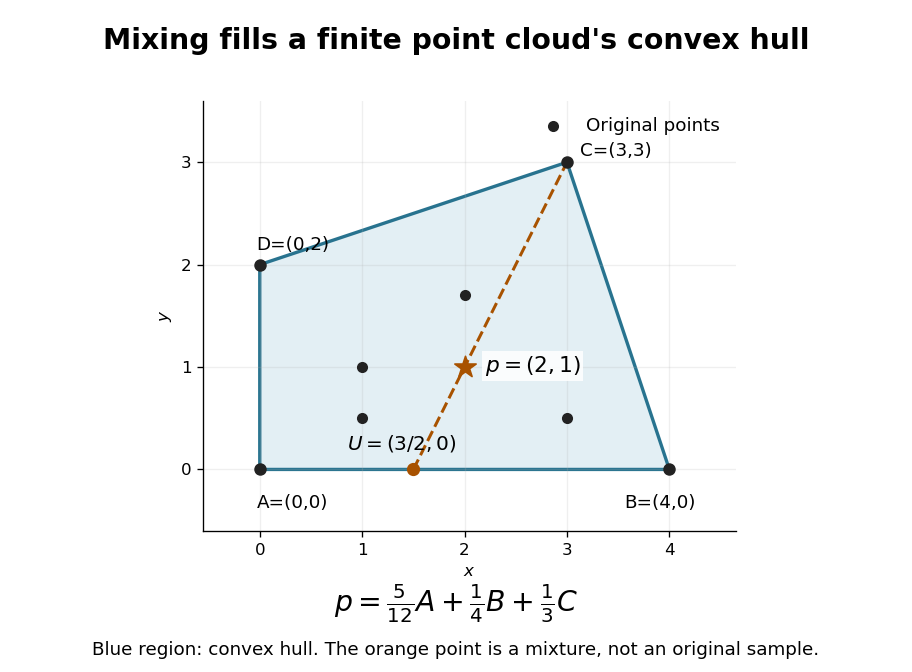

For a finite nonempty , the convex hull is the image of a probability simplex of weights under the linear map . The probability simplex is a compact set, and the map is continuous, so this convex hull is compact and closed. A one-point input stays one point; a collinear input stays in a line segment. Filling the convex hull does not necessarily produce a full-dimensional region.
The construction is useful whenever mixtures preserve the intended meaning of a choice. Mixing resource-allocation vectors, for example, interpolates their coordinate requirements. The convex hull describes the resulting feasible region. A coordinate-wise box can admit combinations that no mixture produces, as the outside-point certificate in linear optimization on a convex hull shows.
Second-order cone Created 2026-09-24 Updated 2026-10-14
Euclidean projection onto a convex set Created 2026-09-24 Updated 2026-10-14
For a nonempty closed convex subset of a finite-dimensional inner-product space, is the unique point of minimizing .
This closest-point map is the metric projection onto a closed convex set. Repeated projections onto several sets form the separate projections onto convex sets method.
Extreme point Created 2026-09-24 Updated 2026-10-18
An extreme point of a convex set is a point that cannot be made by genuinely mixing two different points of the set. For a convex set in a real vector space, the condition on isThus lies on no open line segment between two distinct points of . It is enough to exclude midpoint representations: if lies inside a line segment, two nearby points on opposite sides have midpoint .[ref]
Convex geometry (BME course BMETE94AM22). §6, Definition 6.6, printed p. 37: extremal points of closed convex sets
The square has just four extreme points, at . In a convex combination giving a corner, each coordinate is already at its largest or smallest allowed value, forcing both input points to agree with that corner. In contrast, the boundary point is not extreme:It is the midpoint of two other points on the same edge. An interior point also admits a small line segment through it.
The unit disk has a different shape: every point on its unit circle is extreme. For a unit vector , the Cauchy-Schwarz inequality givesand equality is possible only at . If a convex combination equals , applying this linear functional forces both ingredients to attain that equality. Both must therefore be . Extremality need not look like a sharp corner.
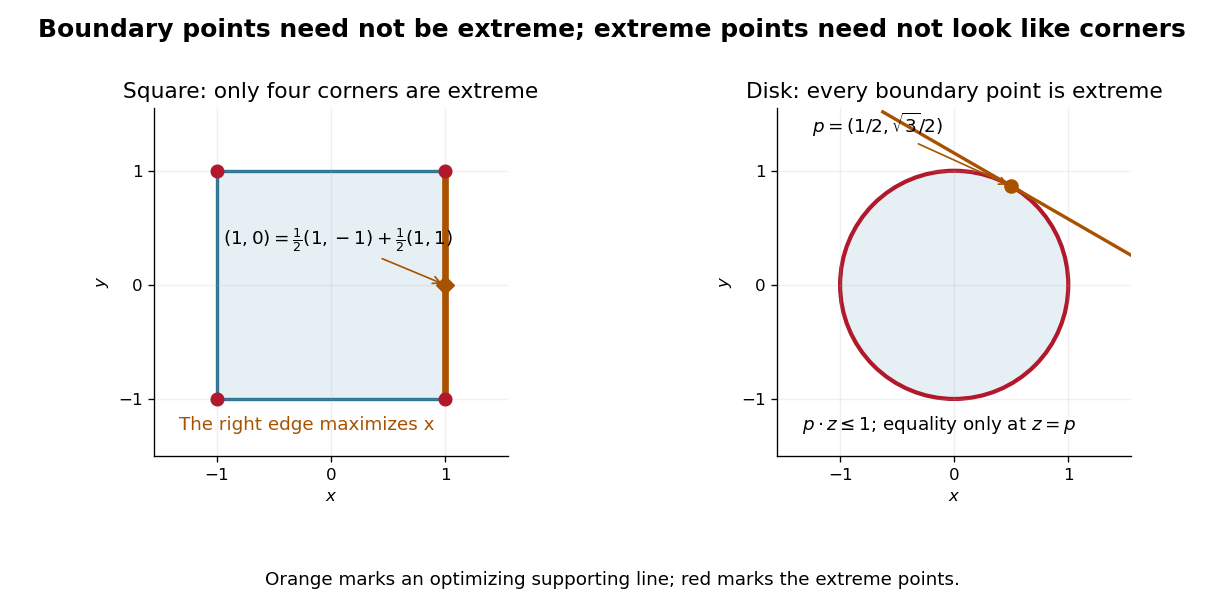

These points help describe all allowable mixtures. Every is a convex combination of its four corners, with the weight on equal to . For the unit disk, write , with and a unit vector; at zero choose any . ThenTwo extreme points suffice for that mixture. The Krein-Milman theorem gives a much broader reconstruction: a nonempty compact convex set in a locally convex space whose topology is Hausdorff is the closed convex hull of its extreme points.
Mark Krein and David Milman published their reconstruction theorem in 1940. Milman's colleagues describe that result and its subsequent use as a method of representing convex sets through their extreme points.[ref]
David Milman (1912–1982) by Israel Gohberg and others. David Milman (1912–1982), printed p. 4: 1940 collaboration with M. G. Krein, the reconstruction theorem and subsequent method; citation 3 refers to their original paper
Convex polytope Created 2026-09-24 Updated 2026-10-14
A convex polytope is a bounded intersection of finitely many closed half-spaces, equivalently the convex hull of finitely many points.
Line segment Created 2026-09-24 Updated 2026-09-24
Closed half-space Created 2026-09-24 Updated 2026-10-14
This is the non-strict version of a half-space; replacing the inequality by a strict one gives the open version.
Convex combination Created 2026-09-24 Updated 2026-10-14
A convex combination is a finite weighted average of points in a real vector space. For , it has the formThe nonnegative coefficients forbid subtracting a component, and their unit sum keeps the result on the same affine scale as the inputs. With two points it parametrizes their line segment; equal coefficients give their centroid. A convex set contains every finite convex combination of its points. Conversely, the two-point case already gives the defining property of a convex set.[ref]
Convex Optimization by Stephen Boyd and Lieven Vandenberghe. §2.1.4, p. 24: finite combinations, weighted-average interpretation and convex hull
The distinction from a linear combination is concrete. Combining and with coefficients and gives , outside their line segment, despite the unit coefficient sum. Using two coefficients both equal to one gives here, but their sum is two, so it is not a convex combination with those coefficients. A numerical output may happen to coincide with a point admitting a different convex representation; the definition applies to the specified coefficients.
Nonnegative orthant Created 2026-09-24 Updated 2026-10-14
The nonnegative orthant consists of vectors whose coordinates are all nonnegative. Its interior is the positive orthant, where every coordinate is positive.
Projected gradient descent Created 2026-09-24 Updated 2026-10-14
This is the proximal gradient method when the nonsmooth term is the indicator of the feasible convex set, whose proximal operator is the metric projection.
Stiemke theorem Created 2026-09-24 Updated 2026-10-14
For a real matrix , exactly one of the following holds: there is with and , or there is with . Separating from the standard simplex proves the result; may then be normalized to sum to one.
Subdifferential Created 2026-09-24 Updated 2026-09-28
Swap test Created 2026-09-24 Updated 2026-10-14
Hadamard test Created 2026-09-24 Updated 2026-09-24
Controlled-NOT gate Created 2026-09-24 Updated 2026-10-06
Closure of a connected set Created 2026-09-24 Updated 2026-09-24
Product of connected spaces Created 2026-09-24 Updated 2026-10-03
The product of any family of connected spaces is connected. For two factors, fix and use the connected setsThey cover and all contain the connected horizontal slice .
Pairwise-intersecting connected cover Created 2026-09-24 Updated 2026-09-24
There are unlisted articles, also show them or only show them.