
Reduced density operator of a weakly coupled oscillator pair Created 2026-09-24 Updated 2026-10-14
If a weak interaction changes to a normalized state proportional to , tracing out either oscillator gives eigenvalues and .
Purity of a density operator Created 2026-09-24 Updated 2026-10-18
The purity of a density operator is . It equals one exactly for a pure state; in finite dimension it lies between and . The minimum occurs exactly at the maximally mixed state .
A worked qubit family interpolates between the mixed state and the pure state , where :The eigenvectors are , with eigenvalues . Squaring and summing these eigenvalues givesHere is the Born rule probability of the positive outcome in an projective measurement. The Bloch vector is , since with one of the Pauli matrices. At the purity is ; at it is , with ; at it is one. Within this family, is a pure state and every is a mixed state. Extending the formula to produces a negative eigenvalue , so it ceases to be a density operator despite remaining Hermitian with trace one.
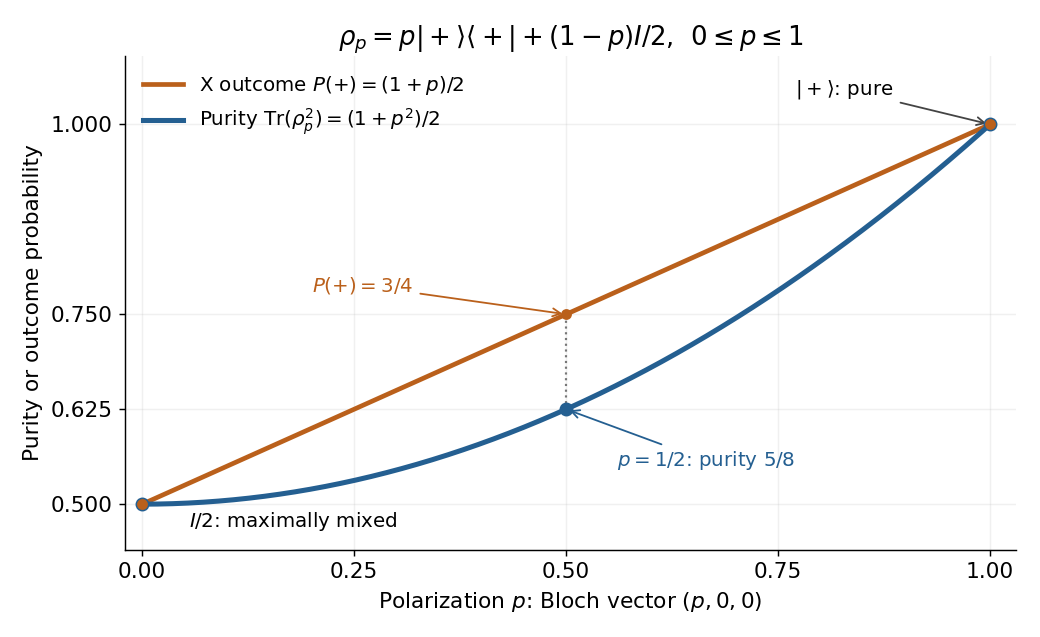

The Bloch vector length measures polarization: for any qubit density operator, . This connects the interior of the Bloch ball with mixed states and its boundary, the Bloch sphere, with pure states. [ref]
For a short proof of the general bound, use the spectral theorem: the nonnegative eigenvalues sum to one, so . ThenThe lower bound is attained only when all eigenvalues equal ; the upper bound is attained only when exactly one eigenvalue is nonzero, and hence equals one. Purity is therefore a simple quantitative test of mixedness, invariant under a unitary operator. It does not specify the entire density operator: even distinct pure states all have purity one. [ref]
Von Neumann entropy Created 2026-09-24 Updated 2026-10-14
The Von Neumann entropy of a density operator isIt vanishes for a pure state and measures mixedness and quantum entanglement in reduced states.
Scattering by a delta potential Created 2026-09-24 Updated 2026-09-24
Multiple delta potential Created 2026-09-24 Updated 2026-09-24
For delta interactions at points , a Green-function solution reduces the Schrodinger equation to a finite linear system for the values .
Bound state in a delta potential Created 2026-09-24 Updated 2026-10-14
An attractive one-dimensional delta potential has one even exponentially decaying bound state.
Exact diagonalization within a degenerate subspace Created 2026-09-24 Updated 2026-09-24
Perturbation diagonal within a degenerate eigenspace Created 2026-09-24 Updated 2026-10-18
If the perturbation is already diagonal in a basis of a degenerate eigenspace, those basis vectors receive its diagonal entries as first-order shifts.
Dark soliton Created 2026-09-24 Updated 2026-09-24
No rapidly decaying standing wave for the defocusing cubic nonlinear Schrodinger equation Created 2026-09-24 Updated 2026-10-14
For with real , the defocusing equation has first integralA nonzero smooth function tending to zero at both infinities cannot satisfy this identity: a nonzero extremum requires , but then the right side is negative for sufficiently small nonzero .
Forced harmonic oscillator Created 2026-09-24 Updated 2026-10-07
Local minimum Created 2026-09-24 Updated 2026-10-14
A real-valued function , with , has a local minimum at if some satisfiesEquality is allowed; a strict local minimum excludes equality at every other sufficiently nearby point. The comparison uses a neighbourhood relative to the domain of a function. On an open set, this is an ordinary small ball around . At an endpoint, only points belonging to the domain of a function are tested. Some elementary texts reserve "local" for interior points; here endpoints are allowed under the relative convention, but the zero-gradient condition still requires an interior point.
For , each of and is a strict local minimum, although both attain the same global minimum. For , zero is a strict local minimum despite the missing derivative. Thus the definition compares values and does not require differentiability.
A local minimum describes a valley that cannot be improved by a sufficiently small move; mathematical optimization also asks whether a better value lies farther away. At a smooth interior local minimum, the gradient is zero. If the function is twice continuously differentiable nearby, its Hessian matrix is positive semidefinite: restrict to a line through the point and its second derivative is nonnegative. The converse fails for a degenerate Hessian matrix, as at zero shows.
Critical set Created 2026-09-24 Updated 2026-10-05
The critical set of a differentiable map consists of the points where its derivative fails to have full rank.
Goldstone boson Created 2026-09-24 Updated 2026-10-14
Each broken continuous internal-symmetry generator normally produces a massless Goldstone mode; for a symmetry breaking pattern , their number is in the standard relativistic setting.
Scaling relation for critical exponents Created 2026-09-24 Updated 2026-10-06
Homogeneity at a fixed point relates thermodynamic critical exponents to the correlation-length exponent and anomalous dimension .
Renormalization group Created 2026-09-24 Updated 2026-10-18
A renormalization group compares models at different observation lengths. A Wilsonian coarse-grained statistical Hamiltonian sums over short-distance fluctuations; a renormalization-group transformation rescales coordinates and fields for comparison. Kenneth Geddes Wilson's 1982 lecture treats fluctuations across successive length scales to explain critical phenomena.[ref]
The Renormalization Group and Critical Phenomena by Kenneth Geddes Wilson. Section II, pp. 103–104: successive scale integration; inspected in an AGH-hosted reproduction
The experimental motivation is Andrews's carbon dioxide experiment. Dried carbon dioxide occupied a capillary tube above mercury; a screw compressed the transmitting water. A second air-filled tube gauged pressure. Flowing water controlled temperature, and a cathetometer read column positions for volume. The liquid meniscus vanished near the liquid-gas critical point. Residual air and imperfect air-gauge corrections limited accuracy.[ref]
The Bakerian Lecture: On the Continuity of the Gaseous and Liquid States of Matter by Thomas Andrews. pp. 576–578: preparation, apparatus, calibration and pressure caveats; pp. 583–584: critical-temperature observations
These observations motivate critical-point theory without determining a correlation-length critical exponent. The renormalization group explains how critical measurements can become insensitive to many molecular details.In 1972, Kenneth Geddes Wilson and Michael Ellis Fisher used an epsilon expansion about to compute nonclassical critical exponents. Their paper distinguishes a Gaussian fixed point from an interacting renormalization-group fixed point, tunes the thermal parameter, and extracts powers from a linearized recursion. Its Ising-like result is for .[ref]
Critical Exponents in 3.99 Dimensions by Kenneth Geddes Wilson and Michael Ellis Fisher. Critical Exponents in 3.99 Dimensions, Physical Review Letters 28 (1972), pp. 240–242, abstract and equations (7), (10)–(14); p. 243 discusses the more general interaction and accuracy of the approximation
The worked model below isolates this mechanism with chosen coefficients; it is not a precision calculation for the three-dimensional Ising model. Upper critical dimension Created 2026-09-24 Updated 2026-09-24
The upper critical dimension is the dimension above which the Gaussian or mean-field fixed point controls critical exponents. It is four for the ordinary Ising critical point and three for its tricritical point.
Landau theory Created 2026-09-24 Updated 2026-09-24
Landau theory expands an effective free energy analytically in powers of an order parameter, constrained by symmetry.
Order parameter Created 2026-09-24 Updated 2026-09-24
An order parameter vanishes in a symmetric phase and becomes nonzero when that symmetry is spontaneously broken.
There are unlisted articles, also show them or only show them.