A locally convex space is a topological vector space with a neighbourhood basis at zero consisting of convex sets. Equivalently, its topology is a seminorm topology generated by some family of seminorms. We allow non-Hausdorff spaces here; a separating family of seminorms gives precisely the Hausdorff case. Every normed vector space is locally convex, but smooth convergence generally requires a whole family of measurements.
The geometric and measurement descriptions fit together: seminorm sublevel sets are convex, while the Minkowski functional of an open, convex zero neighbourhood invariant under all scalar multiplications with is a continuous seminorm. Such neighbourhoods can be chosen as a neighbourhood basis. [ref]
https://www.math.lmu.de/~philip/publications/lectureNotes/philipPeter_FunctionalAnalysis.pdf. Peter Philip, Functional Analysis, Theorem 1.40, equivalence of local convexity and seminorm topologies
.Local convexity makes Hahn-Banach theorem and separation of a point and an open convex set available. It turns geometric distinctions into continuous linear functionals, connecting convex sets to the continuous dual space. For a seminorm topology generated by , a linear functional is continuous exactly when there are and withThus one continuous linear functional needs only finitely many of the available measurements. For example, point evaluation of a derivative on the space of smooth functions on a compact interval is controlled by a suitable derivative seminorm.
Given a nonempty family of finite-valued seminorms on a real or complex vector space , its seminorm topology has basic open zero neighbourhoodsTheir translates form a basis of a topology. Only finite intersections are required: an infinite intersection might impose a stronger topology. Equivalently, put ; then is a seminorm and . See Günther Hörmann, Advanced Functional Analysis, section 4, neighbourhood systems from seminorms for the general construction.
Each defining seminorm is continuous, since . A sequence satisfies precisely when for every ; the same criterion holds for nets. Finitely many measurements can each meet a prescribed tolerance after a common index.
The seminorm axioms also establish the required joint continuity of vector addition and scalar multiplication:For a basic neighbourhood, apply these estimates to its finitely many seminorms; near the absolute value is bounded. This gives a locally convex space even when some directions are invisible to every measurement.
A family of seminorms separates points when every nonzero vector has for some member . Equivalently, its kernels of seminorms have intersection , or any two distinct vectors have for some . Individual seminorms can have large kernels of seminorms; the whole family must have no common invisible direction.
The associated seminorm topology is Hausdorff if and only if the family separates points. Indeed, if , the neighbourhoods and are disjoint by the triangle inequality. Conversely, if every vanishes on a nonzero , then zero and belong to exactly the same open sets and cannot be separated. This criterion keeps separation distinct from completeness: detecting all directions does not guarantee that all Cauchy sequences have limits.
Here the set is a nonempty compact metrizable convex subset of a Hausdorff locally convex space. The ambient space can be infinite-dimensional. Continuous affine functions separate its points, and weak-star compact dual balls with separable preduals provide examples. This general setting is needed for Choquet theorem.
Every point of a compact metrizable convex subset of a Hausdorff locally convex space is the barycenter of a Borel probability measure concentrated on its extreme points. The theorem is an existence assertion; uniqueness requires additional hypotheses such as a simplex structure.
For a real function in the unit ball, push uniform measure on forward by the displayed sign-valued functions. In the weak-star topology this is a Borel probability concentrated on the extreme points, and Fubini's theorem shows that its barycenter is . Weak-star compactness and separability of the predual place the example within Choquet theorem.
Maximize the integral of a continuous strictly convex function among probability measures with a fixed barycenter. The supporting measure lemma for affine upper envelopes implies that the maximizing measure has zero integral of the nonnegative envelope gap. Strict convexity makes this gap positive at every nonextreme point, so the measure is concentrated on the extreme boundary. Metrizability makes that boundary Borel and supplies the continuous strictly convex function.
For a bounded real function on a compact convex set, this envelope is the infimum of its continuous affine majorants. It is finite, concave and upper semicontinuous, and dominates the function. For continuous functions it describes the maximal integral among probability measures with a specified barycenter. Its homogeneity, subadditivity and affine-translation identities give the supporting measure lemma for affine upper envelopes.
The sublinear functional has a linear supporting functional taking the value at a specified continuous , by the Hahn-Banach theorem. It is positive and normalized because has these values on constants. The Riesz-Markov-Kakutani representation theorem gives the probability . Testing affine functions and their negatives shows that and have the same barycenter.
The barycenter of a probability measure on a compact convex set is the point satisfying the displayed affine integral identities. It exists by approximating the measure by finitely supported measures and using compactness of their finite convex combinations. It is unique because continuous affine functions separate points. In a Banach-space setting it agrees with the appropriate vector integral when that integral is defined.
A seminorm on a real or complex vector space is a finite-valued function satisfying absolute homogeneity and the triangle inequality:In particular and . A seminorm is a norm exactly when implies : this is the extra definiteness of a norm axiom. The zero function is a valid seminorm. The missing definiteness is useful when a measurement deliberately ignores some directions, such as an individual coordinate or the constant term of a function whose derivative is measured.
For example, on the function is a seminorm that vanishes on every constant function. Adding the value measurement gives the norm : if , the fundamental theorem of calculus gives . A family of such partial measurements defines a seminorm topology.
The kernel of a seminorm is its zero set, a linear subspace by absolute homogeneity and the triangle inequality. The estimate shows that adding an element of does not change . Hence defines a norm on the quotient vector space .
On itself, is a pseudometric; it is a metric exactly when is a norm. In particular, zero distance in one pseudometric need not mean equality of vectors. A separating family of seminorms removes the common zero-distance ambiguity.
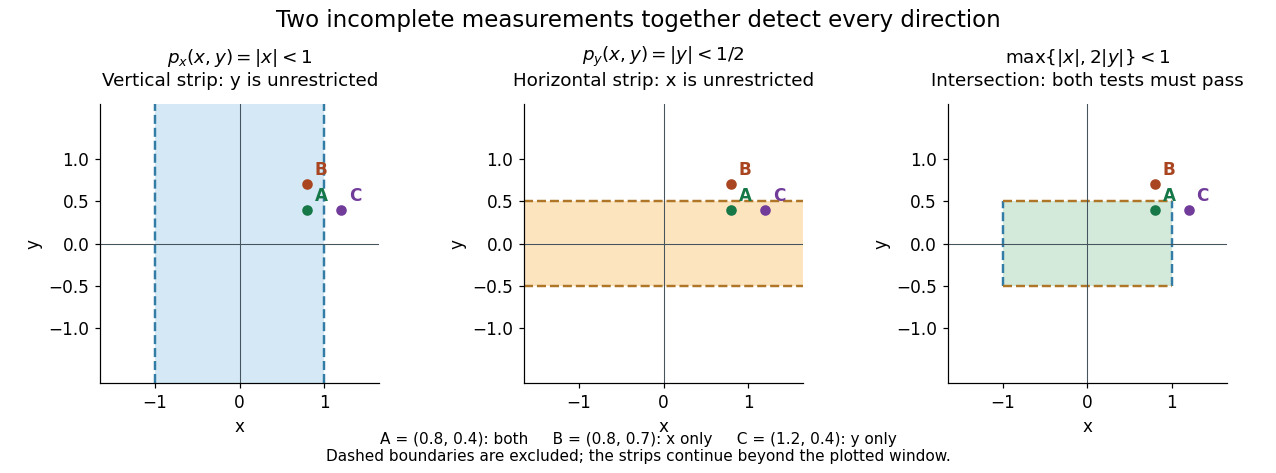
On , the coordinate seminorms and measure horizontal and vertical components separately. Their kernels of seminorms are the vertical and horizontal axes. Neither is a norm, but together they form a separating family of seminorms. A basic zero neighbourhood isEach condition alone is an unbounded strip; their intersection is an open rectangle. For , this is the unit open ball of the maximum norm . For unequal tolerances it is the unit open ball of the weighted norm . Thus the two coordinate measurements generate the usual topology of the plane.
For a numerical check, take , : passes both tests, passes only the horizontal test, and passes only the vertical test. A direction missed by one seminorm is detected by the other.
Given a bilinear pairing and a seminorm , its dual seminorm isIt may be infinite when does not annihilate the kernel of . Whenever it is finite, the defining inequality gives .
A Fréchet space is a Hausdorff locally convex space whose topology is induced by a complete translation-invariant metric. Translation invariance means ; completeness means every Cauchy sequence converges in the space. Use a translation-invariant metric for this condition: an arbitrary compatible metric can change which sequences are Cauchy sequences. [ref]
https://www.math.lmu.de/~philip/publications/lectureNotes/philipPeter_FunctionalAnalysis.pdf. Peter Philip, Functional Analysis, Definition 1.22 and Remark 1.23
.Equivalently, the topology comes from a countable separating family of seminorms and is complete in their common sense: if as for every fixed , then some satisfies for every . A useful compatible translation-invariant metric isIt is finite because the weights sum to one. The separating condition makes it a metric; without that condition the formula gives only a pseudometric. Its convergence in a metric space and Cauchy sequence conditions are exactly the conditions for all the separately: control finitely many terms, then bound the remaining tail by . Replacing by gives an increasing family with the same topology.
Every Banach space is a Fréchet space, using its norm as the single measurement. The space of smooth functions on a compact interval is a Fréchet space with derivative seminorms but with no single norm inducing its smooth topology. This is why Fréchet spaces are useful in differential equations: one can require accuracy in every order of derivative, while each particular estimate uses only finitely many orders.
The name honors Maurice Fréchet. His doctoral thesis was published as [ref]
https://link.springer.com/article/10.1007/BF03018603. Sur quelques points du calcul fonctionnel, Rendiconti del Circolo Matematico di Palermo 22, pages 1–72 (1906)
; an [ref]https://zenodo.org/records/1428464. open scan of Fréchet's original paper
is available. This identifies a historical source without attributing the modern locally convex definition to that paper.Here means the real- or complex-valued functions continuous on , smooth on , with every interior derivative having a continuous extension to the endpoints; endpoint values of derivatives are these extensions. On this space of smooth functions on a compact interval, defineThese finite-valued seminorms increase with and separate points. In fact every is a norm, since it includes . The terminology seminorm includes norms; it does not assert that every measurement has a nontrivial kernel of a seminorm. Smooth convergence means for every fixed , equivalently uniform convergence of every derivative separately. It does not demand one tolerance or one convergence index that works for all orders simultaneously. The maximum convention is equivalent to the derivative supremum norm convention using a finite sum, since .
For a worked example, gives , , , and for . The linear functional obeys and is continuous. Similarly, differentiation is a continuous linear operator for smooth convergence, because .
The space of smooth functions on a compact interval is complete for this seminorm topology. A Cauchy sequence has uniform limits for its derivatives of each order. Passing to the limit in the fundamental theorem of calculus identitygives , so and belongs to the same space. This is the completeness of the smooth-function metric argument; the metric there and the increasing- metric above induce the same smooth topology and the same Cauchy sequences.
Smooth convergence on a compact interval requires uniform convergence of the functions and of their derivatives of every order separately, as measured by the derivative seminorms. The need for several scales is visible inFor , because lies in . The derivative has supremum norm one for every , already at . Thus converges uniformly to zero, but fails the test for smooth convergence to zero. Andreas Buttenschoen, Applied Functional Analysis, spaces of continuous and differentiable functions discusses this example and the family of smoothness measurements.
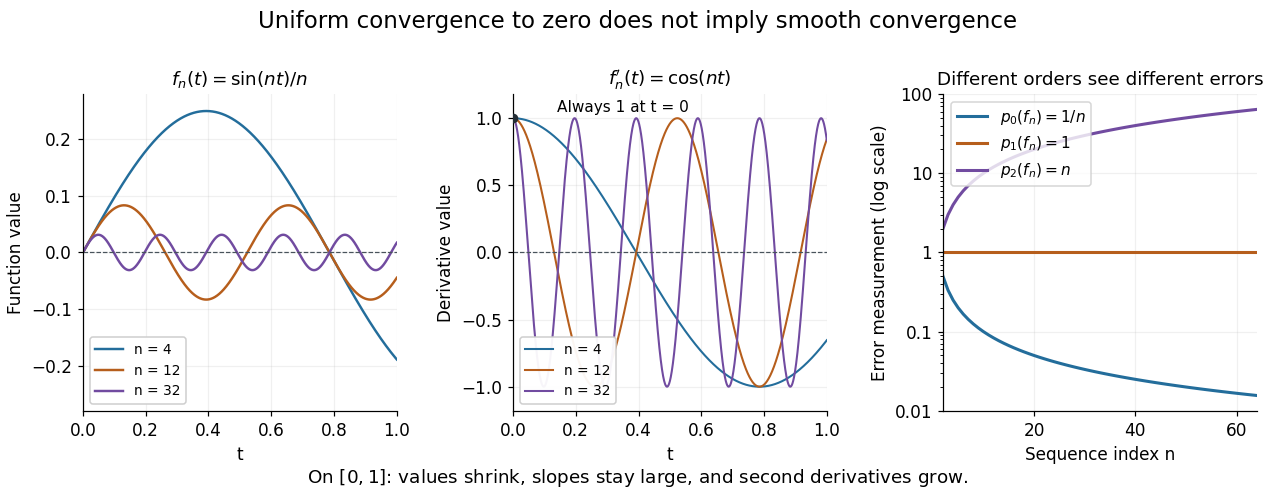


More generally, for any fixed , has but for . If a norm induced the smooth topology, its continuity would give for some finite , while continuity of for would give . Substituting contradicts these two bounds. Smooth convergence therefore cannot be reduced to one norm. Its beauty is that every finite order can be controlled without fixing a final order in advance.
For an absorbing convex set containing zero, its Minkowski functional is . If is open and convex, then is sublinear and .
For a bounded convex open set containing zero and invariant under , its Minkowski functional is a norm. Inner and outer Euclidean balls give positive finite bounds; symmetry and scaling give absolute homogeneity; convexity gives the triangle inequality. Openness makes , while boundedness prevents nonzero vectors from having zero gauge.
If is a nonempty open convex subset of a real locally convex space and , a continuous linear functional strictly separates them: after choosing a sign, for every . Apply the Hahn-Banach theorem to the Minkowski functional of a translate of .
If and are disjoint nonempty convex subsets of a real locally convex space and is open, then some continuous linear functional satisfiesfor all and .
If finitely many open convex subsets of a locally convex space have empty intersection, some continuous linear map preserves that fact: .
A dual pair consists of a real vector space and a vector space of linear functionals that separates the points of . Its weak topology is the coarsest topology making every continuous, and its continuous dual is exactly .
For a separated dual pair, the continuous linear functionals for its weak topology are exactly evaluations by members of the paired space. Continuity bounds a functional on a neighbourhood defined by finitely many evaluations; scalar rescaling makes it vanish on their common kernel. It then factors through their finite-dimensional evaluation map and is a finite linear combination of them.
Let separate points of a Banach space . If the closed unit ball of is compact for and has the norm inherited from , then the evaluation map is an isometric isomorphism. Goldstine theorem makes its unit-ball image weak-star dense, while the assumed compactness makes that image closed.
Articles by others on the same topic
There are currently no matching articles.