
The Hamiltonian is a function of canonical position and momentum that generates time evolution through Hamilton's equations.
Phase space has one position coordinate and one conjugate momentum for every degree of freedom; a point specifies an instantaneous mechanical state.
If of items are marked and , each Grover iteration rotates the state by in the marked--unmarked plane, so after iterations the marked amplitude is .
The order of an element is the least positive power equal to the identity and divides the order of a finite group.
This is the order of a group element in the finite setting, one use of order (group theory).
Every finite group is a torsion group; its exponent is a common multiple of the order of a group element for every element.
A subgroup is a normal subgroup when for every . In other words, conjugation by any group element preserves the subgroup as a set, although it may exchange its individual elements. Equivalently, for every : the left and right cosets of agree. Write .
Every subgroup of an abelian group is a normal subgroup, because conjugation fixes each element. Normality can also hold in a nonabelian group: in , the three even permutations form the alternating group , a normal subgroup as the group kernel of the sign of a permutation. Its two cosets separate the even and odd permutations.
In contrast, is a subgroup of but is not a normal subgroup. With function composition of permutations acting rightmost first, choose . Thenwhich are different cosets. Also , directly contradicting invariance under conjugation. Thus a subgroup alone does not suffice for quotient group multiplication.
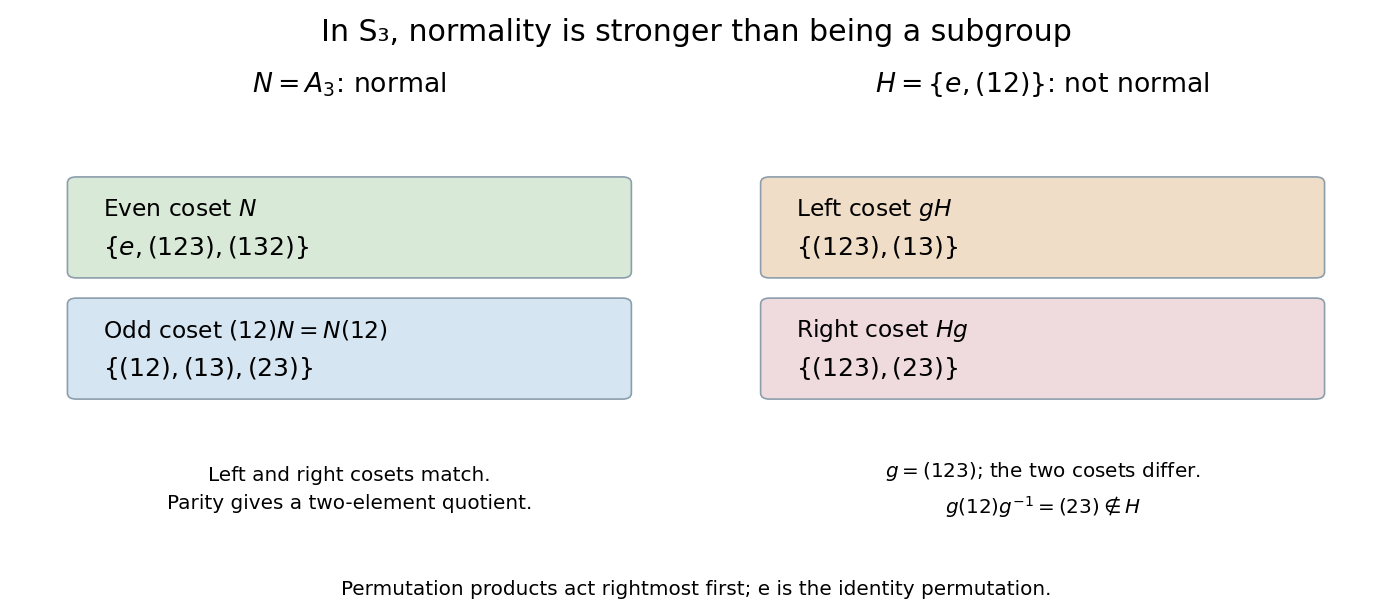
A normal subgroup gives matching left and right cosets, while a nonnormal subgroup can give different ones
. Details. 
The practical value of normality is coset multiplication is well-defined exactly for normal subgroups. Each coset can act as one element of a quotient group, with results independent of representatives. Conversely every normal subgroup is the group kernel of its quotient map of groups, so normality also identifies which distinctions a group homomorphism can consistently forget.
A torsion element has finite order.
Finite group theory studies groups with finitely many elements.
A group homomorphism is a map preserving the group operation: . It also preserves the identity element and inverse elements. In an additive group, the same requirement reads . A group homomorphism preserves a way of combining inputs, even when several inputs have the same output.
Reduction modulo three from to is a group homomorphism: reducing a sum agrees with adding the reduced residues. For example, modulo six, and both sides reduce to one modulo three; the outputs and also add to one modulo three. This map is surjective but not injective, since zero and three both map to zero.
The sign of a permutation gives another example, from the symmetric group to the multiplicative group . A product of two odd permutations is even, matching . Its group kernel is , the alternating group of even permutations. This shows how a group homomorphism can retain a useful feature while forgetting other details.
The general linear group is the group of invertible linear maps from a vector space to itself, with composition as its operation.
For a group and a normal subgroup , the quotient group is the set of cosets , with operationIts identity element is the coset , and the inverse element of is . A quotient group treats all elements within one coset as the same input while retaining a consistent operation on the classes. The normal subgroup condition is what makes this operation independent of which representatives are chosen. [ref]
https://ocw.mit.edu/courses/18-703-modern-algebra-spring-2013/ecdbd211f736b3ac92379dea05b34491_MIT18_703S13_pra_l_9.pdf. McKernan, MIT 18.703, Theorem 9.1: quotient-group construction
.Take the additive group and . Since is an abelian group, is a normal subgroup. There are three elements in the quotient group:Adding two copies of gives ; adding and gives . Hence the quotient group has the addition table of . It does not select one representative and discard the others: its elements are the entire cosets.
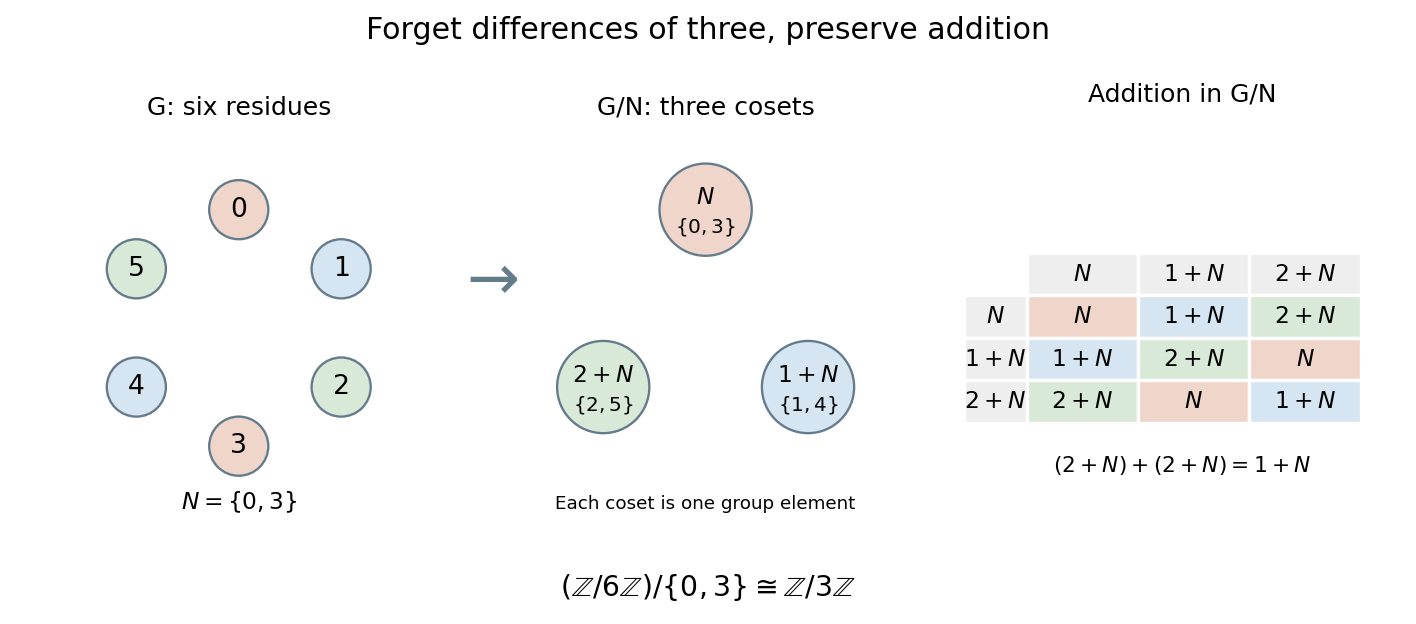
Identifying residues differing by three turns a six-element cyclic group into a three-element quotient group
. Details. 
This is useful whenever distinctions within a normal subgroup should be ignored. For example, the sign of a permutation retains only even or odd parity of a permutation in . Its group kernel is the alternating group , and the quotient group has two elements. The first isomorphism theorem explains why a group homomorphism's image is a quotient group of its domain.
There are unlisted articles, also show them or only show them.