
A force exerted by an active or passively stretched muscle. Its contribution to rotation about an anatomical joint depends on the muscle moment arm, rather than its magnitude alone.
The operation adding multiset multiplicities pointwise. Its result retains all occurrences from both operands. Some sources use the name multiset union instead for pointwise maximum, so a contract should state which operation is meant.
Historical pharmaceutical preparation; its composition and clinical use must be identified by edition. [ref]
The Essentials of Materia Medica and Therapeutics by Alfred Baring Garrod (1865). corresponding monograph and British preparation
For a fixed word , store the length of the longest suffix of the received stream that is also a prefix of . On a new input symbol, append it to the represented prefix and select the longest resulting suffix that is a prefix of . The complete-word state signals recognition. Its outgoing transitions retain proper suffix matches, allowing overlapping occurrences rather than automatically restarting from the empty prefix. This is the finite-state form of the prefix information used by the Knuth-Morris-Pratt algorithm.
For example, recognizing needs suffix-prefix states of lengths zero through four. After a complete match followed by one, the last two symbols are , so the next state retains length two. This permits the second match in without clearing the useful suffix.
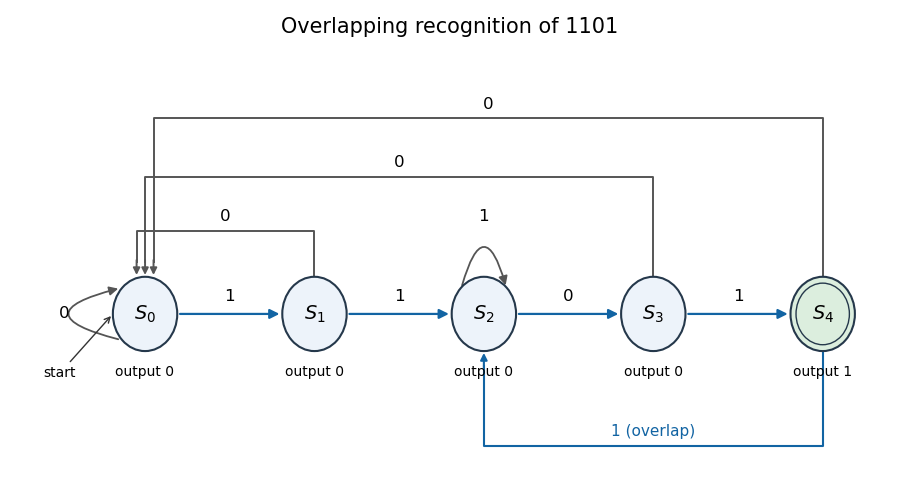
An overlapping prefix-suffix sequence recognizer for
. Details. 
Enter a distinguished Moore machine state whose output is active, and ensure that every outgoing transition leaves that state for an inactive-output state. The output then lasts one clock period. Its outgoing transitions may simultaneously recognize the start of the next event, avoiding an unnecessary idle cycle. The one-period statement refers to the synchronous logical model, with ordinary propagation delay after each clock edge.
A synchronous sequential circuit can use three states: armed, pulse, and waiting. Only the pulse state has output one. A reset input rearms the circuit, including when it arrives during the pulse cycle; this permits pulses on alternate clock cycles while each pulse still lasts exactly one cycle.
If and are independent real random variables, then the moment-generating function of their product is wherever the expression is finite. This follows by conditioning on : the conditional law of is unchanged by independence, so . For uniform on , the formula becomes . If is finite on a neighborhood of zero, this product also has a finite moment-generating function on a neighborhood of zero, because the bounded factor keeps between zero and .
For a module over an integral domain with field of fractions , its rank is the dimension of . The tensor product of modules here extends scalars to a field, turning the question into a dimension calculation. For a free module , the result is .
For a finitely generated module over a principal ideal domain, the structure theorem for finitely generated modules over a principal ideal domain gives , with nonzero nonunits. Each torsion element of a module vanishes after extension of scalars, because its annihilating nonzero scalar becomes invertible in . Thus , proving that the rank is the number of free summands. The rank does not record the torsion submodule: for example, and have the same rank.
A right module over a unital ring is an abelian group with an additive scalar action on the right satisfying , and . The order of multiplication matters for a noncommutative ring. Equivalently it is a left module over the opposite ring. Row vectors acted on by matrices on the right give a basic example.
A module over a complex associative algebra has central character if every element of the centre acts as the scalar , where is a unital algebra homomorphism. A Verma module has a central character: the centre preserves its one-dimensional highest-weight space, and centrality extends that scalar action from the cyclic generator to every vector. A nonzero homomorphism between two modules with scalar central actions forces their central characters to coincide. A generalized central character allows each to act locally nilpotently instead of as zero.
Let . Writing , its inverse gives and . The lens condition is therefore exactly . Multiplication by converts that to positive real and imaginary parts. Thus the displayed Möbius transformation maps the lens bijectively to the first quadrant. Its two boundary arcs meet at , which map to zero and infinity. The centre zero maps to . The derivative never vanishes inside the lens.
A useful way to map a circular lens is to send its two corner points to zero and infinity with a Möbius transformation. The two bounding circles then become straight rays, and a suitable power opens their sector into a half-plane.
For the lens , , the corners are . Put , with inverse . For , substitution givesThus the image is precisely , or . Rotation through followed by squaring gives the displayed conformal map onto the upper half-plane. The open sector contains no opposite pair, so squaring is injective; it has nonzero derivative away from its excluded vertex. These facts also prove bijectivity and conformality, rather than merely identifying boundary images.
For ordered triples of distinct points of the Riemann sphere, a unique Möbius transformation sends the first triple to the second. Normalize each triple to using , with the usual limits at infinity, and compose . Any two choices differ by a Möbius transformation fixing those three standard points. Fixing infinity makes it affine; fixing zero and one then makes it the identity. Thus the Möbius group action is sharply three-transitive, a stronger property than mere transitivity on triples.
Root a finite tree, and let be the optimum vertex cover sizes of a descendant subtree conditional on excluding or including its root. Excluding a parent forces all children to be included; including it permits either child state. These facts prove the displayed recurrences by structural induction. Empty child sums give at a leaf of a rooted tree. Evaluating in postorder traversal and taking the smaller root state gives a linear-time dynamic programming algorithm.
For a permutation input, the first row of its RSK insertion tableau is the minimum-tail table for increasing subsequences: its th entry is the least attainable final value of a strictly increasing subsequence of length in the processed prefix. Inserting replaces the first entry larger than , or appends if none exists. In replacement position , the previous entry in position supplies a subsequence that can be extended by . Shorter minimum tails were already smaller, and a longer subsequence ending at would require an old tail in position at least smaller than , contrary to the replacement rule. This proves the invariant inductively. Consequently the first-row length is the longest increasing subsequence length. The row entries need not be a subsequence together: input gives first row , although one occurs after three. They are minima for different lengths, obtained from potentially different subsequences.
Sort the edge weights of a minimum spanning tree and of any spanning tree in nondecreasing order. Then for every position. To prove it, fix a threshold and retain the graph's edges of weight at most . If this graph has connected components, contains a spanning forest of each component using those edges: otherwise a light edge joining two of its pieces could replace an edge heavier than on its tree path, decreasing total weight. Hence exactly edges of have weight at most . No other spanning tree can have more, since its retained edges form a forest inside those components. These threshold counts imply the coordinatewise inequality for sorted weights.
There are unlisted articles, also show them or only show them.