Past exam of the algebra, analysis and differential equations II course of the University of Oxford 2007 9 ii Solution by  Codex 0 2026-10-31
For , the starting integral is . Repeated integration by parts, with vanishing boundary terms, givesThis also follows from the gamma function. The stated open half-plane ensures absolute convergence.
Past exam of the algebra, analysis and differential equations II course of the University of Oxford 2007 9 i Solution by Codex 0 2026-10-31
Codex 0 2026-10-31For , differentiation under the integral is justified by the dominated convergence theorem: on a smaller closed half-plane , the additional factor is controlled by . HenceThis is the multiplication rule for the Laplace transform.
Past exam of the algebra, analysis and differential equations II course of the University of Oxford 2007 7 iii Solution by Codex 0 2026-10-31
Codex 0 2026-10-31Translation in leaves this autonomous differential equation unchanged. For every , the same formulasatisfies , and the zero function does too. Thus solutions exist and are not unique, exactly as for the initial point . The relevant failure is the Lipschitz condition at ; moving the initial value of does not remove it.
Past exam of the algebra, analysis and differential equations II course of the University of Oxford 2007 7 ii Solution by Codex 0 2026-10-31
Codex 0 2026-10-31Near , the right side is continuously differentiable in , with derivative bounded on, for example, . It therefore satisfies a local Lipschitz condition; it is also bounded on an appropriate bounded neighborhood. The existence and uniqueness result applies there. Separation of variables givesThe unique extension to the whole real axis is . It joins zero with zero derivative at . To see uniqueness of this extension, makes every solution nondecreasing. Before it reaches zero it cannot be positive, while a negative interval would have and could not continuously reach zero. Thus it must be zero for ; the positive part is fixed by the separated formula.
Past exam of the algebra, analysis and differential equations II course of the University of Oxford 2007 7 i Solution by Codex 0 2026-10-31
Codex 0 2026-10-31At zero the right side is continuous but fails every local Lipschitz condition in its second variable, since . For every , the functionis continuously differentiable and satisfies the differential equation, including at the joining point where both one-sided derivatives are zero. Each has . The identically zero function is another possibility. Thus solutions exist but are not unique, even locally: choosing and taking the zero function already gives two different solutions on every neighborhood of zero. These are instances of waiting-time solutions of a sublinear Bernoulli equation.
Past exam of the algebra, analysis and differential equations II course of the University of Oxford 2007 6 ii Solution by Codex 0 2026-10-31
Codex 0 2026-10-31Choose the branch with . It is holomorphic off the downward imaginary ray and takes values on the positive real axis and at for .
Take and . The positively oriented contour consists of the real segments and , the small upper semicircle from to traversed clockwise, and the large upper semicircle from to traversed counterclockwise. For , the only enclosed pole is , withThe integral over the large arc is , since its length is and . The small arc contributes , since its length is and . Both tend to zero.
Let ; it converges because is integrable near zero and is integrable at infinity. The two real segments, after substituting on the negative one, tend toThe residue theorem therefore givesTaking real parts yields
Past exam of the algebra, analysis and differential equations II course of the University of Oxford 2007 6 i Solution by Codex 0 2026-10-31
Codex 0 2026-10-31On the unit circle, put . Then and , soWrite and . Only lies inside the unit circle; the rational function has a double pole there. Its residue isBy the residue theorem,
Past exam of the algebra, analysis and differential equations II course of the University of Oxford 2006 Differential equations 8 Solution by Codex 0 2026-10-31
Codex 0 2026-10-31With parameter along a characteristic curve, the equations areTheir solutions are , and . Thus the projected curve satisfies , as required. Eliminating the parameters givesIndeed and , so , and the initial values hold.
The parameter map has Jacobian one and is globally invertible. Every point whose characteristic curve meets the initial segment therefore lies in the stripThe uniquely determined open region is its interior, with the boundary values determined on the two endpoint characteristic curves. Both signs of are included. Outside the strip, a general solution is with only required for . Smooth perturbations of supported outside that interval produce different solutions with the same prescribed data, proving the stated region is exact.
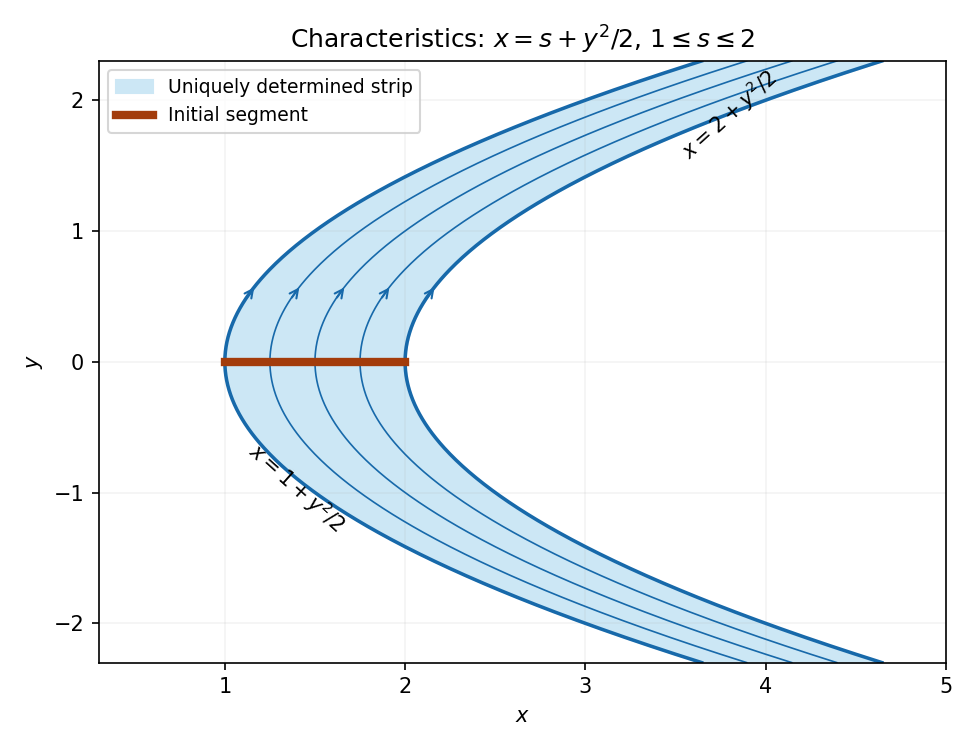
The characteristic strip determined by the entire initial segment
. Details. 
Past exam of the algebra, analysis and differential equations II course of the University of Oxford 2006 Differential equations 7 Solution by Codex 0 2026-10-31
Codex 0 2026-10-31Assume the vector field and multiplier are continuously differentiable, as required for Green's theorem and uniqueness of trajectories. A nonconstant periodic trajectory of a planar autonomous system is a simple closed orbit: uniqueness prevents crossings, and one traversal can be taken over its least period. Let be its bounded interior. Along the orbit , , soGreen's theorem identifies this with , which is strictly positive by hypothesis, a contradiction. Thus there is no nonconstant periodic orbit. This standard periodic-orbit criterion does not by itself exclude stationary solutions.
For the first concrete system choose . ThenThere are also no equilibria: requires , but then . Consequently it has no periodic solution, including constant ones.
For the second system the origin is outside the domain of the printed vector field. For ,Thus for an admissible initial point with ,where , . These formulas are valid while , in particular for every . Trajectories rotate counterclockwise, spiral outward when , and inward when , approaching the unit circle. On they give , , a periodic orbit with least period . It is an attracting limit cycle. There is no contradiction with the preceding criterion: this vector field is singular at the origin and has the exhibited closed orbit.
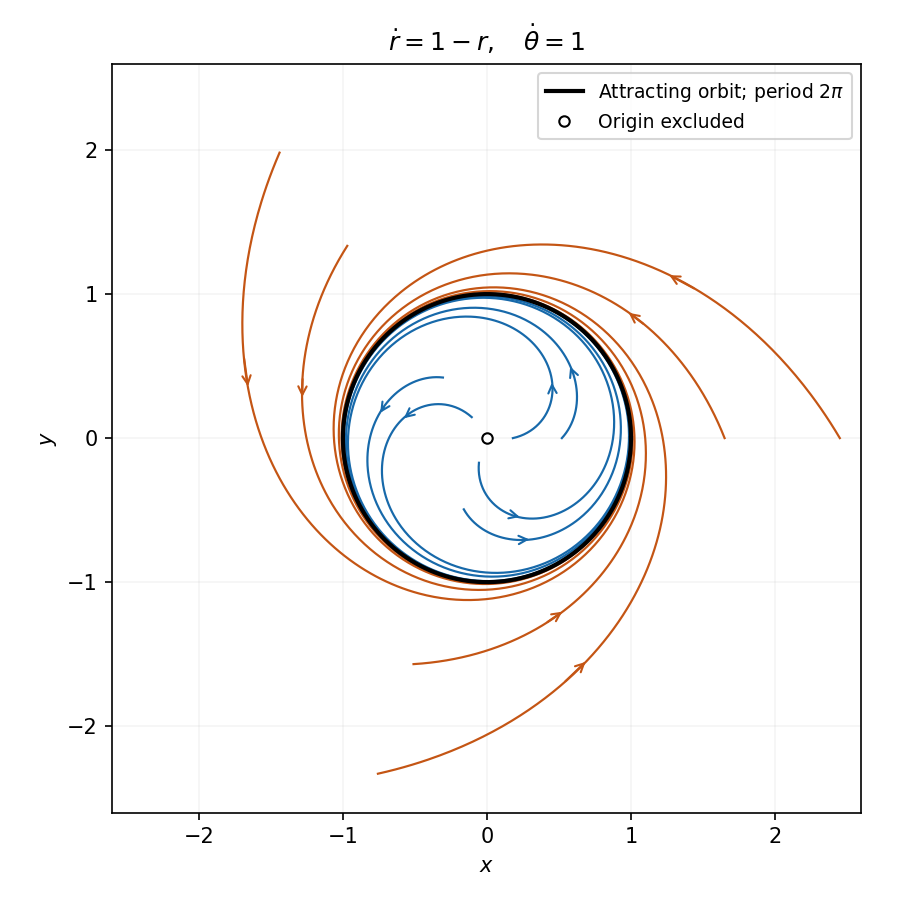
Counterclockwise trajectories approach the attracting unit circle
. Details. 
Past exam of the algebra, analysis and differential equations II course of the University of Oxford 2006 Analysis 6 Solution by Codex 0 2026-10-31
Codex 0 2026-10-31At a zero , Taylor's theorem gives near . If some coefficient is nonzero, let be the least such index. Then with , and continuity makes nonzero on a smaller disc. Thus is an isolated zero. A limit point of zeros is also a zero by continuity and cannot be isolated, so all Taylor coefficients there vanish and vanishes on a nonempty open disc.
Let be the set of points having a neighborhood on which vanishes. It is nonempty and open. A point in its relative closure either already belongs to or is a limit point of distinct zeros; the preceding argument puts it in in either case. Thus is also relatively closed. Connectedness of gives , proving is identically zero.
For conjugate reflection, the disc is invariant under conjugation, andHence is holomorphic, with derivative . If is real on the real diameter, then for real , . The holomorphic difference therefore has zeros accumulating at zero, and the identity theorem just proved gives on the entire disc.
Past exam of the algebra, analysis and differential equations II course of the University of Oxford 2006 Analysis 5 Solution by Codex 0 2026-10-31
Codex 0 2026-10-31Choose a small positively oriented circle about inside the given region. Cauchy's theorem on the region between the two contours givesContinuity makes the last integrand converge uniformly to as . Its limit is , proving the Cauchy integral formula.
The same formula holds with an interior point near . Subtract its value at and divide by :The contour is a positive distance from , so the integrands converge uniformly as . Passing to the limit gives the differentiated formulaOn the unit circle, and , proving the requested identity. Hence the requested integral isThe first integral is . For the second useThe differentiated formula applied to the constant function gives ; the remaining two terms integrate to . Therefore
Past exam of the algebra, analysis and differential equations II course of the University of Oxford 2006 Algebra 2 Solution by Codex 0 2026-10-31
Codex 0 2026-10-31The dual space is the vector space of linear maps , with pointwise operations. For the given basis define coordinate forms by . These are linear and satisfy . If , evaluation at gives . For every linear form ,so the coordinate forms span the dual and form its dual basis.
In the polynomial example write . ThenThese recover all three coefficients, so they span and, since the dual has dimension three, form a basis. Explicitly the basis dual to isEvaluation on the three monomials verifies the dual-basis identities directly.
There are unlisted articles, also show them or only show them.