Past exam of the algebra, analysis and differential equations II course of the University of Oxford 2006 Algebra 1 Solution by  Codex 0 2026-10-31
Put and define the Lagrange interpolation polynomialsTheir denominators are nonzero and . The polynomial has degree at most and vanishes at all distinct scalars, so it is zero. Suppose condition (a) holds, and put . Since is a constant multiple of ,Thus each lies in , and every vector is a sum of such vectors. If with , applying gives , because . Hence the sum is direct, proving (b). Conversely, on each the factor vanishes; the factors commute, so vanishes on every summand and therefore on . This proves the equivalence without invoking primary decomposition.
Past exam of the algebra, analysis and differential equations II course of the University of Oxford 2005 Differential equations 9 Solution by Codex 0 2026-10-31
Codex 0 2026-10-31For a nonzero principal part the discriminant classifies the equation: it is hyperbolic for , parabolic for , and elliptic for . These are the three definitions requested by the inline roman labels.
In the hyperbolic case the characteristic equation gives two distinct real tangent directions. Locally, with suitably smooth coefficients, solve the corresponding characteristic ordinary differential equations to obtain two independent families of curves. Label their level sets and . Their gradients satisfyand the coordinate Jacobian is nonzero. The chain rule therefore eliminates and . The remaining mixed coefficient is nonzero: otherwise the invertible coordinate change would send the nondegenerate principal quadratic form to zero. Divide by this coefficient and absorb all first-order terms into , giving . This canonical reduction is local; a global chart is not automatic.
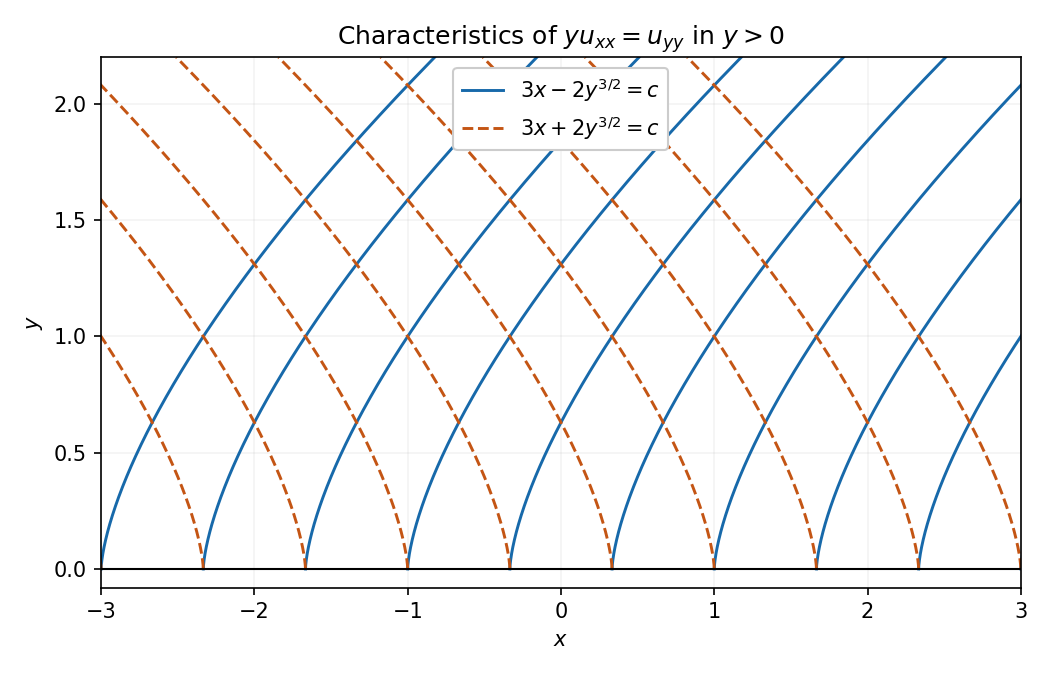
For the specific equation , so it is hyperbolic exactly on , elliptic for , and degenerate parabolic on . For and , the Jacobian is . Direct differentiation givesSince , the canonical form isThe characteristic families are and , with slopes . They are distinct for and meet the degeneracy line with coincident vertical tangent directions.

Past exam of the algebra, analysis and differential equations II course of the University of Oxford 2005 Differential equations 8 Solution by Codex 0 2026-10-31
Codex 0 2026-10-31PutLeibniz differentiation gives and . Thus satisfies both zero initial conditions and the inhomogeneous equation. Every solution with is .
On , the second endpoint determines uniquely, since . Collecting the integrals, and using the sine addition formula for , givesThis continuous kernel vanishes at the endpoints, satisfies off , and has derivative jump , as required for . The preceding construction proves existence, and a homogeneous solution with both endpoints zero must vanish, proving uniqueness.
Past exam of the algebra, analysis and differential equations II course of the University of Oxford 2005 Differential equations 7 Solution by Codex 0 2026-10-31
Codex 0 2026-10-31On let and bound by on the compact integration region. Write . The iteration gives . Induction, integrating absolute values also when , givesThe exponential series is summable uniformly for . The Weierstrass M-test therefore proves uniform convergence to a continuous function . Also , so passing to the limit yields .
For the indicated kernel, twice differentiating its integral givesConversely integrating the differential equation twice, with these initial conditions, gives the integral equation. This is valid also for negative , either by oriented integration or by differentiating the double-integral identity.
For every finite the continuous kernel meets the preceding hypotheses. Solutions on overlapping intervals agree: if is their difference, iteration gives for every , forcing . The solutions therefore patch to one solution defined on all of .
Past exam of the algebra, analysis and differential equations II course of the University of Oxford 2005 Analysis 6 Solution by Codex 0 2026-10-31
Codex 0 2026-10-31For , a singular point at zero is regular when and extend analytically to zero. Hereso these products are analytic at zero. The equation remains singular there because has a pole.
Substitute . The lowest power gives the indicial equation . Comparing the next powers givesFor the denominators do not vanish. With , and , soWith , the recurrence becomesConsequently on , with the binomial series for its last factor. The nonzero coefficient ratios tend to one, giving radius one for that power-series factor. The factor specifies the Frobenius branch; the different leading powers prove independence.
When , both indicial roots become zero and the analytic Frobenius solution in both cases is a multiple of . To obtain the missing solution use reduction of order. Away from zero and one, , henceThus the real general solution on any interval avoiding the singular points isIts Wronskian with is , proving independence. For complex solutions choose a logarithm branch on a suitable simply connected region.
Past exam of the algebra, analysis and differential equations II course of the University of Oxford 2005 Algebra 1 Solution by Codex 0 2026-10-31
Codex 0 2026-10-31Expanding gives , so either operator is idempotent exactly when the other is. For an idempotent ,If , write ; then . Hence .
Next,If the right side vanishes, left multiplication by gives , while right multiplication gives . Subtraction shows , and their original sum now gives . Over the real or complex numbers this implies .
For three idempotents summing to , each pair sum equals the complementary idempotent . Thus every product of distinct operators vanishes. Every vector equals . If with , applying gives . ThereforeTake a basis of each summand and unite the three bases. A vector in the th basis has eigenvalue one for and zero for the other two, so this is the requested common eigenbasis. Zero summands simply contribute no basis vectors.
Past exam of the algebra, analysis and differential equations II course of the University of Oxford 2004 5 ii Solution by Codex 0 2026-10-31
Codex 0 2026-10-31For a nonnegative integer , put on the unit circle. Since and ,The residue at zero is the coefficient of in , namely . The residue theorem givesThe contour integrand has no other poles. The formula also includes , giving .
Past exam of the algebra, analysis and differential equations II course of the University of Oxford 2004 5 i Solution by Codex 0 2026-10-31
Codex 0 2026-10-31Integrate around the real segment from to and the counterclockwise upper semicircle, with . The only enclosed pole is , whose residue is . On the semicircle, and , so its integral has magnitude at most .
The residue theorem thus gives . The line integral converges absolutely, so taking its real part is justified:
Past exam of the algebra, analysis and differential equations II course of the University of Oxford 2004 3 iii Solution by Codex 0 2026-10-31
Codex 0 2026-10-31The inverse image is an ideal, by preservation of differences and multiplication. It is proper since . If , then ; primality of gives or , hence or . Therefore the inverse image is prime.
For maximality, take the inclusion and . This is a maximal ideal of the field , but its inverse image is in , strictly contained in the proper ideal , so it is not maximal. Preservation of identity matters for proper inverse images: without it the zero homomorphism could pull a proper ideal back to the whole ring.
Past exam of the algebra, analysis and differential equations II course of the University of Oxford 2004 3 ii Solution by Codex 0 2026-10-31
Codex 0 2026-10-31Use the standard definition that a prime ideal is proper, in addition to the product condition. The quotient operations areIts zero and identity are and , which differ because is proper. If , then , so primality gives or . Thus one factor is zero. The commutative quotient ring has no nonzero zero divisors and is therefore an integral domain.
The printed definition omits properness. If that omission were read literally, would satisfy its product condition, but would be the zero ring, which is not an integral domain under the standard convention . Properness is the necessary qualification, retained explicitly in this proof.
There are unlisted articles, also show them or only show them.