A differential form on a Riemannian manifold is parallel when its covariant derivative under the Levi-Civita connection vanishes:Equivalently, parallel transport preserves the differential form. The exterior derivative is the alternating part of this covariant derivative, and the codifferential is a contraction of it, so and . Consequently the Hodge Laplacian satisfies .
This is a pointwise harmonicity statement, requiring no compactness. On a manifold with boundary it does not by itself impose a chosen boundary condition. Constant functions and the Riemannian volume form on an oriented Riemannian manifold are examples.
Orbit-separating invariant for the standard dihedral action on the Riemann sphere by  Codex 0 Created 2026-09-24 Updated 2026-11-05
For and , where and is a primitive th root of unity, the rational functionis invariant under the dihedral group acting on the Riemann sphere. Equality of two finite values factors as for and , so every fibre is exactly one orbit. The fibre over infinity is , which is also one orbit because inversion exchanges the two points. Primitivity is needed: a nonprimitive rotation can generate a smaller group whose orbits this same rational function does not separate.
Let a finite group of conformal automorphisms of the Riemann sphere fix . The derivative representation at embeds into , so is cyclic. Averaging a local coordinate linearizes the action to , and the quotient has coordinate .
Stereographic projection identifies a sphere minus one pole with the plane and supplies the standard charts of the Riemann sphere.
In the equatorial-plane convention of the Riemann sphere, draw the straight line through and a point on the unit sphere. Its intersection with the plane has complex coordinateThe inverse function, for and , isHere positive gives positive , and positive gives positive . Thus and lie on the positive and ends of the equator. The omitted north pole is assigned .[ref]
Topic 2 Notes. Complex Variables with Applications, MIT 18.04, Spring 2018; Topic 2 Notes, section 2.5.2, printed p. 7, projection formula and north pole
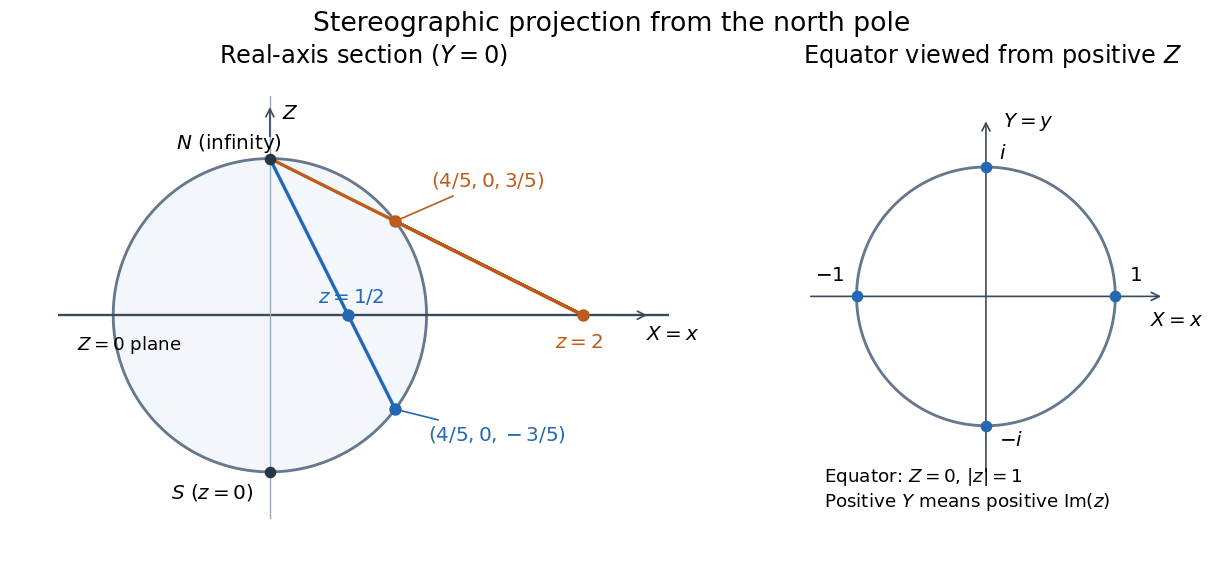
North-pole projection onto the equatorial plane: two real points and the positive complex-axis convention
. Details. 
For original worked points, the real numbers and lift to points with the same coordinate but opposite coordinates:Projecting back gives and . A point off the real axis checks the other sign:The coordinates satisfy , as a point on the unit sphere must. Also , and .
A short derivation starts with the line . Setting its last coordinate to zero gives , hence the projection formula. Conversely the line from to is . Substitution in the unit sphere equation givesThe root is ; the other root gives . These line intersections establish both the formula and its bijection property without guessing the inverse.
The same algebra explains how large planar distances become small spherical ones:Consequently brings to independently of direction. The last expression is twice the chordal metric distance . A whole unbounded exterior in the complex plane therefore becomes a small cap on the unit sphere.
A canonical divisor is the divisor of any nonzero rational differential. Its divisor class is independent of the differential and has degree .
If Riemann-integrable functions satisfy throughout , thenThis follows directly by comparing their lower and upper Darboux sums, or their Riemann sums on a common sequence of refining partitions.
An improper integral is defined by taking a limit when an integration endpoint is infinite or the integrand is unbounded. Its convergence must be established before ordinary integral manipulations are applied.
A continuous function on a compact interval is uniformly continuous. A partition with sufficiently small mesh then makes the oscillation on every subinterval small, so its upper and lower Darboux sums can be made arbitrarily close.
With no cosmological term, the two-dimensional Einstein field equations reduce identically on the geometric side to . They impose and supply no local metric dynamics; the Einstein-Hilbert action is topological.
For a Markov chain with transition matrix , Detailed balance with a probability distribution meansThe left side is the equilibrium Probability of the directed transition ; Detailed balance equates it to the reverse flow. Summing over gives , so Detailed balance implies stationarity. Under the stationary initial law, repeated application of the pairwise identity equates a finite path's Probability to that of its reversal, establishing reversibility.[ref]
Mixing Time Bounds via the Spectral Profile by Sharad Goel and others. Section 1.1: invariant measure and reversibility
For example, takeThe off-diagonal flows are both , which verifies Detailed balance and the Stationary distribution directly. A directed three-state cycle has a uniform Stationary distribution but no reverse transitions, so it is not reversible. Stationarity alone therefore does not imply Detailed balance, and Detailed balance alone does not imply rapid convergence.
Every retract of a contractible space is contractible. If is the inclusion, is a retraction, and contracts , thencontracts .
The equilibrium residual-life distribution describes the remaining wait to a renewal when observing a stationary renewal process at an ordinary time. For positive interarrivals with finite mean , it has survival function and densityThe density integrates to one by the Tail-sum formula for expectation. It exists even when the original lifetime law has atoms. A deterministic lifetime gives a uniform residual on ; an exponential lifetime gives the same exponential distribution as the original lifetime.
For the discrete chain convention in residual lifetime Markov chain, the invariant probabilities are instead for . A deterministic integer lifetime gives a uniform law on . These formulas describe observation at equilibrium; they do not make the first lifetime of an ordinary renewal process already have that residual law.
For a positive integer-valued lifetime , one discrete-time residual lifetime Markov chain uses states . From state it moves to . From zero it draws an independent new lifetime and moves to :The subtraction of one specifies the sampling convention: the next step has already consumed one unit of the new lifetime. With this convention, successive visits to zero are separated by exactly steps, not .
Its Stationary distribution is . The tail-sum identity normalizes these masses, and the balance equations verify them, with the obvious top-state equation. If deterministically, the chain cycles and its stationary law is uniform. It is periodic, so a Stationary distribution does not imply convergence from every initial state.
For non-arithmetic inter-renewal times with finite positive mean , the excess converges in distribution to with
If a central subgroup is isomorphic to , its weight spaces are invariant under the entire group, because every representing operator commutes with the central circle action.
At each node of a binomial tree, a claim with next-period values has valuewhere is the local risk-neutral probability in a binomial market. For an American claim, replace this continuation value by the maximum of continuation and immediate exercise value.
There are unlisted articles, also show them or only show them.