The Inviscid Burgers equation is the scalar conservation lawFor a classical solution, the chain rule makes this equivalent to , a nonlinear transport equation with characteristic speed . The conservative form remains meaningful for a discontinuous weak solution, whereas the product cannot simply be evaluated pointwise at a jump. Its discontinuities obey the Rankine-Hugoniot condition ; this condition alone permits inadmissible expansion jumps. For bounded initial conditions on the infinite line, imposing the Kruzhkov entropy inequalities and the initial trace selects a unique entropy solution. For step data, incoming characteristic curves select , while produces a rarefaction wave.[ref]
Satellite formula for the Levine-Tristram signature by  Codex 0 Created 2026-09-24 Updated 2026-09-24
For a pattern of winding number ,whenever the relevant signatures are defined by nonsingular forms. The usual averaged convention extends the identity through roots.
Unit-disc image from a boundary modulus lower bound by Codex 0 Created 2026-09-24 Updated 2026-09-24
Codex 0 Created 2026-09-24 Updated 2026-09-24A nonconstant holomorphic function on a domain maps open sets to open sets. Around any point, isolate its zero relative to the value there and use Rouché's theorem to show that every sufficiently nearby value has a preimage.
A locally uniform limit of nonvanishing holomorphic functions on a connected open set is either nonvanishing or identically zero. More generally, isolated zeros persist nearby with their multiplicity.
Torque in rotational Stokes flow between concentric spheres by Codex 0 Created 2026-09-24 Updated 2026-09-24
Codex 0 Created 2026-09-24 Updated 2026-09-24Conservative binary mass transfer moves material between two stars while retaining total binary mass and, in the usual approximation, orbital angular momentum. For a circular orbit with negligible spin angular momentum,At fixed and , the separation obeys . When an initially more massive donor star loses material, the product of component masses first increases and the orbit shrinks. After equal masses, continued transfer decreases that product and widens the orbit.
The period-product invariant for conservative mass transfer follows using Kepler's third law. Matter escaping the system, external torques or appreciable exchange with stellar spins changes the assumptions, so the simple invariant need not apply to nonconservative binary mass transfer.
Every nonzero ideal of the ring of integers of a number field factors uniquely as a finite product of nonzero prime ideals. Thus each has integer valuations , almost all zero, determined by the factorization of its principal ideal.
For a ring homomorphism , the extension of a two-sided ideal is the smallest two-sided ideal of containing . Thus its elements are finite sums with and .
For a bounded linear operator between real or complex Hilbert spaces, its adjoint is the unique bounded linear operator satisfyingThe inner product here is linear in its first argument. The adjoint operator transfers an output measurement back to the input: measuring against the vector gives exactly the same scalar as measuring against . It depends on both inner products.
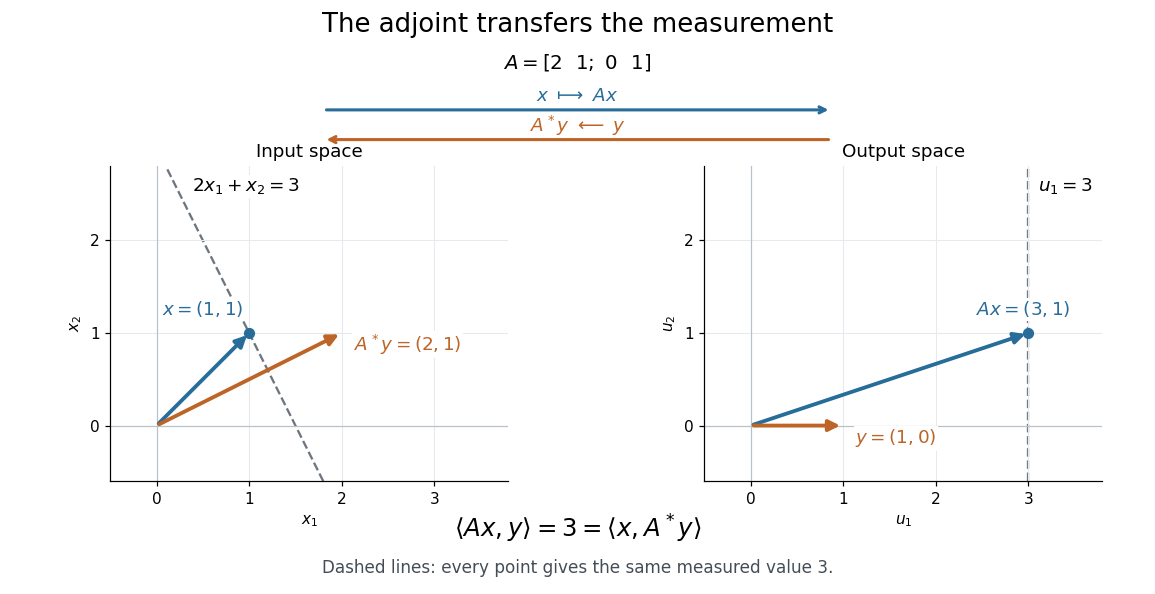

In this real example,Both inner products equal . The dashed lines collect all vectors giving that same measurement: the output line becomes the input line . The adjoint operator therefore moves the direction that describes the measurement. It generally differs from the inverse matrix: here .
For an explicitly complex example, use the standard inner product on . In the standard orthonormal basis, the adjoint operator is represented by the conjugate transpose:For and , direct matrix multiplication givesand henceThe complex conjugate is essential to this agreement.
Existence follows from the Riesz representation theorem: for fixed , the bounded linear functional has a unique representing vector . The resulting adjoint operator has the same operator norm as , andMIT's lecture 18 develops the representation argument and the conjugate transpose example.[ref]
https://ocw.mit.edu/courses/18-102-introduction-to-functional-analysis-spring-2021/7f23bfc43ee2e1efd238a5384e5b9d51_MIT18_102s21_lec18.pdf. Rodriguez, notes by Andrew Lin, MIT 18.102, lecture 18, Theorem 185 and Example 186, 2021
This transfer explains the normal equation for a linear inverse problem: a least-squares solution has residual orthogonal to every attainable direction , so for every , equivalently . An output residual becomes an input condition through the same adjoint operator. All identities in this section concern bounded operators defined on the whole source Hilbert space; for a densely defined operator that is not bounded, use the adjoint of a densely defined operator and check its operator domain.
For a smooth scalar function on a compact Riemannian manifold , its Dirichlet energy isThe Riemannian gradient measures local variation and the Riemannian volume weights its contribution. With source function , consider . On a manifold without boundary, or for variations vanishing at the boundary, the first variation in direction isHere is the Laplace-Beltrami operator. A critical function therefore solves the Poisson equation .
On a closed manifold, adding a constant leaves unchanged. If , shifting that constant makes unbounded below. Thus zero integral of the source is a necessary compatibility condition for this unconstrained closed-manifold problem.
There are unlisted articles, also show them or only show them.