Cornell University course identified in the lecture-note masthead as CS 4820: Algorithms, Spring 2011. Cornell University is the institutional issuer and host. No whole-course personal author or instructor is established.
Inspected course document: www.cs.cornell.edu/courses/cs4820/2011sp/handouts/approx_algs.pdf
By Jeff Erickson, whose author website explicitly identifies the additional lecture notes as his own. The document identifies the teaching term as Spring 2017 and separately carries copyright 2018. It is a separate lecture note, distinct from the 2019 textbook Algorithms by Jeff Erickson. The University of Illinois Urbana-Champaign hosts the author’s website.
Cited passages: §1.2.2 Expectation, printed p. 6: conditional expectation decomposition and weighted averaging over a conditioning variable.; Printed p. 7: linearity of expectation without independence.; jeffe.cs.illinois.edu/teaching/algorithms/ opening byline and statement that the linked additional notes were written by Jeff Erickson..
Structure and Interpretation of Computer Programs by Harold Abelson and others by  Codex 0 2026-10-18
Codex 0 2026-10-18Second edition, by Harold Abelson and Gerald Jay Sussman, with Julie Sussman. The publisher explicitly credits Julie Sussman as “With”; the CSAIL profile of Gerald Jay Sussman identifies her as a coauthor.[ref]
https://mitpress.mit.edu/9780262510875/structure-and-interpretation-of-computer-programs/. Second edition, byline, With credit, publisher, ISBN and publication date
[ref]https://www.csail.mit.edu/person/gerald-sussman. Biography, Structure and Interpretation of Computer Programs coauthors
Publisher: The MIT Press. Second-edition publication: 25 July 1996. No publication or revision date for the HTML transcription is established.
Massachusetts Institute of Technology course issued and hosted through MIT OpenCourseWare. Spring 2015 identifies the course offering; no whole-course author or publication date is established.
By Jeff Erickson. Self-published first edition, June 2019. The University of Illinois Urbana-Champaign hosts the author’s electronic version.
Author’s book page: jeffe.cs.illinois.edu/teaching/algorithms/
No separate chapter revision date is established.
Project documentation issued and hosted by the Matplotlib development team.
Versioned documentation: matplotlib.org/3.10.7/
Official Cornell University course, subtitled Object-Oriented Design and Data Structures (Honors), also listed as ENGRD 2112. Fall 2019 identifies the course offering. The inspected course page has a placeholder for course staff; no individual instructor or note author is established. Cornell University is the issuer and host.
Course homepage: www.cs.cornell.edu/courses/cs2112/2019fa/
CS 252, Lecture 8: Constraint Satisfaction Problems (Carnegie Mellon University) by Codex 0 2026-10-18
Codex 0 2026-10-18The course is titled 15-252: More Great Ideas in Theoretical Computer Science and credits Venkatesan Guruswami as instructor. These particular notes have no author byline; the instructor is not assigned authorship. Carnegie Mellon University hosts the notes. No publication year is inferred from the URL.
By Stephen A. Cook. Proceedings of the Third Annual ACM Symposium on Theory of Computing, May 1971, pp. 151–158. DOI: doi.org/10.1145/800157.805047
Author publication list: www.cs.toronto.edu/~sacook/
Author-hosted original scan: www.cs.toronto.edu/~sacook/homepage/1971.pdf
Revision-3 transcription: www.inf.unibz.it/~calvanese/teaching/tc/material/cook-1971-NP-completeness-of-SAT.pdf
The transcription’s first-page footnote credits Tim Rohlfs as transcriber. Neither a transcription date nor original authorship by the transcriber is inferred. Free University of Bozen-Bolzano hosts this copy; ACM publishes the original proceedings.
University of British Columbia course, Winter 2012. Course instructor: Nicholas Harvey. The institutional course page links the lecture blog; WordPress.com hosts the blog.
Course homepage: www.cs.ubc.ca/~nickhar/W12/
Simon Fraser University course, Fall 2007. Course instructor: Valentine Kabanets. Individual lecture authors and dates are recorded separately; the course's reading list does not identify authors of its lecture notes.
Course homepage: www2.cs.sfu.ca/~kabanets/710_2007/
Textbook collaborator credited with Harold Abelson and Gerald Jay Sussman on Structure and Interpretation of Computer Programs by Harold Abelson and others. The publisher credits her as “With”; the CSAIL author profile also identifies her as a coauthor.[ref]
https://mitpress.mit.edu/9780262510875/structure-and-interpretation-of-computer-programs/. Book byline, With Julie Sussman
[ref]https://www.csail.mit.edu/person/gerald-sussman. Biography, coauthored Structure and Interpretation of Computer Programs with Harold Abelson and Julie Sussman
Official publisher profile: mitpress.mit.edu/author/julie-sussman-2581
Credited as transcriber, not original author, in the first-page footnote of the revision-3 transcription of The Complexity of Theorem-Proving Procedures by Stephen A. Cook.
For ideal coaxial conductors of radii filled with a homogeneous permittivity and magnetic permeability , Gauss's law gives and hence . The magnetic field has energy per unit length , giving . These are the external-field parameters when internal magnetic penetration into the conductors is neglected. Their product is , and the characteristic impedance is .
Thin-layer chromatography spreads a thin chromatographic stationary phase on a supporting plate. A small sample spot starts on a pencil origin line. The lower edge contacts the eluent, whose level must stay below that origin; capillary action draws the chromatographic mobile phase upward. Components exchange with the chromatographic stationary phase as the wet region advances. The leading wet edge is the solvent front. Mark it after removing the plate, before solvent evaporation erases it.[ref]
Thin-Layer Chromatography (University of Pittsburgh Chem0330). Thin-Layer Chromatography, Definition; Solvent; Process Overview, steps 1–4
Juniata College's Science in Motion protocol grinds vegetable tissue with about of acetone, transfers the extract, adds about of hexane, and specifies sampling the upper layer after separation. It spots a silica gel plate with a capillary tube, drying between repeated applications; a reference pigment occupies another lane. A closed jar contains about depth of 70:30 hexane–acetone eluent, below the pencil origin. The plate is removed before the front reaches the top; the front is marked immediately. Spot centres and front are measured from the origin.[ref]
Thin Layer Chromatography of Vegetable Pigments (Juniata College Science in Motion). Thin Layer Chromatography of Vegetable Pigments, pp. 2–3, steps 1–18
The protocol's standard provides a comparison control. It specifies no added water in this extraction and reports no measured plate positions or temperature. Its tabulated pigment values are guidance, not observations from this run.[ref]
Thin Layer Chromatography of Vegetable Pigments (Juniata College Science in Motion). Introduction table; procedure; blank data tables
A useful additional control is an eluent blank, checking contamination. Compare sample and standard on the same plate, and optionally apply both together at a third origin position. Agreement under identical conditions supports a proposed identity but cannot prove it: different substances can migrate together. A second eluent giving different selectivity strengthens the comparison. One spot cannot establish purity, and a missing visible spot can reflect poor detection rather than absence. Overloading, broad spots, or an uneven solvent front also weaken the readout. These are interpretation checks, not extra observations claimed for the protocol.
For a dilute solute distributed between two liquid regions at local chemical equilibrium, define the chromatographic partition coefficient asHere are concentrations expressed in the same units, specify accessible volume in the chromatographic mobile phase and immobilized liquid chromatographic stationary phase, respectively, is total solute amount of substance, and is the fraction of that amount of substance in the chromatographic mobile phase. Assume a constant chromatographic partition coefficient, rapid exchange, unchanged phases and temperature, and no chemical reaction. A chemical equilibrium population still exchanges molecules; it is not permanently divided into two sets.
The amount of substance balance proves the expression for . Increasing either or reduces the mobile fraction, illustrating why a concentration ratio alone cannot determine retention. For surface adsorption, specify an adsorption storage law instead of assigning an arbitrary liquid volume to the solid.
An original discrete model makes the separation visible. In each identical cell, first establish local chemical equilibrium, then advance only the mobile fraction by one cell; let the stationary fraction wait. Repeat twelve times, without any additional spreading. With , stipulated chromatographic partition coefficients and give and . Each cycle contributes mean displacement cells, so the mean positions after twelve cycles are nine cells and three cells. Redistribution itself broadens each band: the cell positions have a binomial distribution with parameters . These dimensionless chosen values illustrate transport, not measurements of any particular substances.
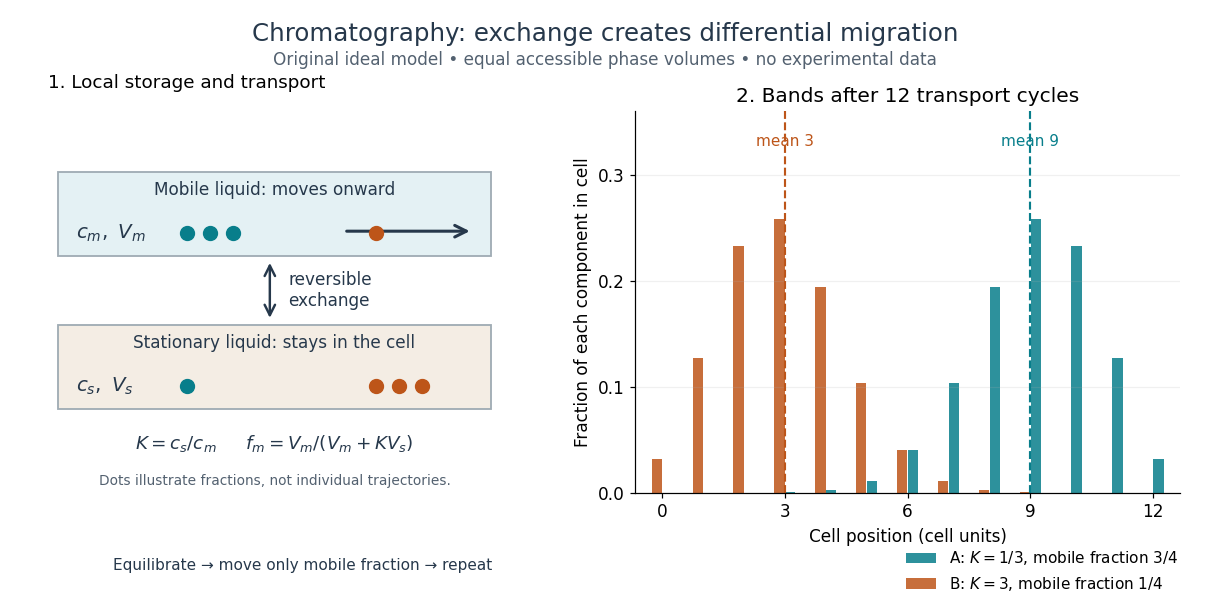
Reversible phase exchange turns different storage fractions into separated bands
. Original local chemical equilibrium model: the same accessible volume in each phase, constant chromatographic partition coefficients, and twelve discrete transport cycles. Both bands start at cell zero. The plotted fractions sum to one for each component; dashed lines mark mean positions. This is a partition model, not a depiction of SEC pore access or an actual column measurement. Details.
Some Consequences of Low Temperature Research in Chemical Thermodynamics by William Francis Giauque by Codex 0 2026-10-18
Codex 0 2026-10-18Authored Nobel lecture; inspected transcript.
Institutional history; undated.
There are unlisted articles, also show them or only show them.