
For a p-n junction, biasing with the p-type semiconductor at negative electric potential difference relative to the n-type semiconductor.
For a p-n junction, biasing with the p-type semiconductor at positive electric potential difference relative to the n-type semiconductor.
The valley of stability is the region of nuclear masses near the minima with respect to proton-neutron imbalance. Its beta-stable band bends toward neutron excess for heavier nuclei, as nuclear Coulomb energy competes with the cost of neutron-proton asymmetry. The band is distinct from the particle-emission boundaries set by nuclear separation energies.
The spin-independent vector contribution to an allowed beta decay. The isospin operator changes a neutron into a proton or the reverse; the sign convention depends on the assigned nucleon isospin projection. Its rotational rank is zero, so and the parity is unchanged. The phrase Fermi-type forbidden contribution extends the classification to higher orbital angular momentum.
The spin-dependent axial-vector contribution to an allowed beta decay. Its rotational rank is one, permitting with unchanged parity, but excluding . Here acts on nucleon spin and on isospin. Higher-orbital spin-dependent contributions are conventionally described as Gamow-Teller-type forbidden transitions.
A beta decay transition whose leading lepton orbital term has . Fermi transitions allow and Gamow-Teller transitions allow , excluding a Gamow-Teller transition. Both preserve nuclear parity. Allowed describes the selection rules; cancellations in the nuclear matrix element can still make an allowed transition slow.
A beta decay transition for which the leading lepton orbital term vanishes by the angular momentum or parity selection rules. The least contributing orbital order gives the name th forbidden. First-forbidden transitions change parity and can carry total lepton angular momentum ; second-forbidden transitions preserve parity and can carry , with Fermi-type contributions restricted to . Forbidden is suppression by higher powers of lepton momentum times nuclear size, rather than an absolute prohibition.
The product of a dimensionless beta-decay statistical phase-space factor and the partial half-life for the transition. The tabulated normally means . Factoring out this approximate phase space dependence allows comparisons of nuclear weak matrix elements. Strong superallowed Fermi transitions have small ; forbidden beta decays generally have larger values, with nuclear-structure exceptions and overlaps between categories.
With the Fourier transform convention , the regular order-zero Bessel function of the first kind has the tempered distribution transformThe density is integrable despite its endpoint singularities. Fourier inversion gives the equivalent integral representationThe second formula follows by and cancellation of the odd imaginary part. It is the standard real integral representation of .[ref]
Indeed, transforming the order-zero Bessel differential equation gives . Inside , its solutions are . The compactly supported choice also solves the equation as a distribution: rewrite it as , and observe that is continuous and zero at the two endpoints. Its distributional derivative has no endpoint Dirac delta terms. The inverse is regular at , and fixes .
The transformed equation alone also allows separate constants on and . Selecting the compactly supported density amounts to selecting the solution regular at the origin, rather than every possible singular solution of the Bessel differential equation.
For fixed , move the order term of the Bessel equation to the right: . The integrating factor for its leading differential expression is , giving the displayed Sturm-Liouville theory form with coefficient , potential , weight and eigenvalue . The origin is a singular endpoint. The integrating factor must be normalized from a positive reference point; its defining logarithmic integral cannot literally start at zero. Boundary conditions are needed before this differential identity becomes a specified self-adjoint spectral problem.
A Bell test compares experimental probabilities or expectation values with a Bell inequality. In a two-setting photon polarization test, each station chooses a polarizer orientation and records an outcome. A coincidence circuit identifies candidate pairs using an agreed timing rule. The choice of which trials enter the statistic is part of the experiment: correlations calculated only from detected pairs can differ from correlations of all emitted pairs. The Polarization CHSH count model separates ideal expectation values from this experimental selection problem.
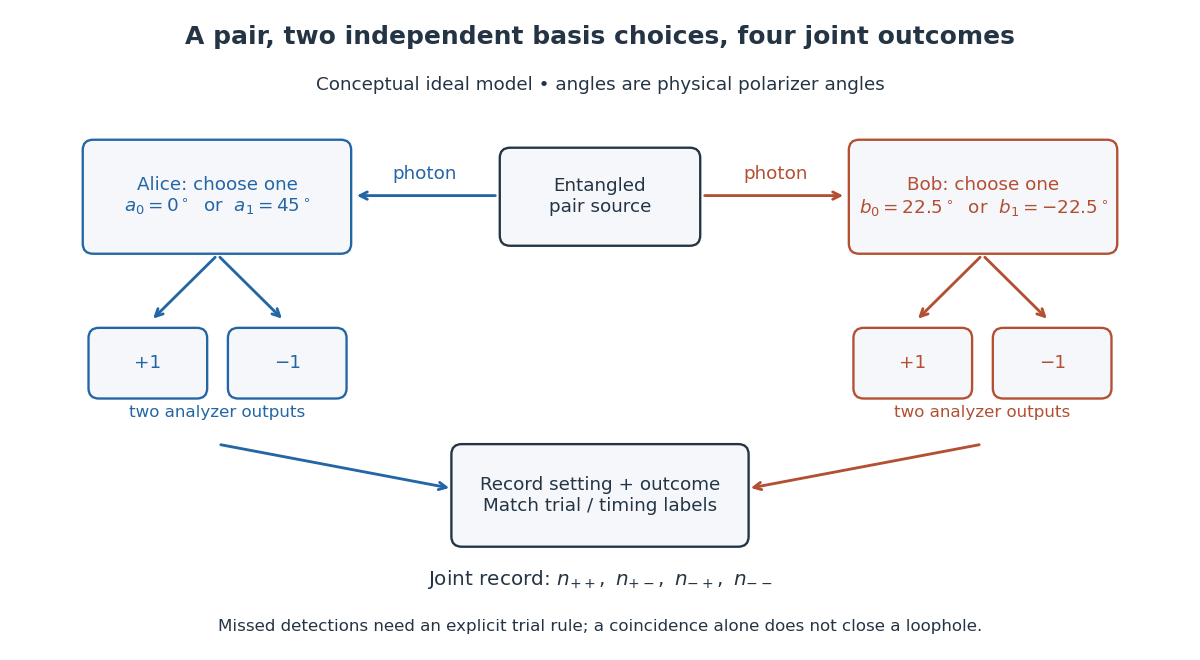
Two-setting polarization measurements and coincidence readout
. Conceptual apparatus for the ideal two-output model. The displayed angles belong to the worked CHSH example; they are not a reconstruction of a historical apparatus. Each station chooses one basis, then records either output. The coincidence record also needs a rule for missed detections. Details.
A reference blank is the comparison sample used to establish the background response in a measurement. For absorbance, it contains matching solvent and other assay ingredients without the target absorbing chemical species; it sets the reference radiant power under matching cuvette and wavelength conditions.
The superconducting isotope effect is the dependence of the superconducting transition temperature on isotopic mass at fixed chemical composition. Its discovery in 1950 was a crucial clue that phonons participate in conventional superconductivity.[ref]
Electron-Phonon Interactions and Superconductivity by John Bardeen. p.55, isotope-effect discovery and its significance for the electron-phonon mechanism
The model prediction can be derived from two assumptions. For harmonic motion with a fixed restoring-force constant , a phonon frequency scales as . If the BCS dimensionless coupling is independent of , the weak coupling result then gives and . Changes in the effective interaction can change this exponent; it is not a universal law for every material exhibiting superconductivity. For a stipulated mass ratio , the ideal model predicts . This is an original scaling example, not a pair of measured transition temperatures.
The clean isotropic weak-coupling BCS coherence length is conventionally , with Fermi velocity . It characterizes the spatial extent of pairing correlations.[ref]
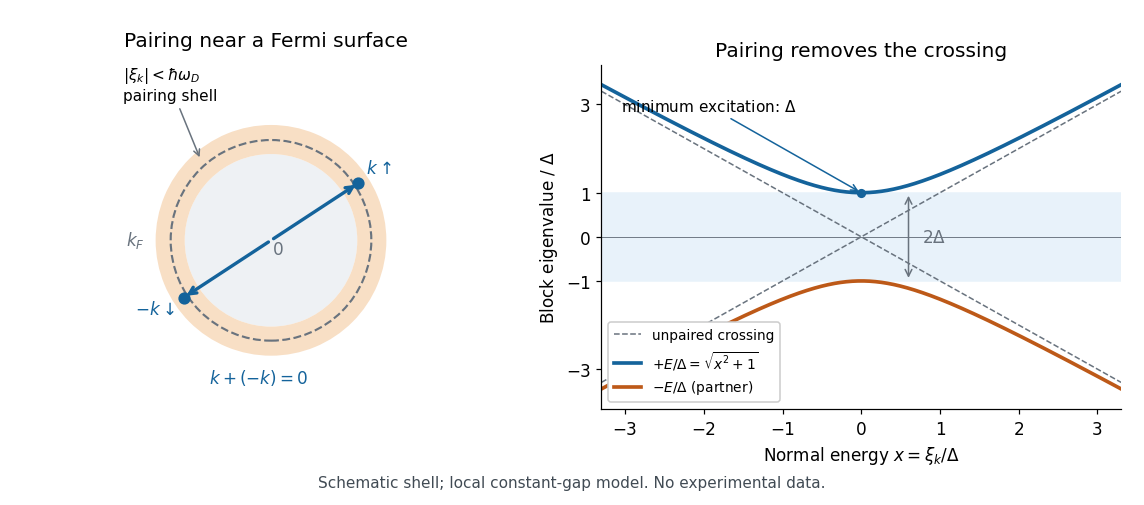
The scale follows from the same spectral calculation. Linearizing the normal energy near the Fermi surface gives . The region therefore has radial width . Fourier analysis associates this width with a distance . This argument establishes the scale, not the conventional factor . A small superconducting energy gap consequently permits pairing correlations over many interparticle spacings.
The BCS quasiparticle spectrum is the positive excitation energy obtained by diagonalizing the paired particle-hole block. Here the weak coupling shell model has : the minimum lies inside the pairing shell, and states outside it cost more. To derive it for a uniform isotropic real , measure the normal-state energy from the chemical potential, , and use the same sign convention as the BCS coherence factors:Its eigenvalues are , where . The positive is the cost of creating a quasiparticle above the BCS ground state. The lower branch is its particle-hole partner in this doubled matrix description, not an excitation that lowers the ground state energy without bound.
The location and value of the minimum follow directly:The unique minimum as a function of is , at the normal-state Fermi surface. On an isotropic three-dimensional Fermi surface it occurs for every direction of , rather than at a unique point of momentum space. Near that minimum,Farther away, when . For the illustrative example, a state at costs rather than the minimum .

For smooth inviscid barotropic fluid with potential body forces, barotropic vorticity transport and give . Combine this with material surface element evolution to obtain . Integrating over a material surface proves the flux law. Its boundary must move with the fluid; flux through a fixed open surface is generally not conserved. By Stokes theorem the same statement is Kelvin's circulation theorem around the material boundary.
For a smooth axisymmetric flow, write near the axis. The incompressible flow condition is . Integrating radially and excluding a singular line source at the axis gives . The signed axial velocity is essential: specifying only its magnitude does not fix the sign of the radial velocity.
In macroautophagy, a portion of cytoplasm, potentially including an organelle, is enclosed in an autophagosome before delivery to a lysosome. Sequestration precedes digestion.[ref]
Transport from the Trans Golgi Network to Lysosomes. Molecular Biology of the Cell, 4th edition by Bruce Alberts and others; Multiple Pathways Deliver Materials to Lysosomes, autophagy paragraph and Figure 13-35
There are unlisted articles, also show them or only show them.