
Gel electrophoresis through polyacrylamide under conditions that suppress nucleic acid folding; suitable sequencing conditions resolve adjacent nucleotide lengths.
Starch gel electrophoresis uses a starch-based gel to separate material in an electric field. The IgG chain reduction experiment uses it to compare polypeptide chains.
A gel band is a localized population of stained or otherwise detected molecules with sufficiently similar migration in one sample lane. One visible gel band need not contain only one nucleotide sequence. Two different linear DNA fragments of 375 base pairs can occupy the same unresolved gel band; equal migration supplies size evidence under suitable conditions, not a sequence determination.
Fluorescence from a bound stain can support an estimate of DNA quantity, but suitable staining and detector response matter.[ref]
Five Main Nucleic Acid Gel Electrophoresis Steps by Thermo Fisher Scientific. Step 4, Sample visualization, Fluorescent dyes: relation between fluorescence and bound nucleic acid
For a quantitative model with equal staining response per unit mass, background-subtracted, integrated fluorescence satisfies . This requires an unsaturated detector and a common proportionality constant ; visual peak brightness alone does not supply .
The amount of substance is , where is molar mass. For double-stranded DNA with approximately equal average mass per base pair, is proportional to length , so is proportional to . In a constructed example, equal integrated signals from 250-base pair and 1000-base pair gel bands imply approximately equal masses but four times as many short DNA molecules. Conversely, equal numbers of those DNA molecules would give about four times the signal for the longer fragments in this model. Neither conclusion follows from darkness in a schematic drawing.
A particle accelerator increases the kinetic energy of charged particles through the work of an electric field. A single electric potential difference gives an energy gain of magnitude to a particle of electric charge crossing in the accelerating direction. Reusing a smaller electric potential difference many times can give a much larger final kinetic energy without requiring the whole apparatus to withstand the equivalent single voltage. A magnetic field can return the particles to the accelerating region: magnetic forces do no work, but they make repeated energy gains possible. The cyclotron turns this separation between bending and acceleration into a particularly elegant machine.
A DNA ligase is an enzyme that joins appropriately juxtaposed DNA ends by forming phosphodiester bonds.
An acid phosphatase catalyses hydrolysis of phosphate esters under acidic conditions; its lysosomal enzyme latency supplied evidence for lysosomes.
An acid hydrolase is an enzyme that catalyses hydrolysis most effectively under acidic conditions; lysosomes contain multiple kinds.
An enzyme inhibitor lowers an enzyme's reaction rate. In reversible enzyme inhibition, reducing free inhibitor concentration can restore activity; slow release can make this difficult to distinguish experimentally from irreversible inactivation. Competitive inhibition and mixed inhibition describe different changes in enzyme kinetics; pure noncompetitive inhibition is a special case of mixed inhibition, not a name for every inhibitor that binds away from an active site.[ref]
Symbolism and Terminology in Enzyme Kinetics (Recommendation 1981) by Nomenclature Committee of the International Union of Biochemistry. Symbolism and Terminology in Enzyme Kinetics, recommendation 1981, sections 6.1 and 6.4: reversibility and the ambiguity of non-competitive
The useful question is how adding substrate changes the inhibition. The model below connects binding to a measurable reaction rate, predicts when more substrate can overcome inhibition, and supplies examples for comparison with an enzyme inhibition initial-rate assay. Its inhibition constants are explicitly defined; neither a binding cartoon nor one reduced reaction rate by itself determines a mechanism.
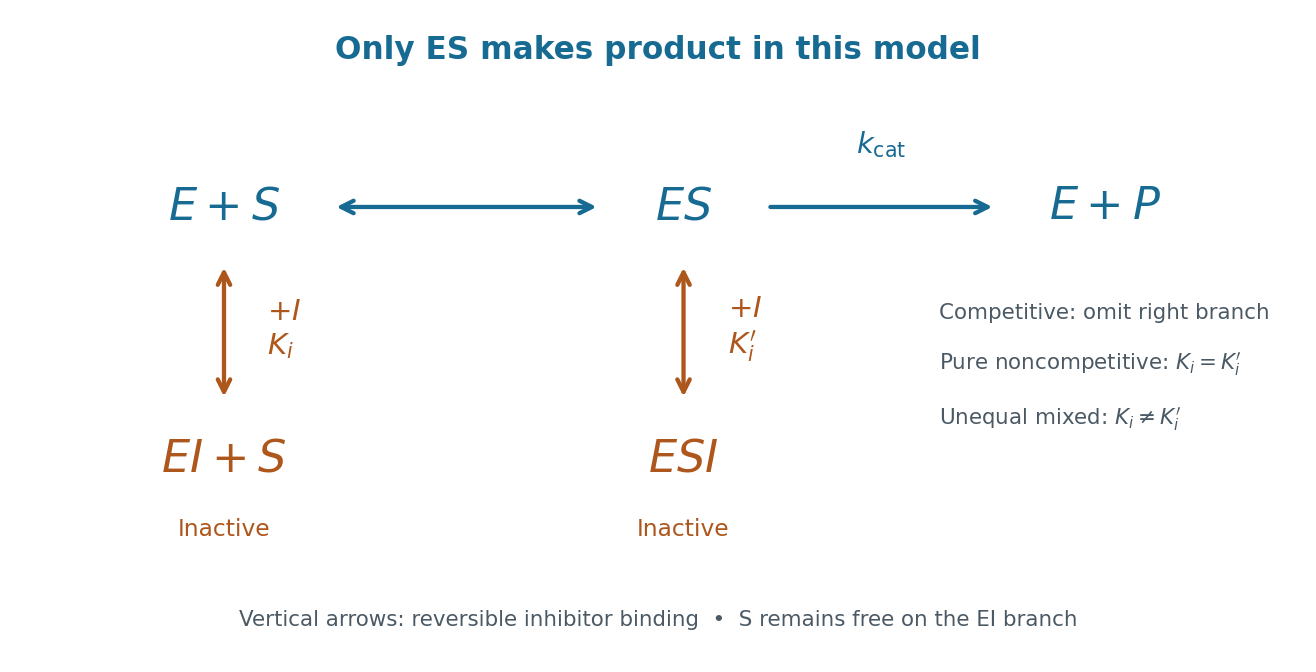
Reversible enzyme inhibition: which bound states can form?
Original branching scheme for a single substrate. is free enzyme, free substrate, free inhibitor, the productive enzyme-substrate complex, and and inactive complexes. Reversible vertical arrows show inhibitor binding and release. In competitive inhibition the right-hand inhibitor-binding branch is absent. Pure noncompetitive inhibition retains both branches with equal inhibition constants; general mixed inhibition permits unequal constants. The drawing specifies populations and allowed steps, not an atomic binding-site geometry. Details.
Trypsin is a serine protease: an enzyme that performs proteolysis by catalysing peptide bond hydrolysis. It preferentially cuts on the C-terminus side of lysine and arginine amino acid residues, leaving the selected amino acid residue in the preceding fragment.[ref]
Trypsin from bovine pancreas, DPCC Treated (T1005) - Product Information Sheet (Sigma-Aldrich). Trypsin from bovine pancreas, DPCC Treated, T1005 product information sheet, p. 1: Product Description, serine-protease family and C-terminal cleavage specificity
The bond being broken is the backbone amide linkage, rather than the lysine or arginine amino acid side chain. A formal connectivity equation for hydrolysis isHere and stand for the connected portions of the original peptide. Actual terminal protonation and electric charge depend on pH; the equation displays connectivity. Water supplies the elements needed to form the two new ends, while the enzyme is regenerated.
Selective cutting turns an unwieldy protein into shorter peptides, making peptide mapping useful for comparing proteins. In cell culture, trypsin also helps detach adherent biological cells: the HeLa culture viability experiment provides a concrete example of its use and subsequent stopping of proteolysis. The same enzyme can therefore serve both chemical analysis and preparation of a biological cell suspension.
Pyruvate kinase catalyzes phosphate transfer from phosphoenolpyruvate to ADP, producing pyruvate and ATP in glycolysis.
An entomologist studies entomology.
There are unlisted articles, also show them or only show them.