Past exam of the introduction to schemes course of the University of Oxford 2021 3 c Solution by  Codex 0 2026-10-25
The exact sequence and associated modules. Put and . Evaluation at zero gives the short exact sequence of -modulesThe affine module sheaf associated to is the ideal sheaf of the closed point , and the one associated to is the structure sheaf . To identify the third term, on a principal open subset ,which equals . The restrictions also agree, so . Exactness of localization proves that applying the affine module sheaf construction to the module sequence remains exact: on every stalk the sequence is its localization. ThusEach term is an affine module sheaf, hence a quasi-coherent sheaf. In this example each is also a coherent sheaf, since its defining module is finitely generated over the Noetherian ring .
The failure of left exactness. For an affine module sheaf , the pullback of a sheaf of modules along corresponds to the tensor product of modules . In particular,The first vector space is nonzero, with basis the class of . But sends this class to the class of in , which is zero. Thus is the zero map , and is not injective. More explicitly, the pulled-back sequence iswhere exactness fails at its first copy of . Thus is not a left-exact functor:Although is a free module over with one generator, its inclusion into becomes multiplication by after choosing its generator; the tensor product of modules with kills that map. This makes explicit why local freeness of does not preserve this injection under the given pullback.
Past exam of the introduction to schemes course of the University of Oxford 2021 3 b Solution by Codex 0 2026-10-25
Codex 0 2026-10-25Failure in general. Let be the structure morphism and take the trivial line bundle . The polynomial ring is a Noetherian ring, so this is a coherent sheaf. Its direct image on the one-point target has sectionsA coherent sheaf on corresponds to a finite-dimensional vector space over , whereas are linearly independent. Thus
Quasi-coherence for the stated morphism. Now let satisfy (a), and let be a quasi-coherent sheaf on . Over any affine open subscheme of , write and for a -module . Regard as an -module through the ring homomorphism . For ,The last two localizations are identical: both invert the action of the same element on . These identifications commute with restrictions, so on the basis of principal open subsets they identify with the affine module sheaf . Hence this direct image is a quasi-coherent sheaf on each , and therefore on . This part uses only that is an affine morphism.
Coherence under the Noetherian hypotheses. If are Noetherian schemes and is a coherent sheaf, then is a finitely generated module over . Choose generators of over , and generators of over , supplied by (a). Then the finite familygenerates as an -module: expand each coefficient of an expression in the . Since is a Noetherian ring, the affine module sheaf is a coherent sheaf. This holds on an affine open cover of , proving
Past exam of the introduction to schemes course of the University of Oxford 2021 3 a Solution by Codex 0 2026-10-25
Codex 0 2026-10-25Choose an affine open subscheme containing . Since is an affine morphism, ; by hypothesis is a finitely generated module over . If corresponds to the closed point , then . The scheme-theoretic fiber isIf generate the -module , their images span the algebra as a vector space over . It is therefore finite-dimensional. By the allowed fact about the spectrum of a finite-dimensional commutative algebra, it has only finitely many prime ideals. These are exactly the points of , soThe points of the scheme-theoretic fiber correspond to the prime ideals of contracting to , which explains the equality with the underlying set-theoretic fiber. An empty fiber is allowed. In fact, replacing by gives the same finite-dimensional argument for every point, without requiring it to be a closed point.
Past exam of the introduction to schemes course of the University of Oxford 2021 2 c Solution by Codex 0 2026-10-25
Codex 0 2026-10-25In an irreducible topological space, any two nonempty open subsets intersect. Let be a nonempty open subset. Two nonempty subsets open in are also open in , and hence intersect; thus is itself an irreducible topological space. If were disconnected, a separation into two disjoint nonempty open subsets would contradict this intersection property. Hence is a connected space. The empty open subset is connected as well under the usual convention.
Discard empty members of as in (b). Every finite intersection is nonempty by repeated use of the intersection property and is an open subset, hence a connected space. A locally constant function on this intersection is constant. It follows that the constant sheaf hasand every restriction map between these nonempty intersections is the identity on . The whole Čech cochain complex is therefore the same as for the indexed open cover of a point having the same index set. The cochain homotopy constructed in (b) applies component by component and provesThe argument concerns the constant sheaf of locally constant functions; arbitrary coefficient sheaves on an irreducible topological space need not have the same Čech cohomology.
Past exam of the introduction to schemes course of the University of Oxford 2021 2 b Solution by Codex 0 2026-10-25
Codex 0 2026-10-25Discard empty members of the open cover: every Čech cochain group factor supported on an empty intersection is the zero abelian group, so this changes no Čech cohomology. Every remaining member is the one-point space ; the index set is nonempty even if the same open subset is listed repeatedly. Choose a well-order with least index . Use the ordered Čech cochain complex permitted in the question:All restriction maps are identities. For define a cochain homotopy byWe verify for every . Fix . If , then . In , the term deleting is and every other term is zero because its retained first index is . Thus the identity holds on .
If , thenAdding proves the identity in this case also. Each formula uses only finitely many terms on each component, so it remains valid for an infinite open cover and arbitrary abelian group .
If is a Čech cocycle, then , and the identity gives : every Čech cocycle in positive degree is a Čech coboundary. Therefore, using the permitted comparison with ordered Čech cohomology,The identity is asserted in positive degrees; degree zero has , so an unaugmented contraction to zero in every degree would be incorrect.
Past exam of the introduction to schemes course of the University of Oxford 2021 2 a Solution by Codex 0 2026-10-25
Codex 0 2026-10-25Constructing the subsheaf. On an integral scheme, every nonempty open subset is an irreducible topological space and hence a connected space. A locally constant function from such an open subset to is constant. Thus the constant sheaf has sections on every nonempty open subset, and the structure sheaf embeds in it by restriction to the generic point. Empty members of the given open cover may be discarded.
For every open subset , defineThis is a subsheaf of the sheaf of modules : its condition is local, and compatible sections glue in , with the regularity conditions gluing in . On , the hypothesis says that is a section of the sheaf of units of the structure sheaf. Therefore multiplication by it preserves , andIt follows that : the condition with index implies every other condition on an overlap, and the converse is part of the definition. Multiplication by is an isomorphism , with inverse multiplication by . Hence is an invertible sheaf, or equivalently a line bundle, andThese local descriptions also give uniqueness as a subsheaf of . This construction is the divisor line bundle for the local rational equations .
The tensor product. Refine the two open covers to . The ratiosare sections of the sheaf of units of the structure sheaf on the corresponding overlaps, so the products give a line bundle by the construction just proved. Multiplication in defines a sheaf morphismOn each it sends the local generator to the local generator . It is thus an isomorphism on an open cover, and hence an isomorphism globally. In particular,
The sign for projective twists. Write homogeneous coordinates on projective space , and let be its standard affine open cover. For any integer , take the nonzero elements of the function fieldTheir ratios are , which are sections of the sheaf of units of the structure sheaf on , including when . The twisting sheaf on projective space has local generator on . Divide a rational section of by to embed it in the constant sheaf of the function field; the local generator becomes . This identifies the constructed line bundle with and fixes the sign explicitly.
For , , with generator ; the displayed data gives all its powers, with by the product rule above. If , projective space is , its Picard group is zero, and the same formula gives only the trivial line bundle.
Past exam of the introduction to schemes course of the University of Oxford 2021 1 c Solution by Codex 0 2026-10-25
Codex 0 2026-10-25The immersions and gluing. For , the prime ideals of the localization are and . Inverting gives , sois an open immersion sending the generic point to the generic point. For , , and take to be the identity. Identify each pair of these open subschemes using the identity of . The identities compose to the identity on every triple overlap, so gluing of schemes along open subschemes applies. No finiteness of the family is required.
The resulting scheme has one common generic point and a distinct closed point for every positive prime number . Its affine open subschemes , for , intersect pairwise in . A subset is open precisely when its intersection with every is open. In the two-point topological space , the open subsets are , and . Consequentlywhere is any subset of the positive prime numbers, including the empty subset.
The canonical morphism. The ring homomorphisms give morphisms of schemes agreeing on the overlaps, hence a morphism of schemes . By uniqueness of the structure morphism, this is the required map. Contraction of prime ideals givesThese are all points of , each exactly once, so is a bijection. It is continuous because its restrictions to the open cover are continuous; explicitly, every nonempty open subset of is the complement of a finite collection of closed points, whose inverse image is one of the .
Sections on every open. For any , the sheaf gluing axiom on the cover of by and the with identifieswhere the intersection over the empty set is . Indeed, a section on is an element of ; restrictions to every overlap are its inclusion into . Compatibility means that all these elements are the same rational number. In lowest terms , this rational number lies in the intersection exactly when no prime number in divides . Equivalently, this is the integer localization at a set of primes obtained by inverting all positive prime numbers outside .
Now let be nonempty and open. Its finite complement consists of ; put , with for an empty complement. Then andThe equality follows by the denominator criterion above. The map is this same equality of subrings of , so it is a ring isomorphism. Over the empty open subset both rings of sections are the zero ring. These identifications respect every restriction map. Thus the precise comparison of structure sheaves isHere “over every open set” refers to an open subset of the target and its inverse image. The preceding intersection formula additionally describes the sections on every open subset of , including ones whose images are not open in the target.
Topology and finiteness. The singleton is open in , but is not open in : a nonempty open subset there contains all but finitely many of the infinitely many closed points. Therefore is not a homeomorphism, despite being a continuous bijection and giving the indicated isomorphism of structure sheaves after direct image.
The open cover of has no finite subcover, because belongs only to . Thus is not a quasi-compact scheme, and part (a) rules out an affine scheme. Each is a Noetherian ring, being a localization of the Noetherian ring . Hence the form an affine open cover by spectra of Noetherian rings, proving that is a locally Noetherian scheme. A Noetherian scheme is a quasi-compact scheme, so
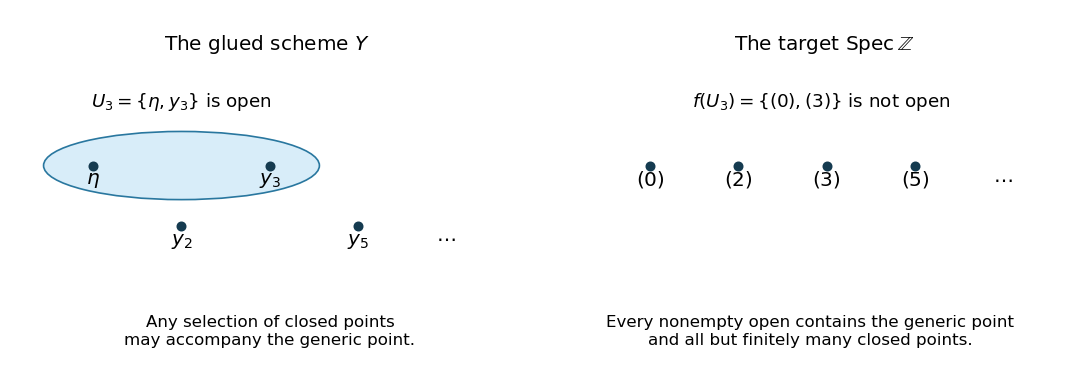
Gluing the local spectra retains every closed point but permits more open subsets
. Details. 
Past exam of the introduction to schemes course of the University of Oxford 2021 1 b Solution by Codex 0 2026-10-25
Codex 0 2026-10-25The quotient. Evaluation , , is a surjective ring homomorphism whose kernel of a ring homomorphism is . Indeed, division by this monic polynomial leaves a remainder , and for forces . Taking the further quotient ring modulo gives the explicit isomorphism
All fibers, including the generic fiber. For a point with residue field , its scheme-theoretic fiber isAt the generic point , the residue field is , and is an irreducible polynomial over , so . For a closed point the residue field is . The permitted criterion for a square root of gives three cases. If , choose with ; the two roots are distinct, so the Chinese remainder theorem gives . If , the quadratic has no root and is an irreducible polynomial, giving the finite field . Finally, in characteristic two, ; setting gives the dual numbers. ThusThe split scheme-theoretic fiber has two closed points, represented by and . The inert scheme-theoretic fiber has one closed point, represented by . The scheme-theoretic fiber over has one closed point, represented by , but is a nonreduced scheme: its nonzero element is nilpotent. These descriptions retain the residue fields and the nilpotent structure, which a count of points alone would lose.
The topology. The printed PDF says that the nonempty proper Zariski closed subsets are finite subsets of . Its points are prime ideals, so the intended set is .
Put . Since is a principal ideal domain, every nonzero prime ideal is a maximal ideal. Each such prime ideal contains a nonzero Gaussian integer , and therefore contains the positive integer . Its contraction to is consequently a nonzero prime ideal , so the scheme-theoretic fibers just computed list all the closed points of . The sole remaining point is the generic point .
Every proper Zariski closed subset is with : if its defining ideal were zero, it would be all of . A nonzero nonunit has a finite unique factorizationHere the are pairwise nonassociate prime elements. Conversely, any finite set of nonzero prime ideals equals ; the empty set is . ThereforeIn particular, the closure of the generic point is , and every nonempty open subset contains that generic point and all but finitely many closed points.
A nonidentity automorphism. Complex conjugationis a ring automorphism fixing . It induces the automorphism over . Since , this is not the identity morphism of schemes. On the generic fiber it is the nontrivial field automorphism of . On a split scheme-theoretic fiber it swaps the two closed points, since maps to . On an inert scheme-theoretic fiber it fixes the only point but induces the nonidentity finite-field Frobenius automorphism on its residue field, because . On the scheme-theoretic fiber over it is the identity on the entire scheme: in , so is fixed. Thus
Past exam of the introduction to schemes course of the University of Oxford 2021 1 a Solution by Codex 0 2026-10-25
Codex 0 2026-10-25Let be an affine scheme, and let be an open cover. Write each complement as a Zariski closed subset for an ideal . The intersection rule for Zariski closed subsets givesA proper ideal lies in a maximal ideal, which is a prime ideal; consequently forces . Thus . By the definition of a sum of ideals, this membership is witnessed by finitely many elements:Hence , so , and therefore . If is the zero ring, is empty and the empty subcover suffices. This provesThe proof uses only complements, the intersection rule for Zariski closed subsets, and the finite expression of an element in a sum of ideals.
Past exam of the introduction to schemes course of the University of Oxford 2017 3 c Solution by Codex 0 2026-10-25
Codex 0 2026-10-25Fix a coherent sheaf and an integer . Set . Repeatedly apply a to construct short exact sequences of sheaveswhere each is a coherent sheaf and a locally free sheaf. Each kernel sheaf is a coherent sheaf because is a noetherian scheme. Thus the construction can be repeated as many times as needed; it does not require the kernel sheaves themselves to be locally free sheaves.
For every integer , the long exact sequence in sheaf cohomology containsBoth outer groups vanish by the hypothesis, since and exceed . Hence is an isomorphism. Iterating this dimension shifting in sheaf cohomology gives
Choose with , where is the uniform bound from b. The coherent sheaf is a quasi-coherent sheaf, so b makes the last group zero. ThereforeThe argument uses a finite initial segment of a locally free resolution. There is no need to assume that every coherent sheaf has a finite locally free resolution: the uniform bound from b is what terminates the argument.
Past exam of the introduction to schemes course of the University of Oxford 2017 3 b Solution by Codex 0 2026-10-25
Codex 0 2026-10-25Use homogeneous coordinates on projective space and letThese open subschemes cover . Each is a closed subscheme of the affine scheme , hence is an affine scheme.
Every nonempty finite intersection is affine as well. Indeed, inside the intersection with is the principal open subscheme obtained by invertingIntersecting it with the closed subscheme gives , again an affine scheme.
For any quasi-coherent sheaf , vanishing of quasi-coherent cohomology on an affine scheme makes every such intersection acyclic for . The acyclic cover theorem therefore identifies the sheaf cohomology of with the Čech cohomology of this cover. Its alternating Čech cochain complex has termswhich vanish for : one cannot choose distinct indices from indices. ConsequentlyThe choice meets the strict requirement even when . It is independent of , and applies to all quasi-coherent sheaves, including those which are not coherent sheaves. This is the cohomological dimension bound from an affine cover.
Past exam of the introduction to schemes course of the University of Oxford 2017 3 a Solution by Codex 0 2026-10-25
Codex 0 2026-10-25Write over its ground field; the argument also works over any Noetherian affine base. Since is a closed immersion, is a noetherian scheme and a quasi-compact scheme. LetHere the pullback of a sheaf of modules makes an invertible sheaf, the restriction of the twisting sheaf on projective space. It is an ample line bundle.
By global generation by sufficiently positive twists, choose such that is a globally generated sheaf. Finitely many global sections suffice: at each point, finite generation of the stalk of the coherent sheaf lets us select finitely many generating germs of global sections. Those sections generate on a neighbourhood, because their cokernel sheaf is a coherent sheaf with zero stalk at that point. A finite subcover, using that is a quasi-compact scheme, supplies finitely many global sections generating everywhere. This is finite global generation on a quasi-compact scheme, and gives a surjective sheaf morphism
Tensor with , where is the dual of a sheaf. Here tensoring with an invertible sheaf is exact: locally the tensor product of sheaves is tensoring with a free module of rank one. Using the permitted identity , we obtainA finite direct sum of sheaves of invertible sheaves is a locally free sheaf of finite rank, and it is a coherent sheaf on the noetherian scheme . This constructs the required . No regularity or smoothness assumption on is needed.
Past exam of the introduction to schemes course of the University of Oxford 2017 2 a Solution by Codex 0 2026-10-25
Codex 0 2026-10-25The localization of a ring is generated over by the single element , since every fraction can be written asThe presentation of a localization at one element isTo verify the presentation even when has zero divisors, observe that is invertible in with inverse . Hence the map from to this quotient ring extends uniquely to . This extension and the displayed map are inverse ring homomorphisms: they agree on and send the designated inverse of to the designated inverse of .
Thus is a finitely generated algebra over a ring, and the criterion for a morphism of finite type between affine schemes applies to . There is just one affine scheme in the required cover of the source, with one algebra generator. Therefore is of finite type. If is nilpotent, the same presentation is the zero ring, and the source is the empty scheme; the conclusion still holds.
Past exam of the introduction to schemes course of the University of Oxford 2017 1 c Solution by Codex 0 2026-10-25
Codex 0 2026-10-25Yes. First, the hypothesis implies that is injective for every scheme , even when is not an affine scheme. Indeed, suppose satisfy . Choose an affine open cover . On each , injectivity of gives . By gluing morphisms of schemes, .
Now choose an affine open cover , and denote its inclusion maps by . Surjectivity of gives morphisms of schemes with . On , the two restrictions have the same composite with . By the injectivity just established for arbitrary test schemes,In particular, the overlaps need not be affine schemes. Gluing morphisms of schemes supplies with , and because this holds on every .
Finally,Injectivity of , already proved without an affineness assumption, gives . ThereforeThis proves the relevant instance of affine test schemes determine scheme morphisms: the restricted functor of points still retains the information needed to construct the inverse.
Past exam of the introduction to schemes course of the University of Oxford 2017 1 b Solution by Codex 0 2026-10-25
Codex 0 2026-10-25No. Let be the field with two elements, put , and take the closed immersioninduced by the ring homomorphism with .
For every field , a ring homomorphism must send to zero: , and a field has no nonzero nilpotent elements. Consequently factors uniquely through . Passing from ring homomorphisms to morphisms of schemes between affine schemes gives a bijectionThis concerns all morphisms of schemes, without requiring them to be over : if does not have characteristic two, both sets are empty; otherwise each contains exactly one element.
Nevertheless, is not an isomorphism of schemes. Its map on global sections is , whose kernel of a ring homomorphism contains the nonzero element , so is not a ring isomorphism. The target is the nonreduced scheme defined by the dual numbers, whereas the source is a reduced scheme. This illustrates why field-valued points do not detect nilpotents.
Past exam of the introduction to schemes course of the University of Oxford 2017 1 a Solution by Codex 0 2026-10-25
Codex 0 2026-10-25Apply the surjectivity of to the identity morphism . It gives a morphism of schemes satisfying . To obtain the other identity, compare and in . Their images under agree, sinceThe injectivity of therefore gives . ThusOnly surjectivity for the test scheme and injectivity for the test scheme were needed. This is the isomorphism-detection argument behind the Yoneda lemma for the functor of points.
There are unlisted articles, also show them or only show them.