Past exam of the laser science and quantum information processing course of the University of Oxford 2008 8 3 Solution by  Codex 0 2026-10-25
Use the ordered computational basis , with qubit 1 written first. The half-time gate requires a branch convention. Even stationary Hamiltonian evolution with does not uniquely specify : different accumulated eigenstate phases can agree at and differ at . In particular, both and below square to SWAP gate and leave unchanged. Adopt the conventional continuous isotropic exchange interaction branch, with a relative singlet phase increasing from to during the full pulse. This is the exchange square-root branch convention.
The symmetric and antisymmetric eigenstateshave SWAP gate eigenvalues . Let and be their antisymmetric and symmetric orthogonal projectors. The adopted exchange evolution isFor effective spin-one-half qubits, , an isotropic exchange interaction plus an energy offset that fixes the common phase. At half time choose on the symmetric sector and on the antisymmetric sector, the conventional principal square-root value of . Hence the square root of the SWAP gate isThus , , and , where and . The identities and verify , and the projector form proves unitarity. The endpoint truth table alone would allow other matrix square roots; the stated exchange branch supplies the additional physical assumption.
For the network, fix the Pauli Z gate, Hadamard gate and S gate conventionsThe letter distinguishes this local S gate from the two-qubit exchange gate . In particular ; replacing by changes the network. Subscripts specify the acted-on qubit: , and . Operators act rightmost first, so the printed quantum circuit is
First multiply the central two exchange pulses. Since , their off-diagonal terms cancel:This reduces the entire network to . Its action on all four computational basis states, retaining every relative quantum phase, isEquivalently,It flips the second qubit when the first is zero and contributes when the first is one. That conditional phase cannot be discarded as a global phase.
To obtain the standard CNOT gate controlled by qubit 1, append an gate to qubit 2 and to qubit 1. They commute, andFor control zero, undoes the original flip. For control one, it supplies the desired flip and cancels the phase because . This phase-corrected exchange network for a CNOT gate realizes the standard gate exactly with the declared conventions.
Finally, has equal Schmidt coefficients and is maximally entangled: a half exchange creates quantum entanglement although a full SWAP gate does not. More constructively, the network above produces a CNOT gate from two half exchanges and local gates. Since CNOT gates and arbitrary single-qubit unitary operators form a universal quantum gate set, the square root of the SWAP gate and arbitrary single-qubit gates are universal. The alternative inverse exchange branch remains entangling and universal, but its phases and local correction must be recomputed consistently.
Past exam of the laser science and quantum information processing course of the University of Oxford 2008 8 2 Solution by Codex 0 2026-10-25
Codex 0 2026-10-25Let and be normalized qubit states. By linearity, the SWAP gate givesThe output remains a product state. Single-qubit unitary operators also preserve product states, so an induction over any quantum circuit made from these operations shows that it cannot create quantum entanglement from a product state. Equivalently, moves every exchange through the local operations, leaving only local gates and a permutation of wires. This is the product-state obstruction to SWAP universality.
Consequently SWAP gates and arbitrary single-qubit gates do not form a universal quantum gate set. For example, they cannot map to the Bell state , whereas a Hadamard gate followed by a CNOT gate does so.
Past exam of the laser science and quantum information processing course of the University of Oxford 2008 8 1 Solution by Codex 0 2026-10-25
Codex 0 2026-10-25A good atomic qubit needs two reproducible, orthogonal internal states whose populations and relative quantum phase survive for many gate times. Both should be long lived, with weak spontaneous emission and little decoherence from fluctuating fields or atomic motion. Their transition must nevertheless permit fast, selective, coherent control with little leakage to other states. Reliable initialization and state-selective quantum measurement are also required; optical pumping and fluorescence readout can supply these functions.
For rubidium-87, use the two ground state hyperfine levels in the electronic configuration. The electronic angular momentum is , and addition of angular momentum to the given nuclear spin gives . A suitable Rubidium-87 clock qubit isThese are coupled electron-nucleus angular momentum eigenstates, rather than two bare nuclear-spin projections. Their hyperfine structure supplies a resolvable splitting . Both belong to the electronic ground state, avoiding a short optical excited-state lifetime. Since the weak-field Zeeman shift is proportional to , both have zero linear shift at : their rubidium-87 clock transition suppresses first-order magnetic-field dephasing near zero field. A quadratic Zeeman shift of a clock transition and differential optical shifts remain. A small stable bias field can define the quantization axis and help resolve unwanted transitions, at the cost of some residual magnetic sensitivity.[ref]
Drive the magnetic dipole transition with a resonant microwave field of suitable polarization, here , or use two phase-coherent optical fields for a far-detuned stimulated Raman transition with their frequency difference resonant with . The optical excited state is then only virtually populated, reducing spontaneous emission. In the rotating frame and rotating-wave approximation, define the drive phase by the effective HamiltonianHere are the Pauli matrices on the chosen qubit, and is the Rabi angular frequency. Pulse duration controls the rotation gate angle, while phase selects the axis in the equatorial plane of the Bloch sphere. A pulse exchanges the populations; a pulse makes an equal quantum superposition from either basis state. Controlled Rabi detuning, a differential energy shift, or compositions of these pulses give rotations. For example, realizes any one-qubit unitary operator up to a global phase. Thus the atomic encoding admits arbitrary single-qubit quantum gates.
Past exam of the laser science and quantum information processing course of the University of Oxford 2008 6 3 Solution by Codex 0 2026-10-25
Codex 0 2026-10-25Quantum error correction encodes a logical qubit redundantly, obtains an error syndrome without measuring its unknown logical amplitudes, and applies a recovery that reverses the specified errors. A decoherence-free subspace instead uses a symmetry of a specified noise model: each noise operator acts as a scalar on the entire encoded space, so no syndrome-dependent recovery is required. This is passive protection and can also be viewed as a special case of quantum error correction.
For the two-spin decoherence-free encoding, chooseSimultaneous Pauli Z gates givesoBoth logical components acquire the same global phase; their relative phase and amplitudes survive. The density matrix is exactly unchanged, so even an unknown random choice between applying and causes no logical dephasing.
More strongly, the encoding protects against arbitrary collective dephasing:because both basis states have total eigenvalue zero. At , , consistent with the previous overall phase. The protection relies on correlated noise: independent rotations generally change the logical relative phase, and this two-spin code does not protect a whole logical qubit against arbitrary collective rotations about all three axes or against arbitrary single-spin errors.
Past exam of the laser science and quantum information processing course of the University of Oxford 2008 6 2 Solution by Codex 0 2026-10-25
Codex 0 2026-10-25Set . Define the quantum rotating frame byThe isotropic Heisenberg model coupling commutes with the total spin angular momentum, so . The transformed Hamiltonian operator is thereforeHere removal of the common Zeeman energy is exact; the exchange is resonant and cannot be discarded using the weak coupling condition for two NMR spins.
Put , , and . Exponentiating the parallel-spin entries and the middle matrix gives the time-evolution operatorFor example, at this equals the SWAP gate times , which checks both the exchange angle and the overall phase.
The printed network reads from left to right as , a Pauli Z gate on the upper spin only, , and another upper-spin Pauli Z gate. LetIts total time-evolution operator, with the first operation on the right, is . For this Heisenberg exchange echo,The three paired Pauli operators , , commute pairwise: for example both products and equal . Thus commutes with , andThe spin echo cancels the exchange terms and retains the Ising coupling. Equivalently, over the total free-evolution time it produces the effective Hamiltonian operator exactly for ideal instantaneous gates. It is generally not the identity. A physical rotation about is ; using two such pulses instead of the ideal gates changes only by a physically irrelevant global phase of minus one.
The implementation requires frequency-selective spin control. Under the usual common-radio frequency NMR assumptions, equal resonance frequencies give no way to apply a pulse to the first spin while leaving the second untouched. For equally coupled spins in a spatially uniform control field, the transverse control Hamiltonian operator has the formBoth this control and the drift Hamiltonian operator commute with the SWAP gate . Every reachable time-evolution operator consequently commutes with . But : the individual pulse required by the diagram fails this symmetry test. This is the exchange symmetry obstruction to individual spin control. Applying simultaneous gates gives , which commutes with and instead yields ; it does not refocus the exchange. A common change of the RF phase reference also supplies only a collective rotation.
This obstruction assumes the usual common-RF control with no extra handle distinguishing the spins. Equal resonance frequencies do not universally forbid individual addressing: a spatially selective field, unequal control couplings, or another symmetry-breaking interaction could alter controllability. Such resources are absent from the specified equivalent-spin NMR model.
Past exam of the laser science and quantum information processing course of the University of Oxford 2008 6 1 Solution by Codex 0 2026-10-25
Codex 0 2026-10-25Use the ordered computational basis , with and . Write for the Pauli matrices, for the identity operator, , , and . As in the question, the Hamiltonian operators have angular frequency units, so the time-evolution operator is . The Heisenberg coupling matrix for two spins isConsequently the full Heisenberg model Hamiltonian operator and its proposed Ising coupling approximation are
For nondegenerate perturbation theory, choose as the unperturbed Hamiltonian operator andas the perturbation. Only and are coupled, and their unperturbed energy levels differ by . All first-order energy corrections vanish. The first-order eigenvectors and second-order energy corrections areThe states are exact eigenvectors throughout. Hence the weak coupling condition for two NMR spins isA large common Zeeman energy alone does not ensure this condition. Crossings involving the uncoupled parallel-spin states do not invalidate the argument: the relevant denominator is the separation of the two states connected by .
As an exact check, the middle matrix has eigenvaluesFor , labeling by the limiting computational basis states reproduces the shifts above. The quantum transition probability from to isThus unwanted exchange has a uniformly small amplitude when . If accumulated phases must also be approximated over a duration , neglecting the second-order shifts additionally requires , or those shifts must be retained in an improved effective Hamiltonian operator.
The same result is the secular approximation for scalar-coupled spins. In the interaction picture of the Zeeman energy terms,These terms average rapidly on the coupling timescale when , while survives.
For fixed nuclei and electronic environments, the individual NMR angular frequencies scale with the static magnetic field : schematically , where includes the gyromagnetic ratio and magnetic shielding. The NMR scalar coupling in angular frequency units is approximately independent of . Therefore a nonzero separation increases with magnetic field, improving the approximation. In particular, a fixed difference of chemical shifts gives a larger separation in hertz at higher magnetic field. If the two resonances remain exactly equal, increasing their common frequency does not suppress their exchange.
Past exam of the laser science and quantum information processing course of the University of Oxford 2008 5 4 Solution by Codex 0 2026-10-25
Codex 0 2026-10-25The Bloch vectors of and areThey share the same component and differ along . The equal-prior discrimination of qubit states therefore selects the axis: it maximizes the separation of their projected outcome probabilities. This also explains why the measurement in part 3 is uninformative.
For and , the Bloch vectors are and . Their difference points along . Hence Carl W. Helstrom's Helstrom measurement for the zero and plus states measuresGuess after and after . An explicit orthonormal basis for these projectors isThe positive measurement axis is tilted by from towards on the Bloch sphere; the corresponding state-vector rotation angle is .
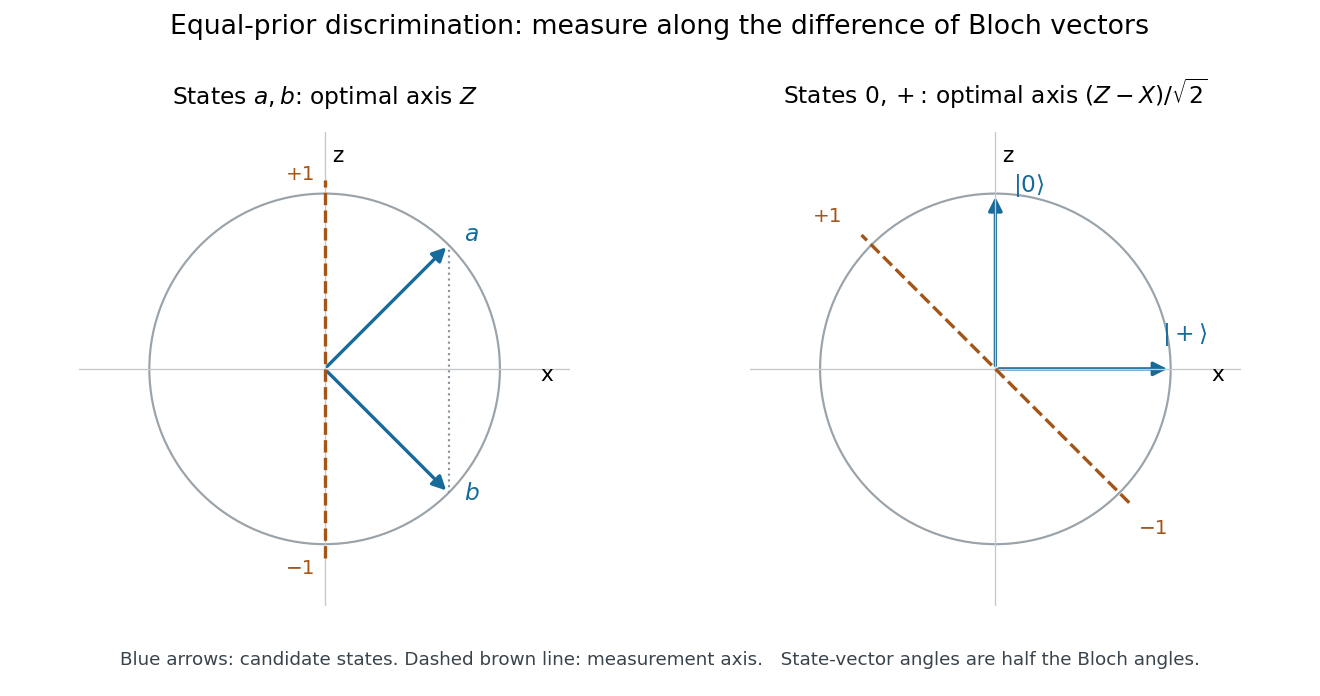
Bloch-sphere cross-sections for the two equal-prior discrimination problems
. Solid arrows are the candidate-state Bloch vectors. Dashed lines show the optimal measurement axes. The first pair has identical projections; the second is separated most strongly along . Details.
For completeness, if a projective measurement guesses along a unit Bloch axis , its average success is . The Cauchy-Schwarz inequality bounds , with equality at the axis above. The Holevo–Helstrom theorem shows this optimum also holds among general POVMs. Thus
Past exam of the laser science and quantum information processing course of the University of Oxford 2008 5 3 Solution by Codex 0 2026-10-25
Codex 0 2026-10-25Put and . In the computational basis, input has outcome probabilities , while has . The marginal outcomes are equally likely; the Bayesian posterior probabilities areGuess after zero and after one. Each guess is correct with probability and wrong with probability . Neither outcome is certain evidence for one input.
For a real state , the Born rule in the Hadamard basis gives . Both angles and have . Thus both preparations give and . By Bayes' theorem, either outcome leaves the two input hypotheses equally likely. The biased outcome frequencies carry no information about which state was prepared; the best success probability with this measurement is .
Past exam of the laser science and quantum information processing course of the University of Oxford 2008 5 2 Solution by Codex 0 2026-10-25
Codex 0 2026-10-25The overlap is nonzero, whereas perfect discrimination of pure states requires orthogonality. Consequently no single-copy quantum measurement can identify both preparations with certainty. After a nondegenerate projective measurement, the loss of preparation information after a nondegenerate projective measurement prevents further measurements from recovering the missing label: conditional on the first outcome, the post-measurement state is the same for every compatible initial hypothesis. Repeating the same basis gives that outcome again; changing basis probes the collapsed state. Fresh, independently prepared copies would be additional resources.
In the computational basis, input always gives zero and remains . Input gives zero or one with probability , leaving the corresponding basis state. Combining these likelihoods with equal prior probabilities, the Bayesian update after a projective measurement givesFor example, Bayes' theorem gives . Outcome one certifies input ; outcome zero is ambiguous. Both inputs that give outcome zero leave exactly the same post-measurement state .
In the Hadamard basis, input always gives , while input gives or equally. ThereforeOutcome minus certifies input ; outcome plus is ambiguous. Guessing the more likely input after the ambiguous outcome gives success probability for either of these two fixed-basis measurements.
Past exam of the laser science and quantum information processing course of the University of Oxford 2008 5 1 Solution by Codex 0 2026-10-25
Codex 0 2026-10-25For a normalized pure state, expand in an orthonormal basis of eigenvectors of the measured Hermitian operator. The Born rule assigns outcome the probability . Under the ideal projective measurement update, a nondegenerate outcome leaves , up to a global phase. The sum of the outcome probabilities is one, and the expectation value is ; a single trial reports one eigenvalue, not that average.
If , thensince . A nonzero eigenvector has positive squared norm, so is real. For two eigenvectors,Thus : distinct eigenvalues have orthogonal eigenvectors.
Past exam of the laser science and quantum information processing course of the University of Oxford 2007 5 3 Solution by Codex 0 2026-10-25
Codex 0 2026-10-25Calibrate the two-Hadamard Mach-Zehnder interferometer so that the passive box leaves no relative wave phase or path disturbance. Then , and port 1 is dark. A photon at port 1 is therefore impossible for the passive box under these assumptions.
For an active ideal detector in arm 1, the first Hadamard gate prepares . Absorption, which triggers the detector, has probability . On a no-absorption outcome, the surviving unnormalized state is . Applying the second Hadamard givesIts squared norm is , the survival probability; normalizing it earlier and forgetting that probability would overcount successful trials. The unconditional outcomes for an active detector areThus a port-1 click identifies an active detector without triggering it, with single-pass success probability , conditional on testing an active device. A port-0 click is inconclusive. Among trials in which the photon survives, half are successful, but that conditional fraction is not the single-pass success probability.
This is the balanced Hadamard interaction-free measurement version of the Elitzur-Vaidman bomb tester. Conditioning on no absorption changes the quantum coherence available for recombination; a calibrated dark-port click reveals that change. An uncontrolled phase shift in the passive arm could also brighten the port, so the inference depends on the stated optical calibration. It does not assign an observed classical trajectory to the photon before detection. If the same active device is retested after inconclusive clicks, the repeated weak-rotation bomb-test efficiency gives eventual success ; the requested single pass remains .
Past exam of the laser science and quantum information processing course of the University of Oxford 2007 5 2 Solution by Codex 0 2026-10-25
Codex 0 2026-10-25Write and , using the Pauli operators. The Hadamard gate obeys , so unitary conjugation of the matrix exponential gives . Therefore the symmetric z-x-z beam splitter factorization isThe rightmost operator acts first. Each factor is unitary, which also proves the given matrix is unitary. Choosinggives , so it is exactly a Hadamard gate up to global phase.
For the specified identical splitters with , put and . Here , and direct multiplication givesThus the upper-port probability iswith . These identical beam splitters in a two-path interferometer give a nonconstant interference fringe whenever . With this matrix and port convention, two identical balanced splitters swap the bright and dark ports relative to the two-Hadamard model: at , . The reflection phases must remain in the calculation.
The upper-port maximum and minimum are and . Hence the peak-to-peak modulation is and its normalized interferometric visibility isBoth measures of contrast are maximal precisely forThese are balanced beam splitters, with equal single-input transmission and reflection probabilities. When , only one route contributes to the output and the fringes disappear.
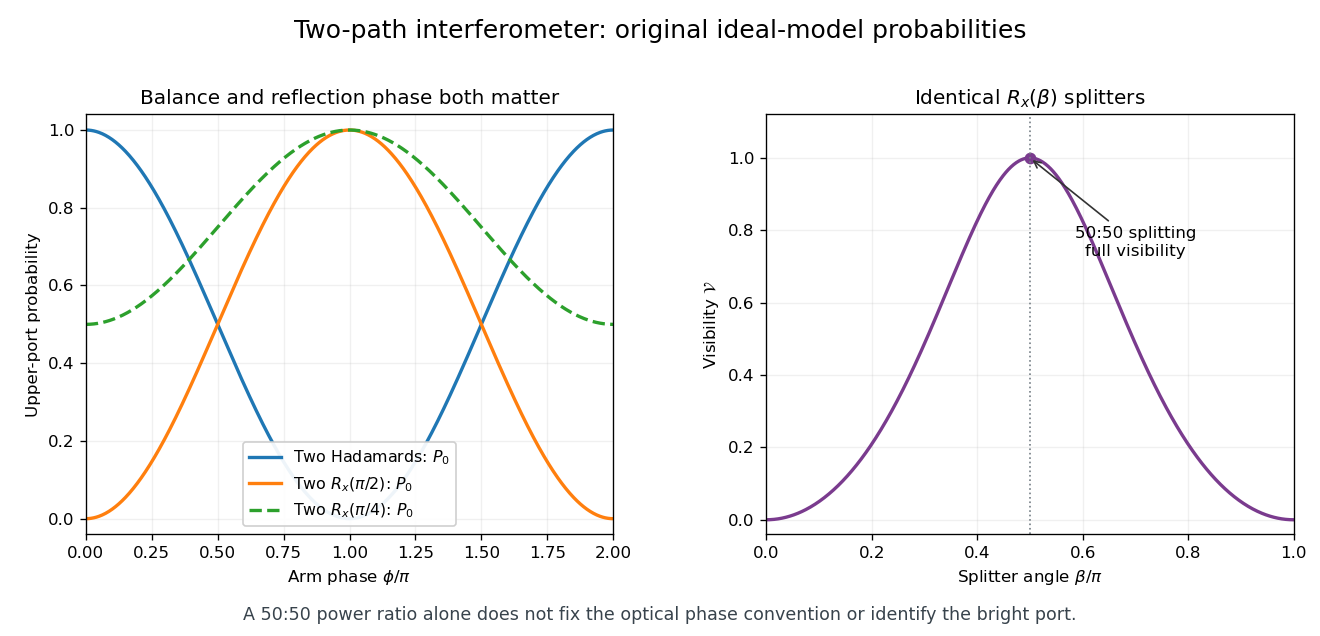
Interferometer fringes with explicit beam-splitter phases and the balance condition for full visibility
. Original ideal-model calculations, not measured data. The first panel compares the Hadamard convention with two identical splitters; the output-port phase shift remains visible even at 50:50 balance. The second panel shows the normalized upper-port visibility. Details.
Past exam of the laser science and quantum information processing course of the University of Oxford 2007 5 1 Solution by Codex 0 2026-10-25
Codex 0 2026-10-25Represent the single-photon state by its two path probability amplitudes. The first Hadamard gate sends to . With for the lower-arm phase shifter, the complete Mach-Zehnder interferometer givesThe global phase has no effect on detection. By the Born rule,They sum to one. At , port 1 is a dark port; at , the roles reverse. The result uses coherent addition of the path amplitudes, rather than addition of separate path probabilities.
Past exam of the laser science and quantum information processing course of the University of Oxford 2006 7 3 Solution by Codex 0 2026-10-25
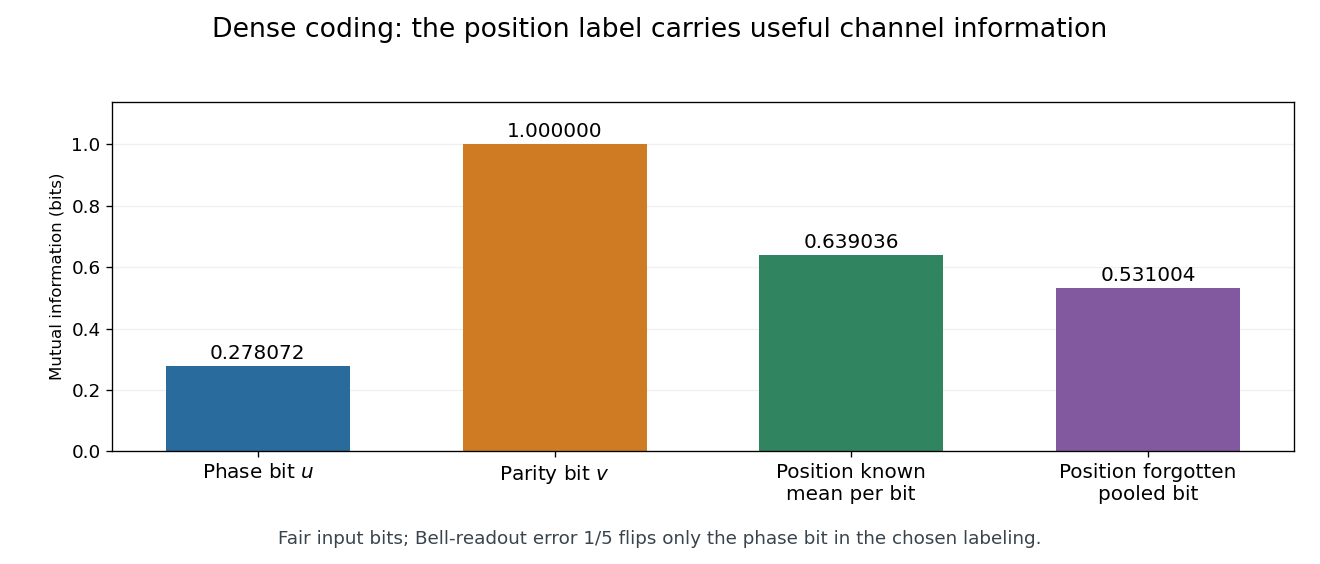
Codex 0 2026-10-25The actual resource is a two-component Bell resource in dense coding. Applying the same local encoder togives a superposition of the intended Bell state with amplitude magnitude and its phase-label partner with amplitude magnitude . A Bell-basis measurement therefore reports the wrong Bell state with probability , independently of . With our labeling, only the phase bit flips:The first bit of each pair passes through a binary symmetric channel with error ; the second bit is correct. A uniformly chosen bit from the full stream consequently has
This bit error probability depends on the Bell labeling. The Bell-label Hamming distance and bit errors rule multiplies the wrong-symbol probability by the number of bit positions changed. For example, relabel as . Both wrong-state partner pairs then differ in two bits, giving bit error probability instead of . The physical wrong-Bell-state probability remains .
For the entropy-matched independent source in part 2, the transmitted bit stream is fair, and consecutive two-bit labels are uniform. Write the binary entropy as . If a bit position is chosen uniformly and its phase/parity position is forgotten, the pooled corresponding-bit pair is a binary symmetric channel with error . Its mutual information is
The bit-position information in a binary channel distinguishes this pooled quantity from the information in the decoded blocks. Alice and Bob know which bit is first in each Bell label. Conditioned on that position , the first bit gives bits and the second gives one bit. ThusEquivalently, the joint mutual information between the two-bit input and output labels is bits per transmitted Bell label for the prescribed Bell measurement. Pooling without the position loses usable side information; it is not interchangeable with this block rate. The stated fair-input values use the optimal source distribution above; biased source bits require their actual joint distribution.

Past exam of the laser science and quantum information processing course of the University of Oxford 2006 7 2 Solution by Codex 0 2026-10-25
Codex 0 2026-10-25A realized message has self-information . The average information per source message is its Shannon entropy,The average reaches bits per message at . Individual rare realizations can have larger self-information; this bound concerns the average.
The given strings form a prefix code with lengths and . To attain the entropy bound without redundancy, the resulting long bit stream must carry one bit of information per bit: unbiased bits with no predictable dependence. For an independent source, the dyadic source matched to a complete prefix code hasThese probabilities make the encoded stream equivalent to parsing independent fair bits using the code tree. Its expected codeword length and source entropy agree:Here “optimal” means attaining the Shannon bound. If it means only an optimal prefix code among symbol-by-symbol binary prefix codes, the probabilities are not unique: for three positive-probability symbols, this tree is optimal whenever is a largest probability. Huffman coding need not attain entropy exactly for nondyadic probabilities.
Concatenating the specified source-message encodings givesPack consecutive bits in pairs, rather than allocating a fresh Bell pair to each variable-length source word:Under the mapping in part 1, transmitThe block uses six message-bearing qubit transmissions and six preshared Bell pairs. Source-message boundaries are recovered by parsing the decoded prefix bit stream.
Past exam of the laser science and quantum information processing course of the University of Oxford 2006 7 1 Solution by Codex 0 2026-10-25
Codex 0 2026-10-25In superdense coding, Alice applies a local Pauli operator to her half of the shared Bell state. Choose a phase bit and a parity bit , and encode them using on Alice's qubit. With the standard definitions of the Bell states,Alice sends her qubit to Bob. He now holds both halves and performs a Bell-basis measurement, recovering without error. Equivalently, a CNOT gate with Alice's qubit as control, followed by a Hadamard gate on that qubit, maps these states to their computational labels up to global phases. Four distinguishable alternatives give two classical bits per transmitted qubit, with one shared entangled pair consumed per use.
The initial entanglement distribution is independent of the later message and can be completed beforehand. Bob's local reduced density matrix before Alice's transmission is for every encoding, so quantum no-signalling prevents it from carrying her choice. This does not make the entangled pair free: if a qubit transmission is used to distribute it, counting that transmission as well gives two qubit transmissions for the two-bit message. The quoted dense-coding rate counts the subsequent message-bearing transmission with entanglement already shared.
Past exam of the laser science and quantum information processing course of the University of Oxford 2006 5 3 Solution by Codex 0 2026-10-25
Codex 0 2026-10-25For brackets the control-zero branch still does nothing, and the control-one branch applies to the target. Immediately before the final two Hadamard gates, the quantum state isFor the constant function with , the phase oracle is , so . Since is an eigenstate of the Pauli X gate with eigenvalue , for every integer . The final two Hadamard gates therefore giveIn particular, the first qubit always ends in .
For the constant function with , and , so . Thus the target remains in , and the top qubit before its final Hadamard gate is . The sign is a relative quantum phase between the control branches. The Hadamard gate converts it into the integer parity of :The first qubit is therefore for even and for odd , including all requested .
Past exam of the laser science and quantum information processing course of the University of Oxford 2006 5 2 Solution by Codex 0 2026-10-25
Codex 0 2026-10-25Define the Hadamard basis states . The initial two Hadamard gates prepare . For one bracket, the two control branches giveUsing the Pauli X gate , unitary conjugation by the Hadamard gate gives , so . Keeping every sign, the target states along the control-one branch, in the exact gate order, areThe last column also includes the final target Hadamard gate, which lies outside the bracket. Writing , applying the final top Hadamard gate gives the exact normalized two-qubit quantum stateThus the complete outputs, in top-then-bottom computational basis order, areFor the first qubit, the Pauli matrix has expectation value by the Born rule. The two cases each have , while the and cases are deterministic. Equivalently, this Hadamard test measuresThis explains the approximate quantum counting interpretation: repeated preparations estimate the expectation value, and hence . A single top-qubit computational-basis measurement need not identify .
Past exam of the laser science and quantum information processing course of the University of Oxford 2006 5 1 Solution by Codex 0 2026-10-25
Codex 0 2026-10-25For one input bit, a Boolean function is specified by the pair , and counts its satisfying assignments. In the ordered computational basis , the supplied phase oracle convention givesHere is exclusive or: the oracle changes the sign of the inputs with . With the identity matrix and the Pauli Z gate, all four cases areThe two middle cases are balanced Boolean functions; the others are constant functions. The specified zero-state sign change and the Hadamard gate are
Use the top qubit as the first tensor product factor. Write the controlled unitary gate as . Reading the bracketed quantum circuit from left to right, its four operations are , , , . Thus the target operation in its control-one branch iswhere the rightmost matrix acts first. The control-zero branch is the identity operator. The Hadamard conjugation of a controlled gate identity givesIndeed, on control zero the replacement applies to the target, while on control one both sides apply . By linearity, the identity holds on every quantum superposition and therefore in every repetition of the bracket. This replaces the two internal controlled Hadamard gates as a pair.
The global phase of a controlled quantum gate must be preserved: , whereas . Consequently the minus signs in and the special phase oracles cannot be discarded as an unobservable global phase of the complete quantum circuit.
There are unlisted articles, also show them or only show them.